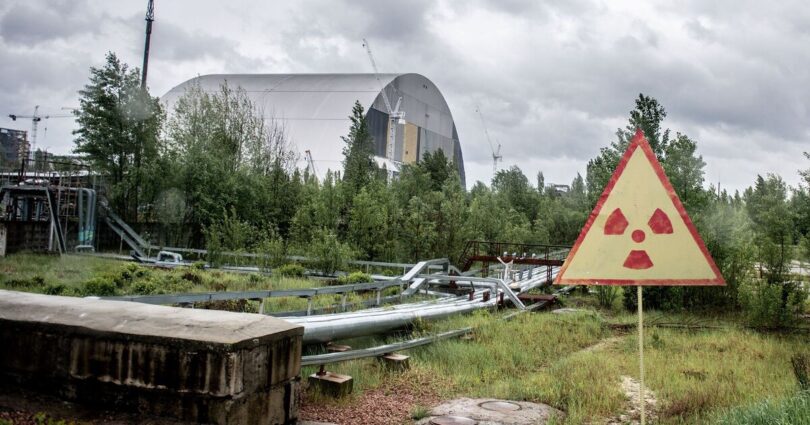
Pressing just one button caused the huge explosion (Image: Getty)
One man pressing one wrong button triggered the nuclear disaster which rocked the world and spilled nuclear waste into thousands of people’s homes.
In the early hours of 26 April 1986, a planned test on Reactor 4 at the Chernobyl Nuclear Power Plant went catastrophically wrong. Engineers were working to see how the nuclear reactor would act in the event of a nuclear attack triggering a power cut to Chernobyl.
Systemic design flaws in the RBMK reactor – coupled with inadequate understanding of those flaws by staff operating it – resulted in the world’s worst nuclear disaster: Reactor 4 exploded.
Regarded as a cutting-edge nuclear power plant – a triumph of USSR engineering – according to the YouTube channel Chernobyl Family.
The nuclear power station was built nine miles north-west of Chernobyl, with the city of Pripyat built at roughly the same time, exclusively as accommodation for those employed at the power plant.
In September 1981, Reactor 1 experienced a partial meltdown – however, the damage was minimal and the incident was not disclosed to the public until several years afterwards.
READ MORE: Not Pompeii or Chernobyl – buried town lays ‘trapped in time’
READ MORE: Chernobyl survivor details what they’ll ‘remember on their deathbed’ 40 years on

Hundreds were given cancer (Image: Getty)
In the spring of 1986, Reactor 4 had recently been brought online and had started generating power, yet a number of tests still needed to be conducted.
This test was intended to establish how long turbines would continue spinning and supplying power to the main circulating pumps following a loss of primary electrical power supply (in the event of, for instance, a nuclear attack).
The night shift had extremely limited time to prepare for and execute the experiment. Furthermore, operators remained unaware of the reactor’s fundamental flaws, due in part to the vast bureaucracy inherent within the communist state.
Anatoly Dyatlov, the deputy chief engineer, chose to override critical safety protocols, including initiating the test while the reactor was producing a dangerously low level of power – a condition which rendered it volatile and difficult to manage.
Despite objections from several operators, the test proceeded with virtually none of the control rods inserted. Shortly afterwards, power levels began to surge dramatically.
Alexander Akimov ordered the fail-safe button (AZ-5) to be activated, inserting all the control rods in an attempt to shut down the reactor. However, the boron rods, specifically engineered to halt the reaction, were fitted with graphite tips.
These displaced water in the lower sections of the core, generating additional steam and increased reactivity. Within just two seconds, the chain reaction began escalating at an unstoppable rate. The reactor was tearing itself apart, with temperatures in some sections exceeding 3,000C.
A succession of steam explosions followed, exposing the reactor’s graphite moderator to open air, triggering ignition and a devastating blast.
Don’t miss: Stranger walked into couple’s Travelodge room moments after their shower
Don’t miss: Horror as tourist rapes teenager in UK seaside town
Previous nuclear incidents involving the same reactor model had been deliberately hidden by Soviet authorities. No one thought a nuclear reactor was capable of exploding — it was seen as impossible.
It took days for the full scale of the catastrophe to become apparent, even to those present in the control room, amongst them Anatoly Dyatlov, the deputy chief engineer who had been overseeing the fateful test.
The facility was incapable of correctly measuring the levels of radiation that were actually present. And even when more advanced devices were distributed, some of those in charge chose to disregard their readings entirely.
Radiation sickness was poorly understood at the time, and firefighters in Pripyat were dispatched to the scene with little or no protective equipment.
It took a staggering 36 hours before the neighbouring city of Pripyat, home to 43,000 residents, was evacuated and a 10km exclusion zone established around the stricken reactor.
Firefighters and control room workers suffered acute radiation sickness and were rushed to Hospital Number Six in Moscow, where a significant number subsequently died.
The long-term impact of the disaster is still being felt 40 years on from the explosion.