
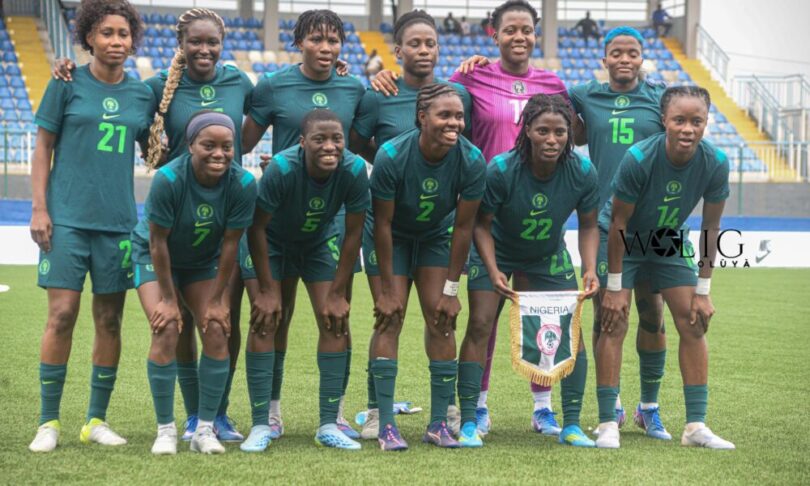
Nigeria, Africa’s most successful women’s national team, return to Olympic qualifying after their appearance at Paris 2024 ended a 16-year absence from the competition.
The Super Falcons will begin their quest for a second consecutive Olympic appearance on Friday when they face Comoros in the first leg of their second-round African qualifying tie for the Los Angeles 2028 Women’s Football Tournament.
The first leg is scheduled for 6:00 p.m. Nigerian time on Friday, 9 October, at Remo Stars Stadium in Ikenne, Ogun State.
Despite Comoros being the nominal home team, the match will take place in Nigeria because the island nation does not have a stadium approved by the Confederation of African Football (CAF) for international fixtures. Consequently, both legs of the tie will be played at the same venue, with the return fixture scheduled for Tuesday.
For interim head coach Augustine Eguavoen, the encounter represents his first official assignment in charge of the Super Falcons and an opportunity to begin the Olympic qualification campaign with a convincing performance.
But while Nigeria enter the tie with significantly greater international experience, Comoros arrive with confidence after an extraordinary opening round in which they scored 30 goals without conceding.
The Super Falcons were among the highest-ranked teams in the qualifying competition and received a bye into the second round, allowing them to avoid the opening stage.
Comoros, meanwhile, earned their place in the second round after dismantling Sudan over two legs in June.
Nigeria’s pedigree in African women’s football is unquestionable. The Falcons have won the Women’s Africa Cup of Nations a record 10 times and remain one of the continent’s most recognisable teams.
However, continental dominance has not always translated into smooth Olympic qualification campaigns.
Nigeria returned to the women’s Olympic football tournament at Paris 2024 after missing the previous four editions. Their participation in France was a significant achievement, and they will now be determined to make the Games for a second consecutive time.
The challenge is straightforward in principle but unforgiving in practice: negotiate five knockout rounds and finish among the two African teams that qualify for Los Angeles.
That leaves little room for a poor two-legged tie, particularly against opponents who have already demonstrated their ability to score heavily.
Comoros could hardly have made a more emphatic start to their Olympic qualifying campaign.
They opened their first-round tie against Sudan with a staggering 17-0 victory on 4 June before completing the job with a 13-0 win in the return fixture on 8 June.
The result gave them a remarkable 30-0 aggregate victory, with the team scoring 30 times and keeping clean sheets in both matches.
Among the standout performers were Houmadi and H. Ahamada, who scored four goals each across the two games. Boina Ali added three goals, while Maoulida and D. Saïd were also among the scorers.
Those numbers highlight the attacking confidence Comoros have carried into the competition. They have shown that they can take their chances and turn territorial dominance into goals.
However, the context is important.
The Sudan tie provided Comoros with a successful opening to their campaign, but facing Nigeria represents a substantial increase in the level of opposition. The Super Falcons possess greater experience in major international tournaments, a deeper history of competing against elite African teams and players accustomed to high-pressure fixtures.
Friday’s contest will therefore provide a more meaningful measure of how far Comoros have progressed and whether their first-round scoring form can translate against a more experienced opponent.
Nigeria’s preparations have not been entirely straightforward, with several players withdrawing from the original squad.
Asisat Oshoala, Ashley Plumptre and Oluwatosin Demehin are among those who became unavailable. Eguavoen also released Oluwakemi Adegbuyi and Favour Nkwocha to rejoin the Flamingos ahead of the FIFA U-17 Women’s World Cup in Morocco.
The changes forced the coaching staff to adjust their plans and bring in replacements before the opening fixture.
Nevertheless, Eguavoen has expressed confidence in the players available to him, insisting that the squad has sufficient quality and experience to handle the challenge.
The immediate task will be to establish control, maintain defensive concentration and ensure Nigeria’s attacking play produces a clear advantage before the return leg.
With both matches taking place in Ikenne, the conventional home-and-away advantage is largely removed. The Falcons must therefore approach the tie with the same seriousness they would bring to a difficult away fixture, while also making the most of their familiarity with the venue.
For Eguavoen, the key is to ensure that the squad changes do not disrupt the team’s organisation or its understanding of what is required over the two legs.
Nigeria’s experience should count for something, but that advantage must be reflected in their performance rather than simply assumed because of their history.
Super Falcons captain Rasheedat Ajibade has also stressed the importance of starting the campaign positively.