
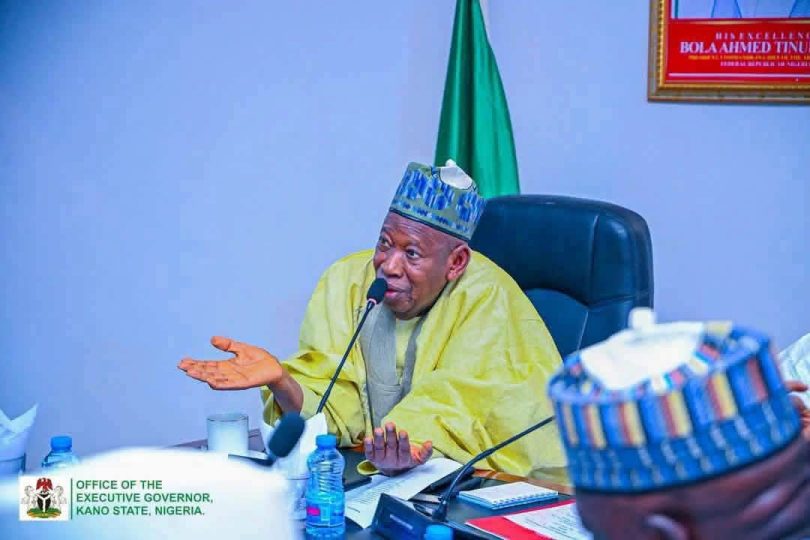
Justice Simon Amobeda of the Federal High Court in Kano ruled that while the court possesses the authority to subpoena a journalist to testify, the reporter retains the right to protect their sources unless those sources are directly linked to the case.
Justice Simon Amobeda of the Federal High Court in Kano has ruled that while the court can subpoena a journalist to testify, the reporter retains the right to protect their sources unless those sources are directly linked to the case.
The dispute arose from a suit filed by the Inspector-General of Police against Ahmad Rabiu, stemming from a PREMIUM TIMES investigative report on the ownership of Dala Inland Dry Port Limited.
At the resumed hearing of the case (suit number FHC/KN/CR/378/2025) on Monday, the prosecution applied to call PREMIUM TIMES’ reporter, Abubakar Maishanu, to the witness box as a prosecution witness.
Mr Maishanu had authored an investigative report published by PREMIUM TIMES in September last year. The exposé revealed how former Kano State Governor Abdullahi Ganduje secretly transferred the state government’s 20 per cent stake in the dry port to private individuals.
The transfer made Mr Ganduje’s children co-owners of the company just before the state awarded a contract worth over ₦4 billion to develop the port’s infrastructure.
The transaction effectively terminated Kano State’s equity in the project, while Mr Ganduje’s children and his aide, Abubakar Bawuro, became directors and shareholders.
The defendant, Mr Rabiu, is facing a six-count charge bordering on cyberstalking and defamation. Counsel to Mr Ganduje linked Mr Rabiu to the leaked documents used in the investigative report.
However, Mr Rabiu denied the allegation.
During the opening court session, Mr Maishanu took the stand and was questioned under oath by the prosecution counsel, Mr Ekwe, on whether he sourced the information that formed the basis of his report.
After Mr Maishanu answered in the affirmative, Mr Ekwe asked the court to compel the reporter to disclose his confidential sources.
Mr Mahmoud, a Senior Advocate of Nigeria (SAN), swiftly objected. He argued that because the witness had been subpoenaed, the defence was entitled to a summary of his expected testimony.
He stated that a journalist can only be compelled to disclose their sources under exceptionally narrow and limited circumstances.
Drawing an analogy to other professional privileges, Mr Mahmoud argued: “Just as a lawyer cannot be compelled by a court to disclose confidential communications with a client, and a doctor cannot be forced to reveal a patient’s medical condition, a journalist cannot be compelled to expose their sources of information.”
Mr Mahmoud stated that journalists’ sources are legally protected unless the matter directly threatens national security, expressing his readiness to present relevant legal authorities to support this fundamental tenet of Nigeria’s legal order.
In response, the prosecution counsel, Mr Ekwe, countered that the court could indeed compel the witness. He cited Section 241 of the Administration of Criminal Justice Act (ACJA), which empowers the prosecution to subpoena any person to give evidence, especially if the case is a criminal offence.
Mr Ekwe urged the court to dismiss the defence’s objections.
Delivering a brief ruling, Justice Amobeda observed that the prosecution had filed a motion to call an additional witness whose name was properly disclosed (Mr Maishanu).
Because proof of service showed the defence had been duly served with the process, the defence’s initial procedural objection regarding the witness’s appearance failed.
However, addressing the demand for source disclosure, the defence reiterated that forcing a journalist to name their sources constituted a severe overreach.
The prosecution countered that disclosure is legally permissible when the subject matter of the confidential information is actively before the court.
At this juncture, Justice Amobeda intervened, directing the prosecution to reframe the question and stick within the confines of the law.
“I will stop you if your questions towards the journalist are contrary to the law”, the judge warned the prosecution counsel.
Following the judge’s directive, the prosecution reframed the query, asking the witness how he compiled his report on the Dala Dry Inland Port.
Mr Maishanu testified that he gathered his information from multiple sources, including state and federal government agencies. He confined his testimony strictly to the published report, stating that all relevant answers were already contained therein, which is in the public domain.
The prosecution then requested the witness to read from a 2022 Corporate Affairs Commission (CAC) status report. The document revealed the names of the directors with significant interests in the Dala Dry Inland Port, including Mr Rabiu and Abubakar Bawuro.
Following this disclosure, Mr Mahmoud stated he had no further questions for the witness and announced his intention to file a “no-case submission.”
Justice Amobeda subsequently discharged Mr Maishanu and adjourned the matter to 15 October for further hearing and the filing of the no-case submission.
When Dala Inland Dry Port Limited was incorporated on 8 December 2003, its only directors were the founder, Ahmad Rabiu, and his son, Rabiu Ahmad Rabiu.
Two years later, at an extraordinary general meeting on 19 January 2005, the board was expanded with the appointment of four new directors: Abdulaziz Haladu, Anwar Isyaku-Rabiu, Diepreye George, and Abdullahi Kwaru.