
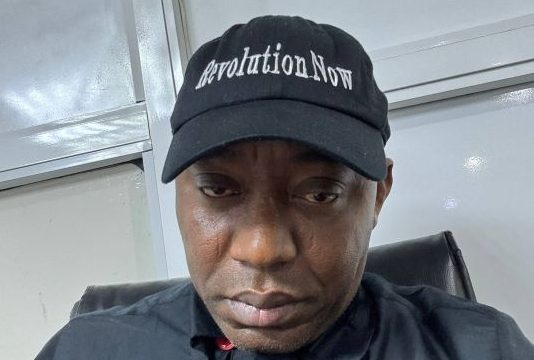
The Federal High Court sitting in Abuja, on Wednesday, returned activist and publisher, Omoyele Sowore, to Kuje Correctional Centre.
Trial Justice Mohammed Umar held that he should remain in custody until June 30, when the application he filed to challenge the revocation of his bail will be determined.
Recall that on June 16, the court revoked Sowore’s bail and issued a bench warrant for his arrest after he failed to appear in court for his trial regarding alleged cybercrime and criminal defamation.
The Department of State Services is prosecuting Sowore for alleged criminal defamation over claims that he referred to President Bola Tinubu as a “criminal” in posts made on his official X and Facebook accounts.
Sowore has pleaded not guilty to the charge.
The court had on Monday, ordered the remand of the presidential candidate of the African Action Congress at the Kuje Correctional Centre, pending the determination of his application seeking a stay of execution of an earlier order revoking his bail.
At the resumed hearing on Wednesday, Sowore’s counsel, R.O. Adakole, alongside C.S. Etonyeaku, holding the brief of Adeyinka Olumide-Fusika (SAN), informed the court that the defendant had filed a motion on notice dated June 17 and filed on June 19, 2026.
The defendant urged the court to restore the bail that was earlier granted to him and set aside the bench warrant for his arrest.
In the application, anchored on section 36 of the 1999 Constitution, as amended, as well as sections 169 and 352 of the Administration of Criminal Justice Act (ACJA) 2015, Sowore contended that the orders made against him were unjust and unwarranted.
He said it prayed the court for an order setting aside the order made on June 16, revoking the bail and issuing a bench warrant against the defendant due to his non-appearance in court on the said date, and restoring the status quo before that date.
According to him, the application is accompanied by a 25-paragraph affidavit deposed to by Emmanuel Larry.
He urged the court to grant all the prayers in the application.
Upon receipt of a counter-affidavit by the prosecution, Adakole said the defence filed another affidavit on 24 June.
“The defendant also filed a reply on points of law dated June 23 and filed it same date.
“We adopt the said reply on points of law while placing reliance on the further affidavit and urge the court to grant the application as prayed in the interest of justice,” he said.
The lawyer further urged the court to discountenance the counter-affidavit filed by the prosecution.
Responding, Kehinde vehemently opposed the application.
He said in response, the DSS filed a 25-paragraph counter affidavit which they shall be relying on in urging the court not to grant the defence application.
“We are placing particular emphasis on Paragraphs 10 to 23,” he said.
The senior lawyer said the prosecution also filed a written address in support of the counter-affidavit, urging the court to refuse the defendant’s application.
He argued that Sowore had not placed truthful facts before the court that were capable of swaying the court to exercise its discretion in his favour.
After listening to parties, Justice Umar adjourned the matter until June 30 for ruling.
Shortly after adjournment, Adakole, who prayed the court to release Sowore to him, undertook to produce him on the next adjourned date.
Kehinde equally opposed Adakole’s request.
He argued that such an application cannot be made orally.
But Adakole told the court that he was only holding a brief for a senior advocate, Mr Adeyinka Olumide-Fusika, “of impeccable character whose words should mean something to the court”.
The judge then asked that if Sowore were released to the counsel, wouldn’t it mean that he had already ruled on the application?
He, therefore, said he was more inclined to leave the matter as adjourned.