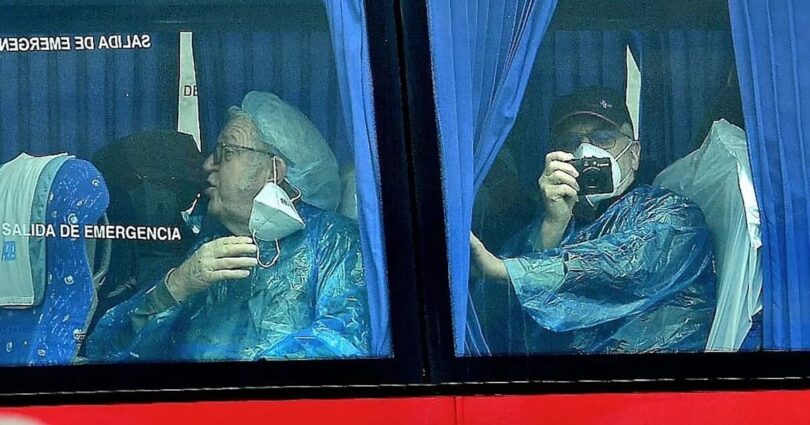
An MV Hondius passenger spotted without PPE (Image: X/Club Antártico)
A number of passengers who disembarked the virus-stricken MV Hondius have already been spotted flouting quarantine protocols, mere hours after the ill-fated vessel made landfall on Spain’s Canary Islands.
One passenger, who is understood to be from the Netherlands, was photographed group waving to journalists from the bottom of the bus after removing his mask.
In another photograph, a passenger from the ship can be seen with a facemask hanging from his ear, despite everyone else being clad with full PPEin the immediate vicinity.
As per the local press, a Spanish healthcare worker from the state-deployed healthcare support team was seen on Sunday getting off one of the buses provided by the Military’s emergency response unit, the Unidad Militar de Emergencias (UME). The healthcare worker then removed his PPE in the middle of a public space.
As locals fear becoming the centre of another pandemic-era disaster, World Health Organisation Director-General Tedros Adhanom Ghebreyesus was pressed by reporters about lax attitudes to quarantine protocols.
He seemed unphased. He replied: “I saw that in the picture [of a maskless passenger] also,” he said. “[The mask] was hanging on his ears. You know, so many of these passengers are elderly, and you can imagine how uncomfortable could be – especially when you have FFP2 masks.”
Read more: WHO reassures Tenerife as hantavirus cruise ship MV Hondius approaches
Read more: British hantavirus cruise ship evacuees arrive at UK isolation facility
NEW – WHO’s Tedros responds to pictures that have been circulating online of one of the passengers not wearing a mask: “Many of these passengers are elderly and you can imagine how uncomfortable it could be when you have, especially FFP2 masks.” pic.twitter.com/n0VzDtZJOW
— Disclose.tv (@disclosetv) May 10, 2026
He said that it was important to remember that the majority of the passengers who disembarked the boat plagued by the ray-borne disease are mostly elderly and already have “many health challenges” that come in one’s twilight years.
“Many of them are elderly and they have many other chronic conditions. There could be symptoms associated with those. So if there are symptoms, it doesn’t mean that it’s related to hantivirus.”
While the WHO chiefs did jot appear to be overly worried about the lax approach to by some to mask-wearing, people on social media were less than impressed.
One user said: “Tell that to all the essential workers required to wear them for hours upon hours during Covid. Not an excuse.”
A second added: “Oh ok, but they forced [masks on us] during Covid. No matter what.” While a third pointed out:”[Wearing a mask is] not more uncomfortable than dying.”
Meanwhile, in the hours after disembarking the infected cruiseliner at Tenerife, another passenger began displaying hantavirus symptoms while being repatriated to their home country of France, the country’s prime minister said.
Sébastien Lecornu said the French national developed symptoms while on a chartered flight from Tenerife to Paris, and so all five evacuated from the MV Hondius had been “immediately placed in strict isolation until further notice”.
The French citizens are among more than 90 tourists to be ferried home from the Dutch vessel on Sunday, which anchored off the Canary Islands before dawn.
And, while official statements in the Spanish isles do indicate that healthcare officials are taking both quarantine and decontamination efforts seriously, it has done little to quell fears from locals that their home is set to become the epicentre of another pandemic.
Healthcare worker David Hernández told the Independent he was gripped by anxiety when he heard that the MV Hondius would soon dock in Tenerife.

An MV Hondius passenger without a properly fitting mask (Image: X/Club Antártico)
“I thought, ‘Why us?’ Everyone will be scared by the uncertainty of the situation. This is bringing back flashbacks of the Covid-19 pandemic. We had a terrible time in the hospital then,” the intensive care nurse, 29, told The Independent.
“I am human, and understand we all could have been on that cruise ship, but there must be some protocols.”
The thought of another quarantine brought bad memories from the 2020 pandemic rushing back, the 29-year-old said.
The Canary Islands became a focal point for the spread of coronavirus February 2020, after several infected guests checked into a Tenerife hotel. Those guests plunged more than 1000 people into total lockdown, making headlines around the world.
And, while the Spanish isles lost only 155 lives out of its then-2.1 million residents, the pandemic saw tourism grind to a halt; the island’s main revenue source.
Hernández continued: “The population on the island has grown by about a million on the island since the pandemic, and we have the same 24 beds in the intensive care unit. I don’t think we can cope,” he said.
Other locals shared similar sentiments.
Francesca Borges, a retired teacher, said: “We think, ‘Why us again?’. During Covid lots of cruise ships were stranded here”
Ms Borges, 65, added to the Independent: “There is a history of the Canary Islands having to take responsibility for a European problem. There is a sense that the Spanish government has always had this attitude that the Canary Islands is treated like a colony when it is in a situation like this.”