
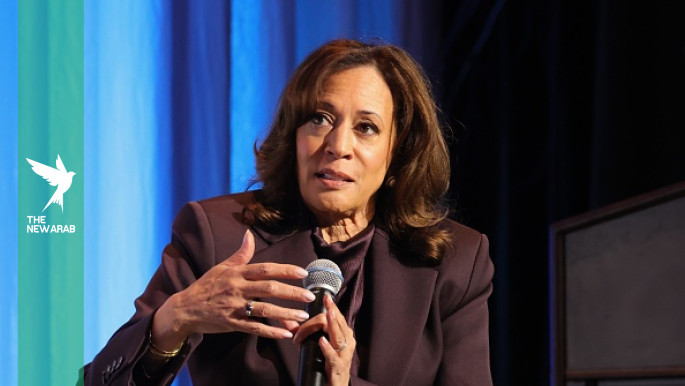
Polling shows that Harris’ pro-Israel position on Gaza was a major reason for her defeat [Getty]
The Democratic National Committee’s long-awaited “autopsy” into Kamala Harris’s 2024 election defeat has sparked backlash after critics noted that the 192-page report entirely omits the war on Gaza and US support for Israel.
The omission has drawn scrutiny because polling and internal findings suggested the issue damaged Democrats electorally, particularly in swing states.
The report, written by Democratic strategist Paul Rivera, was released this week after months of delay and internal controversy.
Several senior Democrats have distanced themselves from the final document after its release, amid criticism over its omissions, perceived lack of seriousness, and even basic grammatical and editing errors that fuelled accusations the review had been rushed and poorly handled.
But the document also avoids several of the most politically sensitive issues surrounding Harris’s defeat, particularly the party’s support for Israel’s war on Gaza.
Progressive Democrats reacted angrily to the omission. Representative Alexandria Ocasio-Cortez reportedly described it as “pretty unbelievable” that Gaza was not addressed in the report.
Representative Ro Khanna argued the party lost support because of its “blank check” backing for Israel during the war.
The Biden administration faced intense criticism during the war for its continued military and diplomatic support for Israel as Israeli forces carried out a devastating genocidal assault on Gaza after a surprise Hamas attack on 7 October 2023.
Despite mounting civilian deaths and destruction in Gaza, Biden repeatedly defended US military aid to Israel and resisted major pressure campaigns inside the Democratic Party calling for an arms embargo or tougher conditions on support for Prime Minister Benjamin Netanyahu’s government.
During the 2024 election campaign, Harris attempted to create some rhetorical distance from Biden on Gaza by speaking more openly about Palestinian suffering and calling for a ceasefire.
However, she maintained the administration’s core pro-Israel position, and also opposed calls for an arms embargo on Israel while pledging continued military support.
Critics argued that while Harris adopted a softer tone than Biden, her policy remained fundamentally unchanged.
‘The opposite is true’
The controversy has intensified because Democratic officials involved in the internal review reportedly reached the opposite conclusion to the report privately.
Axios reported in February that officials conducting the review believed Harris lost “significant support” because of the Biden administration’s approach to Gaza.
The Institute for Middle East Understanding Policy Project (IMEU), which met with officials involved in the process, said Democratic representatives acknowledged internally that Gaza policy had been a “net-negative” electorally.
That assessment appears difficult to reconcile with the final published report, which does not substantively mention Gaza or Israel.
Polling conducted after the election appears to support claims that Gaza played a measurable role in Harris’s defeat, especially in swing states.
According to post-election polling by IMEU and YouGov, 29 percent of 2020 Biden voters who did not vote for Harris in 2024 said “ending Israel’s violence in Gaza” was the most important issue affecting their vote. The economy ranked second at 24 percent.
The same polling found that in battleground states that flipped from Biden to Donald Trump, 20 percent of former Biden voters who abandoned Harris identified Gaza as their top issue, second only to the economy.
Michigan emerged as one of the clearest examples of the problem for Democrats.
More than 100,000 Democratic primary voters in the state cast “uncommitted” ballots against Biden in protest over Gaza before Harris entered the race.
A later analysis by The Guardian found Harris lost roughly 22,000 votes compared to Biden’s 2020 performance in heavily Arab-American and Muslim areas of Michigan, while Trump gained around 9,000 votes in the same areas.