
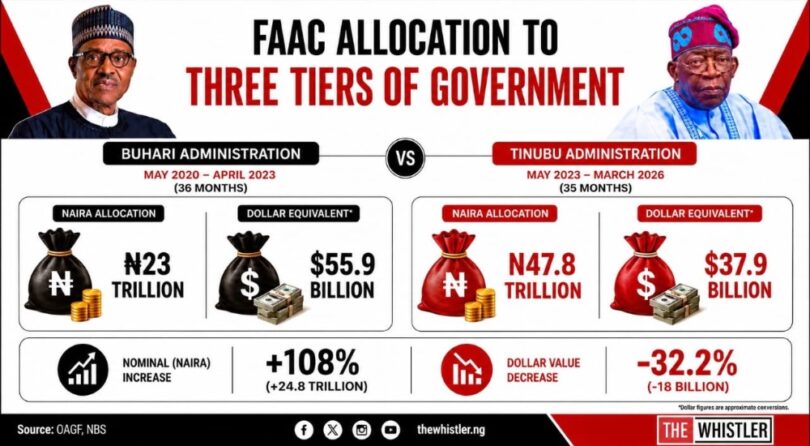
… Tinubu’s N47.8tn FAAC Allocation Worth Less Than Buhari’s N22.9tn In Dollar Terms
… Rising Costs, FX Depreciation Distort True Value Of FAAC Growth — Experts
An analysis of data sourced from the Office of the Accountant-General of the Federation (OAGF) and the National Bureau of Statistics (NBS) by THE WHISTLER has revealed that despite a sharp increase in Federation Account Allocation Committee (FAAC) disbursements under President Bola Tinubu, the real value of revenues shared among the three tiers of government has weakened significantly following the steep depreciation of the naira.
The findings showed that the federal, state and local governments collectively received N47.8tn from FAAC between May 2023 and March 2026 under Tinubu, compared to N23tn distributed during the last 36 months of former late President Muhammadu Buhari’s administration between May 2020 and April 2023.
The figures indicate an increase of N24.8tn in nominal naira terms under Tinubu’s administration. However, when adjusted for exchange-rate movements, the value of these allocations dropped sharply.
Analysis by THE WHISTLER showed that the naira averaged about N409.36/$ during the reviewed Buhari period but weakened significantly to an average of approximately N1,310.61/$ under Tinubu.
Using the Central Bank of Nigeria’s average monthly exchange rate during the Buhari administration and under Tinubu, the allocations translated to approximately $55.9bn under Buhari compared to about $37.9bn under Tinubu.
This represents a decline of roughly 32.4 per cent in dollar terms despite the substantial rise in naira allocations.
The analysis underscores the growing disconnect between nominal fiscal expansion and real value preservation amid Nigeria’s worsening inflationary pressures and currency volatility following major economic reforms introduced by the Tinubu administration.
Shortly after assuming office on May 29, 2023, Tinubu implemented sweeping reforms aimed at restructuring the Nigerian economy, including the removal of petrol subsidy and the liberalisation of the foreign exchange market.
During his inaugural speech, Tinubu famously declared that “subsidy is gone,” insisting that resources previously spent on fuel subsidies would be redirected into productive sectors and distributed more efficiently across the federation.
The administration also moved to unify the foreign exchange market, ending years of multiple exchange-rate windows that economists and investors had criticized for encouraging arbitrage, distortions and rent-seeking.
While the reforms triggered a sharp rise in federally collected revenues and monthly FAAC disbursements, they also accelerated the depreciation of the naira, weakened household purchasing power and pushed inflation to multi-year highs.
The depreciation substantially increased the cost of imported goods, infrastructure materials, foreign debt servicing and other FX-dependent government obligations across all tiers of government.
A detailed breakdown of the allocations revealed that the federal government received N9.6tn from FAAC during Buhari’s final 36 months in office, equivalent to approximately $23.6bn at the prevailing average exchange rate during the period.
Under Tinubu, allocations to the federal government rose sharply to N17.8tn between May 2023 and March 2026, representing an increase of approximately 85 per cent in naira terms.
However, when converted using the average exchange rate of N1,310.61/$ recorded during Tinubu’s administration, the allocation amounted to approximately $14.2bn.
This means that despite receiving significantly higher allocations in naira terms, the federal government experienced a 65 per cent decline in the real dollar value of FAAC revenues compared to the Buhari administration.
State governments also recorded a similar pattern.
Collectively, the 36 states received N7.6tn from FAAC between May 2020 and April 2023 under Buhari, equivalent to approximately $18.5bn.
Under Tinubu, allocations to state governments surged to N17.3tn, reflecting a 127 per cent increase in nominal naira terms.
Yet, after adjusting for exchange-rate depreciation, the allocations translated to approximately $13.7bn, representing $4.6bn decline in dollar value compared to the Buhari era.
Allocations to the 774 local government councils equally expanded sharply in naira terms but declined significantly in real value.
Local governments received N5.6tn during Buhari’s administration, equivalent to approximately $13.8bn.
Under Tinubu, allocations to local governments rose to N12.6tn, representing a 121.8 per cent increase in naira terms.
However, in dollar terms, the allocation amounted to approximately $10bn, reflecting a $3.8bn decline from the Buhari period.
The broader revenue profile of the federation account followed the same trajectory.
Further analysis showed that total FAAC revenue generated between May 2020 and April 2023 under Buhari stood at N30tn, equivalent to approximately $73.1bn using the average exchange rate during the period.
Under Tinubu, total FAAC revenue generated between May 2023 and March 2026 rose significantly to N86.1tn, representing an increase of about 187 per cent in nominal naira terms.
However, when converted using the prevailing exchange rate during the Tinubu administration, the revenue translated to approximately $67bn — about 8.34 per cent lower than the Buhari-era value.
THE WHISTLER findings suggest that while the Tinubu administration succeeded in expanding nominal government revenues through fiscal reforms, the accompanying collapse of the naira substantially weakened the purchasing power and real economic value of those revenues.
The trend has intensified concerns among economists and policy analysts over the sustainability of Nigeria’s public finance structure amid persistent inflation and exchange-rate instability.
The inflationary consequences of the reforms have been particularly severe for subnational governments whose infrastructure programmes rely heavily on imported inputs such as machinery, steel, petroleum products and construction materials.
With the naira losing more than two-thirds of its value against the dollar since the reforms began, the cost of executing public projects has risen sharply across the federation.
Several state governments have consequently reviewed contract values upward, delayed infrastructure projects or sought alternative financing arrangements to cope with escalating costs.
At the same time, governments have faced mounting pressure to increase workers’ wages and social spending as inflation eroded household incomes.
Despite these pressures, supporters of the reforms argue that the policy changes corrected longstanding structural distortions within the economy and placed government finances on a more sustainable path.