
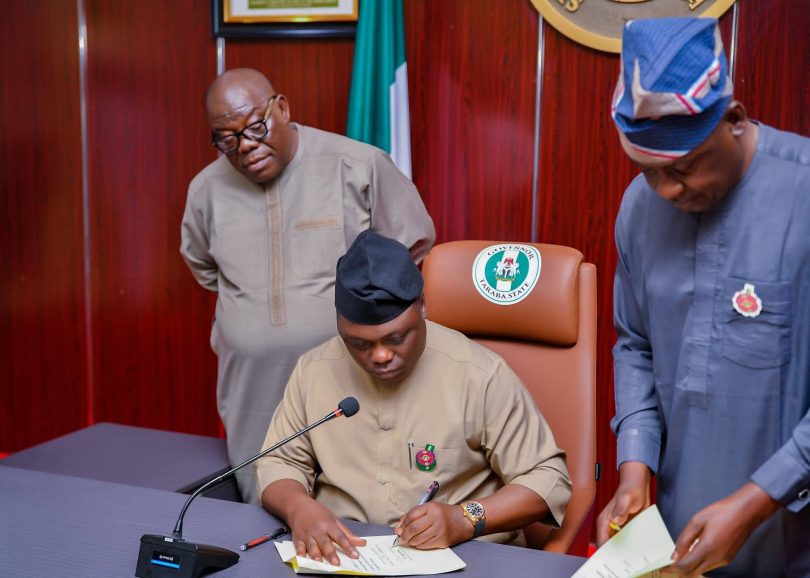
The latest executive order, signed by Governor Agbu Kefas in June 2026, is the administration’s third attempt to halt illegal mining in the state since the governor assumed office in 2023.
Despite three executive orders in three years suspending mining activities, Taraba State continues to lose more than ₦10 billion annually to illegal mining, exposing the limits of repeated government crackdowns on a lucrative underground economy sustained by weak enforcement, difficult terrain, foreign demand and alleged local complicity.
The latest executive order, signed by Governor Agbu Kefas in June 2026, is the administration’s third attempt to halt illegal mining in the state since the governor assumed office in 2023.
Each directive temporarily halted activities as excavators disappeared and mining camps shut down. But once enforcement teams withdraw, the operators quietly return, and billions of naira worth of gold, sapphire and other minerals resume flowing through informal channels.
The recurring cycle raises a critical question: Why is one of Nigeria’s mineral-rich states struggling to stop an illicit trade that, officials say, deprives it of billions of naira every year?
Taraba’s losses reflect a wider national problem.
The House of Representatives Committee on Solid Minerals estimates that Nigeria loses about $9 billion annually to illegal mining, while the Nigeria Extractive Industries Transparency Initiative (NEITI) reported that the solid minerals sector contributed only ₦401 billion, or 0.72 per cent of GDP, in 2023, attributing the sector’s poor performance to weak regulation, opaque licensing, and criminal networks.
Taraba illustrates those concerns.
Years before the current crackdown, an investigation by Daily Trust reported how illegal mining around Mayo Sina in Nguroje, Sardauna Local Government Area, had developed into a thriving underground economy where blue sapphire worth between ₦60 million and ₦100 million was sold daily, largely to foreign dealers from Senegal, Mali, Guinea and Cameroon.
The investigation also showed that miners operated without licences while middlemen controlled the trade, and many host communities depended heavily on the activity for survival.
Interviews with miners, residents and government officials, alongside a previous PREMIUM TIMES investigation, suggest that illegal mining has evolved into a resilient network capable of surviving repeated enforcement operations.
In December 2024, a PREMIUM TIMES investigation found that illegal miners had returned to Abujan Leda in Jamtari Ward of Gashaka Local Government Area months after security agencies dismantled their camps.
Labourers told this newspaper they were often tipped off before task force raids, allowing them to abandon the camps temporarily and then return to continue extracting sapphire, quartz and other minerals. Residents blamed the absence of clear mining guidelines and alleged collusion by some local actors for the persistent return of illegal miners.
In September 2023, the Taraba State Environmental Protection Task Force raided an illegal mining site at Mayo Sina and recovered 22,373 kilogrammes of blue sapphire, arrested more than 100 suspected illegal miners, and confiscated mining equipment in what remains one of the largest gemstone seizures recorded in Taraba State.
An official at the Taraba State Bureau for Solid Mineral Resources, who requested anonymity because he was not authorised to speak publicly, said illegal extraction has persisted for years across Sardauna, Karim Lamido, Bali, Gashaka, Kurmi, Ussa and Yorro local government areas despite successive government interventions.
Interviews with miners, residents and government officials, alongside previous PREMIUM TIMES reports on the return of illegal miners to communities in Taraba, enforcement operations by the state government’s mining task force, and accountability challenges in Nigeria’s solid minerals sector, suggest that illegal mining has evolved into a resilient network capable of withstanding repeated enforcement efforts.
To avoid confrontation with security agencies, operators rely on mobility, local intelligence and well-established supply chains.
Court records from the January 2025 prosecution of suspects arrested at the Abuja leather mining site in Gashaka Local Government Area identified defendants from Plateau, Bauchi and Niger states alongside Taraba residents, highlighting the interstate nature of the business.
The Chairman of the Environmental Protection Task Force, Jeremiah Faransa, also disclosed that the task force arrested suspects from Cameroon, Burkina Faso, Mali and Chad, revealing how the trade attracts players beyond Nigeria’s borders.
Most labourers use basic tools, but repeated seizures of explosives, detonating cables and dynamite indicate that some operators have adopted more sophisticated and hazardous mining methods.
Taraba’s geography further complicates enforcement.
Many mining sites are hidden inside forests, valleys and remote communities with poor road access, making continuous surveillance difficult. Security officials say operators often receive advance warning of raids, abandon camps temporarily and return soon after enforcement teams leave.
The pattern resurfaced in July 2026, when the Taraba Anti-Illegal Mining Taskforce raided a gold mining site at Mayo Kam in Gantu village, Bali Local Government Area, following weeks of intelligence gathering. According to the task force, most of the suspected miners escaped into nearby forests before security operatives arrived because of the difficult terrain, while only two suspects were arrested.
Community members also describe an unequal trading relationship between local miners and the foreigners who buy the minerals.
According to multiple sources interviewed during previous reporting, many artisanal miners lack knowledge of the international value of gemstones, allowing buyers from Guinea, Senegal, Sri Lanka, Thailand, China and Europe to dictate prices before exporting the minerals for processing abroad.
Shortly after assuming office in 2023, Governor Kefas suspended mining activities through an executive order, citing environmental degradation, water pollution and the exploitation of local communities.
The order established the Taraba State Task Force on Environmental Protection, Public Safety, and Prohibition of Deforestation, headed by Mr Faransa, along with a Special Mobile Court to prosecute offenders.
According to Mr Faransa, the task force has arrested more than 3,000 suspected illegal miners and identified over 20,000 legal and illegal mining locations across the state.
Yet illegal mining continued, prompting two additional executive orders.
The latest, issued in June 2026, shifted the government’s focus from environmental protection to security concerns after intelligence reports linked illegal mining to growing insecurity in parts of the state.
It also created a second enforcement body, the Anti-Illegal Mining Taskforce, chaired by Emmanuel Jamu, to intensify operations.