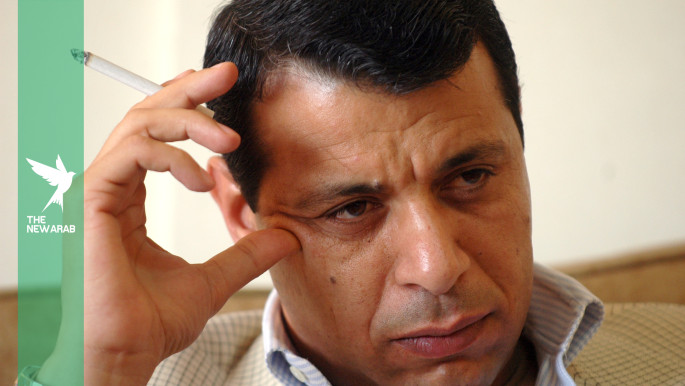
Expelled Fatah leader Mohammed Dahlan has re-emerged in discussions over Gaza’s post-war governance, raising questions about what role he could play in the devastated enclave’s ‘day after’, even as the Gaza peace plan has stalled and Israel continues to attack and kill Palestinian civilians on a daily basis there.
The former Fatah Central Committee member and ex-chief of Preventive Security in Gaza, who now lives in the United Arab Emirates and leads the Democratic Reform Current, returned to relevance at a moment when no Palestinian authority, Israel, or regional actor has outlined a clear end-state for Gaza’s rule.
Recent developments have brought his name back into circulation. According to recent reports, Israeli Shin Bet chief David Zini met with the Palestinian Authority’s exiled former Gaza security chief during a recent visit to the United Arab Emirates.
In Cairo on 6 June, eight Palestinian factions met to discuss a roadmap linked to a possible second phase of a ceasefire and Gaza’s future administration.
The participation of Dahlan’s Democratic Reform Current, alongside the absence of the official Fatah movement led by President Mahmoud Abbas, was read by some observers as politically symbolic.
Yet it did not signal a shift in formal legitimacy. Instead, it exposed a widening gap between institutional representation and the actors increasingly involved in practical discussions about Gaza’s immediate future.
This gap sits at the heart of the question surrounding Dahlan’s potential role: whether Gaza’s post-war phase will be shaped by established political structures or by ad hoc arrangements driven by necessity, external mediation, and humanitarian urgency.
A political figure rebuilt through absence and necessity
Dahlan’s current relevance is inseparable from his political rupture with Fatah and his long absence from formal Palestinian authority structures.
Expelled from the movement in 2011 by a decision of the Fatah Central Committee signed by President Mahmoud Abbas, amid corruption allegations and unresolved claims tied to the death of Yasser Arafat, Dahlan was pushed out of institutional politics and into a prolonged period of political exile.
Before that break, he had been one of the most influential security figures in Gaza during the post-Oslo era, heading Preventive Security and playing a central role in coordinating with Israel on security arrangements and border management. He was also involved in key negotiating tracks including Cairo 1994, Camp David II, Wye River, and Taba, placing him at the intersection of security governance and diplomatic engagement.
His relationship with Hamas, however, was defined early by confrontation. After Hamas won the 2006 legislative elections, Dahlan described the outcome as a “disaster,” a position that deepened tensions that later escalated into armed clashes in 2007.
That confrontation culminated in Hamas taking control of Gaza and the Palestinian Authority’s security apparatus being expelled from the Strip, cementing a division that still defines Palestinian politics today.
Yet Palestinian political analysts argue that Dahlan’s more recent relevance does not stem from reconciliation with any faction, but from the erosion of alternatives. His reappearance in Gaza-related discussions reflects less a rehabilitation than a vacuum.
Humanitarian entry points, not political reinvention
Much of Dahlan’s current influence is channelled through humanitarian networks linked to Emirati support, particularly through initiatives associated with the Al-Faris Al-Shahm foundation, which has facilitated aid deliveries into Gaza during the war.
This operational presence has allowed his current presence to maintain a degree of visibility inside the Strip, but within narrowly defined humanitarian parameters.
Mansour Abu Karim, a political researcher from Gaza, told The New Arab that this reflects a broader shift in how political actors are being repositioned amid Gaza’s crisis.
“What we are seeing is not a return of political figures in the traditional sense,” he said, “but the use of available networks to manage collapse conditions.”
In his view, Dahlan’s relevance is tied to service delivery rather than governance authority. That distinction is crucial: in the absence of functioning institutions, humanitarian coordination has begun to overlap with political space, but without formally replacing it.
Another political analyst from Gaza, Wissam Afifa, draws a sharper boundary.
He told The New Arab that while Hamas may tolerate operational coordination tied to aid, it draws a firm line at political restructuring driven from outside the Palestinian consensus.
“Humanitarian work can be accommodated,” he said, “but governance authority cannot be externally assigned or redistributed.”
Why neither Hamas nor Israel is endorsing an alternative
Despite his renewed visibility, there is no indication that Dahlan is being treated by either Hamas or Israel as a formal successor to the Palestinian Authority in Gaza.
From Hamas’s perspective, Dahlan remains part of internal Fatah dynamics rather than an independent political actor.
A source familiar with Hamas’s position said the movement differentiates between humanitarian coordination and political authority, accepting the former under necessity but rejecting any attempt to reshape Gaza’s governance through external frameworks.
Israel’s position further complicates the picture. While Israeli leadership has repeatedly rejected the return of the Palestinian Authority to govern Gaza after the war, it has not articulated or endorsed an alternative governance figure or structure.
This has effectively created a governance gap rather than a designated replacement system, leaving space for discussion but not decision.
This absence of endorsement from both principal actors is central to answering the question: Dahlan is not currently an acceptable alternative in the political sense to either Hamas or Israel, because neither has formally accepted him as such.
Cairo and the politics of managed fragmentation
The Cairo meeting has been interpreted by some as evidence of Dahlan’s gradual reintegration into Palestinian political relevance.
Yet political analysts caution that such interpretations risk overstating what is, at this stage, a procedural inclusion rather than a political endorsement.
Iyad Al-Qara, a political analyst from Gaza, argues that Egypt’s approach reflects an attempt to manage fragmentation rather than resolve it.
“Cairo is not building a new political order,” he told The New Arab, “it is maintaining multiple channels to prevent total institutional breakdown.”
In that context, the participation of Dahlan’s current is less about elevating a political alternative and more about expanding the range of actors involved in discussions over humanitarian access and transitional arrangements.
A source close to Dahlan’s Democratic Reform Current also rejected the idea that the movement is positioning itself as a governing replacement. The source said its focus remains on ceasefire stabilisation, humanitarian relief, and coordination mechanisms, rather than political competition for authority in Gaza.
A functional role in search of a political system
Across these overlapping perspectives, a consistent picture emerges: Dahlan’s role is becoming more visible but narrowing in scope.
He is increasingly positioned within a functional space that includes humanitarian coordination, aid facilitation, and potentially limited administrative tasks, all under regional oversight, during any transitional phase.
What he is not positioned as, at least at present, is a consensus political authority or a viable governing alternative to the Palestinian Authority in Gaza.
The analysts agree that even in expanded post-war scenarios, any role for Dahlan would likely be embedded within a broader transitional framework involving multiple Palestinian actors and regional stakeholders, rather than constituting an independent governing structure.
So, could Mohammed Dahlan emerge as an acceptable alternative to the Palestinian Authority in Gaza for both Hamas and Israel?
The evidence suggests a clear but limited answer: no, not as a political alternative or governing authority, according to Al-Qara.
His current relevance is real but constrained. It is rooted in humanitarian access, regional mediation networks, and the practical demands of a collapsed governance environment. But it does not extend to mutual political acceptance by Hamas and Israel as a governing replacement for the Palestinian Authority, Al-Qara believed.
What his re-emergence ultimately reflects is not the rise of a new political alternative, but the absence of any agreed one.
In that gap, figures like Dahlan are not being rebuilt as leaders of a political order but positioned as operators within a system that has yet to define what comes next, he explained.
Mohammed Omer is a Palestinian writer and journalist from the Gaza Strip, focusing on stories in the occupied Palestinian territories and specialising in Israeli affairs