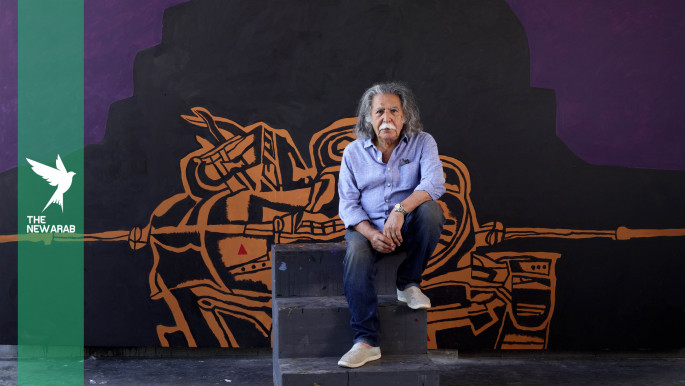
When renowned British Iraqi visual artist Dia al-Azzawi first held a solo exhibition in the city he now calls home — London — it came about by pure coincidence.
Presented in 1978 at the Patrick Seale Gallery, the exhibition drew largely on works he had brought from Baghdad when he relocated, alongside a smaller number of pieces completed after his arrival in the UK.
At this early stage, Azzawi’s paintings and etchings employed a muted, sandy colour palette that helped create an expressionistic, often existential mood, as seen in works such as Martyrs (1970), Man in Desert (1973), and Human States (1975).
Nearly five decades later, the London-based artist marks a significant milestone with his second solo presentation in the capital.
Titled Excursion Across Time, the exhibition at Richard Saltoun Gallery is curated by Louisa Macmillan. As Head of Research at the Azzawi studio, she has worked closely with the artist for over a decade.
In this new iteration, the selection reflects the breadth of Azzawi’s practice across time and medium, bringing together bold, large-scale paintings, previously unseen works on paper, and material drawn from his studio archive.
From Baghdad to the world
Born in Baghdad in 1939, Azzawi’s career has unfolded across multiple cities, institutions, and cultural contexts, shaping a practice informed by both regional and international exchange.
Within this trajectory, between 1968 and 1976, he worked as a curator at several Iraqi institutions, including the Iraq Museum, contributing to the development and practice of museum work in the country during a formative period.
Building on this experience, from 1977 to 1980, he was based in London at the Iraqi Cultural Centre, where he organised and curated a broad programme of exhibitions, helping to foster cultural exchange between Iraq and the UK.
In the decades that followed, his work has been widely exhibited internationally. Notable solo presentations include those at the Ashmolean Museum (2022), Mathaf: Arab Museum of Modern Art and Al Riwaq (2016), the Abu Dhabi Music & Arts Foundation (2009), and the Institut du Monde Arabe (2001), as well as numerous group exhibitions worldwide.
Dafatir: A visual diwan
At its core, Azzawi’s practice is driven by a search for identity as both Arab and Iraqi, beginning with local Iraqi folklore and everyday life and gradually expanding into literature as a shared cultural thread across the Arabic-speaking world.
This becomes particularly evident when moving through the gallery with Louisa and Mysa Kafil-Hussain, who works in Azzawi’s London studio, where attention is drawn to his extensive body of Dafatir (artist’s books).
In particular, these works are closely connected to poetry, which Azzawi refers to as “the pillars” of his practice, and take a variety of forms that sometimes move close to sculpture, combining calligraphic writing with expressive, gestural mark-making.
Rather than being read in a conventional sense, they are intended to be viewed, creating a visual experience that reflects the central role of poetry in Arab culture and its oral tradition of recitation, and one example on display in the gallery is Excursion Across Time, a work based on a poem by Lebanese writer Talal Haidar that also gives the exhibition its title.
Speaking to The New Arab about the Dafatir in greater detail, Azzawi says: “Dafatir are a form that resonates with the Arabic manuscript, one of the most important components of Islamic civilisation, which has left us manuscripts in literature, medicine, geography, astronomy, and more.
“For me, Dafatir are a contemporary achievement of the Islamic manuscript — an achievement worthy of pride — expressed through poetry, described as the ‘diwan of the Arabs.”
“What I sought was to create a visual atmosphere for language, and to enrich it with colour and form, to deconstruct words that draw images for hearing. From here comes the value of the image as a tangible form that enriches emotion.”
Revealing the nude
Moving across the space, it is almost impossible to ignore Azzawi’s distinctive use of bold, polychromatic abstraction.
This is exemplified by the large, emblematic diptych Oriental Window, which is displayed in striking contrast to two monochrome works on paper from the 1960s, shown publicly here for the first time.
In these early drawings, he brings together motifs drawn from everyday life in Iraq — architectural forms, vessels, geometric textile patterns, talismanic symbols, and invocations for protection — alongside human figures, flora, and trees, arranged into experimental compositions and more intimate visual scenes.
One work, in particular, features a rare surviving nude, its large, dark eyes evoking Sumerian sculpture, reflecting Azzawi’s grounding in ancient history and archaeology, as well as his subsequent experience working as a museum curator in Iraq.
Also shown publicly for the first time, these nudes form part of a broader curatorial decision. As Azzawi explains: “Their inclusion reflects the curator’s perspective. Louisa wanted the exhibition to carry a historical dimension, allowing viewers to understand the development of the work over time, the changes that have taken place, and the accumulation of experiences that shaped both the subject matter and the techniques.”
This layering of time and reference extends across his wider practice. Addressing his tendency to draw on visual languages spanning millennia — from Sumerian forms to more contemporary or literary figures — he notes: “Bringing these references together is what creates difference. It forms an identity image that I seek to strengthen through accumulated knowledge and culture.
“This has given me the confidence to test my work against other cultures, enriching my visual and spiritual perspective beyond its traditional foundations.”
Letters in transition
As the exhibition unfolds, Azzawi’s exploration of identity becomes more distilled in works from the 1970s and 1980s, where poetic lines gradually fragment into isolated Arabic letters, reduced to more elemental visual forms.
Reflecting on this development, Azzawi notes that his move to London in 1976 led him to increasingly incorporate Arabic text inspired by Islamic manuscript traditions, while his exposure to European libraries and manuscript collections further shaped his understanding of how past and present can be brought into dialogue within his work.
He explains: “My use of Arabic texts and my engagement with rich manuscript traditions form part of an ongoing exploration of identity that continues to preoccupy me.
“It is grounded in difference, creating a point of dialogue with other cultures, rather than limiting engagement to what is familiar or similar. At the same time, it tests the value of the work itself and its capacity to remain open to interpretation and questioning.”
Mapping civilisations
Turning to more recent works, Folk Carpet is one of the newest pieces in the exhibition.
Drawing on the distinctive triangular motifs of embroidered textiles from Samawa in southern Iraq — an ornamental language that recurs throughout Azzawi’s practice — it is shown alongside Remains, a work shaped by the meticulous, object-based processes of archaeological excavation.
This archaeological approach extends into a large-scale painting that resembles a map of an ancient kingdom, where a modern excavation site, marked with vivid red signs indicating unearthed artefacts, lies beneath the towering shape of a monumental ziggurat, recalling Mesopotamian sites such as Dur-Kurigalzu in modern-day Aqar Quf.
In the sculptural works, this dialogue between past and present continues, as a gilded desert rose rests atop an enlarged cylinder seal and its impression, which depicts a dying lioness taken from the lion-hunt reliefs of Ashurbanipal’s palace in Nineveh, now held in the British Museum.
Reflecting on how these layered elements — textiles, architectural forms, and ancient structures — interact across time, Azzawi explains: “I am the son of a culturally diverse civilisation and part of a contemporary society that faces many challenges, including misconceptions that have, at times, distorted religious roots.
“For my work to remain open within this dialogue, I need a strong civilisational foundation, alongside the ability to construct visual elements that may appear contradictory, yet exist together within a unified intellectual space. Traditional textiles and architectural forms come from the society I belong to — they are a reservoir that I share with others.”
Expanding on his sculptural practice, he adds: “Sculpture and poetry are not separate from our diverse civilisations; they are visual forms that have evolved through historical change and the challenges faced across different eras. As a result, they have been transformed by both material and subject matter, allowing for interpretations that move beyond their original context while maintaining their relevance.”
Lives shaped by civilisation
While there is much more to take in at the gallery, one clear idea emerges throughout: Azzawi captures the everyday lives of Arabs and their neighbours, shaped by the presence of ancient civilisations that continue to define the landscape around them today.
As he reflects on what visitors might take away from the exhibition, he notes: “The Arab viewer should feel a sense of pride in their human presence among different peoples, as an active contributor to achievements that enrich humanity, while the non-Arab viewer should leave with a sense of artistic dialogue rooted in civilisational references different from their own.”
‘Excursion Across Time’ is on view at Richard Saltoun Gallery, 41 Dover St, London W1S 4NS, and runs until 16 May 2026
Zainab Mehdi is The New Arab’s Associate Editor and researcher specialising in governance, development, and conflict in the Middle East and North Africa region
Follow her on Instagram: @zaiamehdi_/@zainabmehdiwrites_