
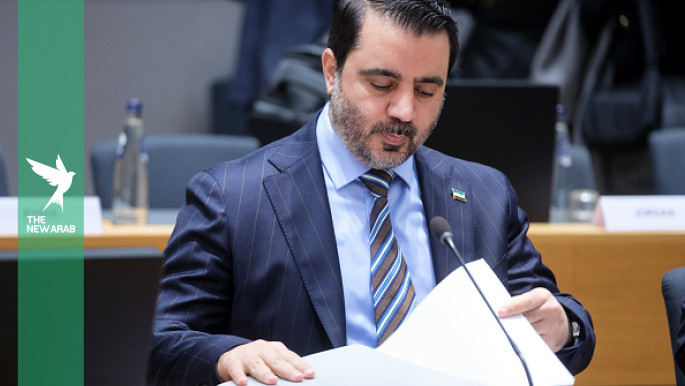
Syria’s Asaad al-Shaibani’s visit to Egypt could be a step towards normalisation between the two countries [Getty]
Egypt’s foreign minister has hosted his Syrian counterpart in Cairo in what appears to be a cautious but notable step towards reviving relations between the two countries, raising questions over whether a broader thaw is underway after years of strain.
Egyptian Foreign Minister Badr Abdelatty received Syria’s Asaad al-Shaibani on Sunday, as the latter arrived at the head of a high-level delegation for talks aimed at strengthening bilateral ties, according to statements from both sides.
The Egyptian foreign ministry said the two sides held “expanded talks, with the participation of Egyptian Industry Minister Khaled Hashem and his Syrian counterpart Mohammad Nidal al-Shaar, which addressed ways to enhance the course of bilateral relations and coordinate positions on current regional developments”.
Foreign ministry spokesperson Tamim Khallaf said Abdelatty “affirmed during the talks the depth of the historical, popular and cultural ties that bind Egypt and Syria”.
He added that Egypt’s position on the Syrian conflict has long been based on supporting “efforts aimed at restoring security and stability” while preserving Syria’s unity.
The meeting also touched on regional tensions, with Abdelatty expressing “Egypt’s categorical rejection of Israel’s blatant violations of Syrian sovereignty”
Abdelatty also called for Israel to comply with the 1974 disengagement agreement, while reaffirming Cairo’s support for “the necessity of ending the Israeli occupation of the Syrian Golan”.
According to the Syrian state news agency SANA, the talks focused on “ways to strengthen bilateral relations and expand prospects for cooperation on issues of mutual interest, alongside discussions on fast-moving regional and international developments”.
A relationship in cautious recovery
The visit comes at a sensitive moment for both sides and is widely seen as a test of whether relations can move beyond the cautious, limited engagement that has defined the post-2024 period.
Ties cooled after the fall of the Assad regime, which was supported by the Egyptian government under President Abdel Fattah al-Sisi, at the end of 2024, with Cairo adopting a wait-and-see approach towards the new leadership in Damascus, particularly given its Islamist background.
While relations never fully broke down, they remained constrained and carefully managed.
Recent contacts, however, suggest a gradual shift. Syrian President Ahmed al-Sharaa met Sisi on the sidelines of an Arab-European summit in Cyprus just days before Shaibani’s visit, signalling a potential willingness at the highest level to re-engage.
Earlier steps have also pointed in this direction, with the first official contact between the two foreign ministers taking place on 31 December 2024, followed by Sharaa’s first meeting with Sisi at an emergency Arab summit in Cairo in March 2025.
An Egyptian trade delegation also visited Damascus earlier this year for the first time in 15 years, exploring ways to expand economic and investment cooperation.
Drivers of a potential thaw
Analysts say shifting regional dynamics may be pushing both countries towards closer coordination.
Journalist Ghazi Dahman told The New Arab that the rapprochement has become “a necessity imposed by regional transformations, amid rising tensions and overlapping security and political files, which require greater coordination between key Arab capitals”.
At the same time, Egyptian concerns remain. Dahman pointed to Cairo’s unease over the Islamist background of Syria’s new leadership and the possible implications for domestic and regional balances.
However, he added that Egypt also recognises the strategic importance of reasserting its role in Syria, both to support the country’s territorial unity and to balance the influence of other regional actors, particularly Turkey, as well as Israel, which he said is seeking to entrench its presence in the Syrian arena.
Economics is also emerging as a key incentive. Syria’s geographic position offers potential as a transit route for energy, particularly gas, from Egypt to Europe via the Arab Gas Pipeline, an option gaining relevance amid heightened regional tensions, including the US-Israeli confrontation with Iran.
Reconstruction presents another avenue for cooperation, with Damascus expressing interest in involving Egyptian companies in infrastructure and energy projects, including during recent engagements with visiting Egyptian business delegations.
Despite the apparent momentum, significant obstacles remain. Issues such as the status of Syrians living in Egypt, alongside Egyptian security concerns over individuals wanted by its authorities who may be present in Syria, continue to complicate relations and require deeper coordination.
For now, Cairo appears to be pursuing what could be described as a policy of conditional engagement – testing the ground without committing to full normalisation.