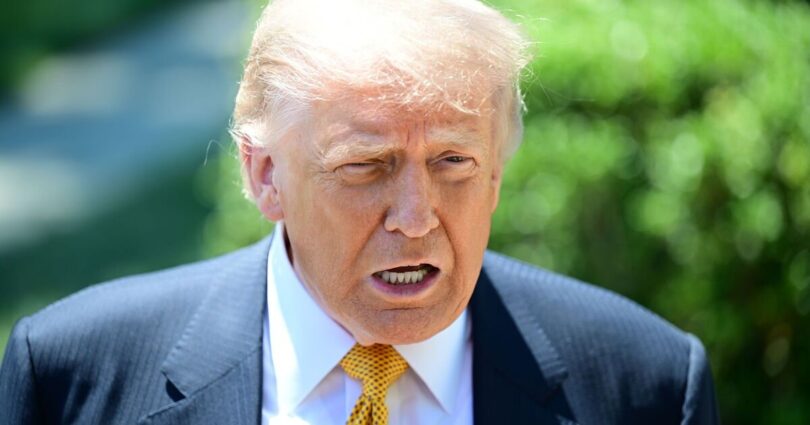
Donald Trump has threatened to “take over” Venezuela in another bizarre post. The US President shared a post on his Truth Social account Saturday showing a map of Venezuela overlaid with an American flag and labelled “51st State.”
It comes after Venezuela’s acting President Delcy Rodríguez told journalists on Monday that her country had no plans to become the 51st US state after President Donald Trump said he was “seriously considering” the move.
She made the remarks at the International Court of Justice in The Hague during the final day of hearings in the dispute between her country and neighbouring Guyana over the mineral‑ and oil‑rich Essequibo region.
Earlier this week, the US President told FOX News that he was considering making Venezuela a new state with the US, months after boasting that Trump was in control of the oil-rich nation.
He said: “We will continue defending the integrity, the sovereignty, the independence, our history, which is a history of glories of men and women that gave their life to make sure that we were not colonies, but our independent country.”
Donald Trump had previously joked about Canada becoming the 51st US state, a theme he returned to repeatedly during his 2024 presidential campaign in jabs at then–Prime Minister Justin Trudeau. The remarks continued even after Mark Carney took office the following year.
Trump most recently floated the idea of a “merger of Canada and the United States” during Carney’s visit to Washington in October 2025, at a time when trade tensions between the two countries were worsening.
Carney brushed off the comment, saying that despite ongoing disputes, the long‑standing ties between Canada and the US should help both sides work through their differences.
The 62,000‑square‑mile Essequibo region, which accounts for roughly two‑thirds of Guyana, is rich in gold, diamonds, timber, and other valuable natural resources.
It also lies close to major offshore oil fields that now produce around 900,000 barrels per day — output that nearly matches Venezuela’s own daily production of about 1 million barrels. This surge has rapidly transformed Guyana into a significant energy player in South America.
Venezuela, however, has long claimed Essequibo as its own, tracing its claim back to the Spanish colonial era, when the territory fell within its historic boundaries. That position was challenged in 1899, when an arbitration panel made up of representatives from Britain, Russia, and the United States drew the border along the Essequibo River, largely in Guyana’s favour — a ruling Venezuela has disputed ever since.