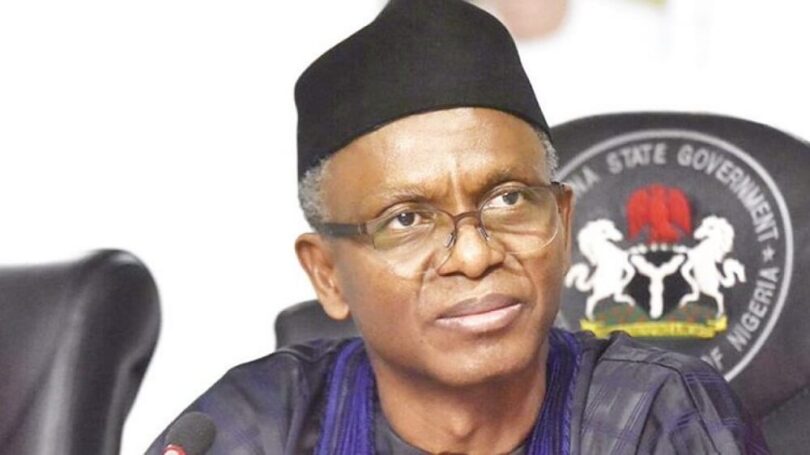
The Department of State Services has arraigned former Kaduna State Governor Nasir El-Rufai before the Federal High Court in Abuja on Wednesday on a three-count charge of unlawfully intercepting the telephone communications of National Security Adviser Nuhu Ribadu, in a case that has been months in the making.
The arraignment, which took place today April 23, was rescheduled from February 25 after the DSS failed to produce El-Rufai in court on the earlier date.
The former governor had been in the custody of the Independent Corrupt Practices and Other Related Offences Commission at the time, following his earlier detention by the Economic and Financial Crimes Commission over separate money laundering allegations.
Justice Joyce Abdulmalik of the Federal High Court subsequently fixed today’s date for the arraignment.
The charges, filed under case number FHC/ABJ/CR/99/2026, stem from remarks El-Rufai made during a live appearance on Arise TV’s Prime Time programme on February 13, 2026.
During the interview, El-Rufai claimed that he and unnamed associates had listened to conversations from Ribadu’s phone after it had been tapped by a third party.
He also claimed to have heard the NSA directing security operatives to detain him, linking the alleged directive to an attempted arrest he said DSS operatives made at Nnamdi Azikiwe International Airport on February 12 upon his return from Cairo.
Although El-Rufai acknowledged that such surveillance is unlawful, he suggested it was not an uncommon practice.
The DSS moved swiftly after the broadcast. In the three-count charge, the secret police accused El-Rufai of admitting on television that he and his associates unlawfully intercepted the NSA’s phone communications, contrary to Section 12(1) of the Cybercrimes (Prohibition, Prevention, etc.) Amendment Act 2024.
The second count alleges that he stated during the same interview that he knew and associated with an individual who carried out the interception without reporting the person to relevant security agencies, an offence under Section 27(b) of the same Act.
The third count accuses him and others still at large of using technical equipment to compromise public safety and national security in violation of Section 131(2) of the Nigerian Communications Act 2003.
El-Rufai has pushed back vigorously against the charges. His legal team filed a motion listing 17 grounds on which the charge should be quashed, arguing among other things that the DSS lacked the authority to treat a remark made on television as a legal confession.
His lead counsel Oluwole Iyamu argued that for a statement to qualify as a confession in law, it must be made under caution, voluntarily, and in circumstances that satisfy the Judges’ Rules conditions he said were not met.
El-Rufai separately filed a one billion naira suit against the ICPC over what he described as an illegal search of his residence.
On March 24, he and one Joel Adoga were also arraigned by the ICPC on separate charges of fraud and money laundering, to which they pleaded not guilty.