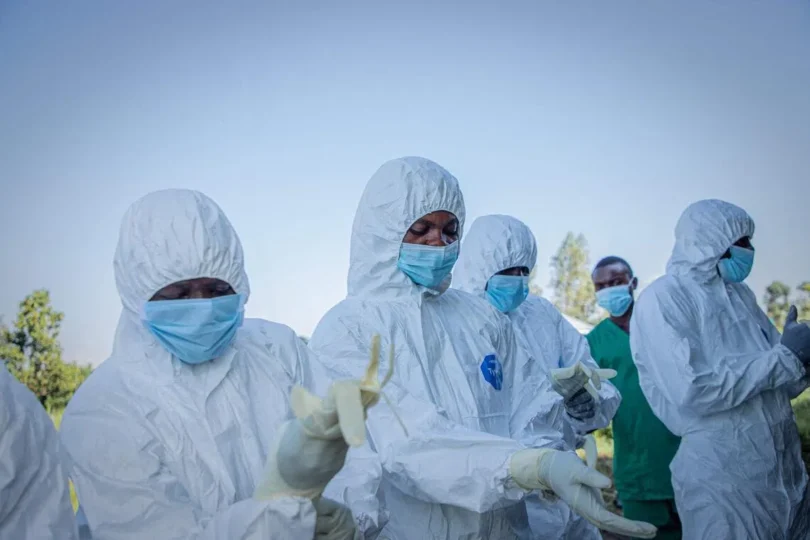
Ebola treatment centres in eastern Democratic Republic of Congo (DRC) are becoming overwhelmed as confirmed cases surge past 800 and health workers struggle to track transmission chains, aid groups warned ahead of an emergency summit of African leaders.
A month after the outbreak was declared, surveillance, testing and contact tracing are struggling to keep pace with transmission in eastern DRC, where conflict and displacement have left almost 1 million people uprooted, health officials and aid groups said.
DRC’s National Institute of Public Health reported 808 confirmed cases and 192 deaths on June 15, while Uganda has confirmed 19 infections. Ituri province, where the outbreak first emerged, accounts for more than 90 per cent of cases in DRC.
“No one knows the true scale or exactly where the disease is spreading in DRC,” said Kate White, national emergency medical coordinator with international medical aid group Medecins Sans Frontieres, in a statement on June 15. “Most treatment centres in Ituri province are overwhelmed.”
Many patients arrive at a late stage of the disease, and most were never identified or monitored as contacts before seeking care, White said.
Concern over this has reached the highest political levels in Africa. Burundi President Evariste Ndayishimiye, who chairs the African Union, will host a virtual summit on June 16 to rally support for a US$518 million (S$663 million) response plan and coordinate efforts to prevent wider regional spread.
It will be attended by Congo President Felix Tshisekedi, Uganda President Yoweri Museveni, United Nations Secretary-General Antonio Guterres and World Health Organization (WHO) Director-General Tedros Adhanom Ghebreyesus.
The outbreak, already the third largest Ebola epidemic on record and the biggest caused by the Bundibugyo strain, has spread across eastern Congo and into neighbouring Uganda. The two countries have already agreed to deploy a mobile laboratory and clinic near their border.
Ebola is spreading in DRC through communities where only one in five people have access to clean water, Oxfam said, warning that the true scale of the outbreak may be far larger than official figures suggest.
In Mongbwalu, a mining town of almost 140,000 people that is considered the outbreak’s point of origin, only a quarter of residents have access to adequate sanitation infrastructure, Oxfam said.
Contact tracing remains one of the biggest challenges. Congo’s health ministry reported that barely 63 per cent of identified contacts were being monitored as of June 14, well below the target of 95 per cent.
Tracing rates remain far below those achieved during the 2018-2020 Ebola outbreak in eastern DRC, Oxfam said, warning that gaps in surveillance are allowing infections to spread undetected through communities.
“We actually don’t know the geographic extent,” Maria Van Kerkhove, WHO’s acting director for epidemic and pandemic preparedness and prevention, said. “If we can understand where cases actually are, then I think we can get a better handle on how many generations it will take to stop.”
With only 0.2 doctors per 1,000 people and more than 70 health facilities destroyed by conflict, Congo’s health authorities are struggling to identify infections quickly enough to interrupt transmission, Oxfam said. In North Kivu province, some deaths are being reported in communities before patients are ever identified as Ebola cases.
The outbreak is occurring in a region affected by armed conflict, population displacement and chronic shortages of health services. About 980,000 people were displaced in Ituri before the outbreak began, according to the UN Office for the Coordination of Humanitarian Affairs.
“We have some areas that are not controlled by the government so there’s a lot we cannot control and these communities need a lot more than just support for Ebola,” Van Kerkhove said. “It will be a lot of time before this is brought under control, but it will be.” BLOOMBERG