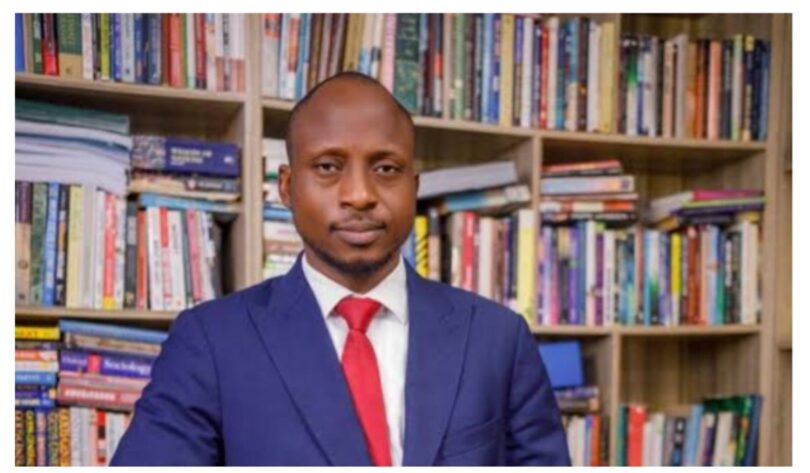
Dr. Paul Alaje, chief economist at SPM Professionals, has weighed in on the country’s borrowing patterns without the government considering the economic implications this will have in the future, news.ng reports.
Alaje, in an interview on Arise Television on Monday morning, bluntly noted that borrowing is neither good nor bad, but added that certain parameters must be considered before requesting loans from international financial institutions.
According to the economist, it is recommended that borrowing should not exceed one-third of the country’s revenue, which will be used to repay the debt.
Assessing the last administration of late Muhammadu Buhari, Alaje claimed that about 97% of the country’s revenue was used to service debt—a financial move that, according to him, should have become a concern for the government.
He said, “Borrowing itself is neither good nor bad. When we discuss borrowing, there are parameters, objectively, economists look at. The least of these parameters is your debt to GDP, because they are both stocks; they are not flow variables.
“So, if they are stock variables, it is really very important to look beyond those and look at what is flow. And when we discuss what is flow, we now talk about debt service versus revenue, because it is money earned that we use to service it. So, for countries, the recommendation globally and professionally is 33.3%, that is, not more than one-third of a country’s revenue should be used to service debt.
“In the previous administration, Nigeria went as high as 97% of all revenue to service debt. We say that borrowing was not a concern at all. As of that time, the answer would be no.
“Borrowing definitely was a concern, because we spend 97% of all revenue. Not to pay National Assembly vehicles that many have complained about, not to build schools, not to build bridges, just to service debt. So, the question is, how do we live in that particular area? And this is not my quote.
“You can check it online. It was the immediate past Minister of Finance that said it at the floor of National Assembly, and also granted interviews with journalists that mentioned over 90% and maybe actually about 97% were used to service debt. In the current dispensation, that has been brought down moderately.
“However, it is still above 60%. So, should we say that it’s absolutely not a concern? I’ll tell you that based on that condition. But the last condition that you look at for borrowing, whether it’s a concern or not, or before we get to what alternative we have, is that we need to check the impact of debt on the economy.”
On the flip side, Dr Alaje suggested that borrowing can be used to fund infrastructure that can be monetised to generate additional revenue for the country.
He said: “Is this debt impacting us positively? If we use debt generically now, and professionally speaking, to build infrastructure, to build hospitals, to improve human capital development, then those are good borrowings. Because all of those things you do will be used to repay back. Human capital will generate more revenue.
“Government collects the revenue as part of taxes to pay back debt. Again, even infrastructure, such infrastructure to be monetised, the monetization of the infrastructure, the revenue that comes will be used to pay back debt. In the case of Nigeria, it’s really not clear.”
He advised that borrowing should not be used for consumption — a move he said is a waste of money.
Assessing how the country’s Gross Domestic Product (GDP) has grown over the years without impacting the lives of the people and its debt profile, this, according to the economist, is where the problem lies — borrowing without objective.
He added: “And I say this with all sense of decency. Because when National Assembly announces amount, we want to borrow, it’s not all the time that those financial announcements are tied to something in particular. For some of the time, yes.
“But in some cases, not exactly so. So, if you are borrowing, no borrowing should go into consumption. It is a waste of money.
“In fact, it brings the country on its knees. Such borrowing, we call it survivor borrowing. Productive borrowing, which is encouraged by professional economists around the world, should go purely into capital expenditure.
“So, when you look at how our GDP has grown over the years, I can say in the last 20 years, compare that to how our debt profile has grown in the last 20 years, then you see a major disparity. And I can confirm to you that this perhaps is the reason why many Nigerians are concerned about borrowing in our country today.”
Watch the clip