
Nigerians are increasingly faced with the pain of rising inflation and cost of living as the Iran-United States-Israel war takes ripple effects on Africa’s most populous country.
DAILY POST reports that this is despite President Bola Ahmed Tinubu administration’s reforms.
The latest inflation data released by the National Bureau of Statistics showed that both headline and food inflation in March rose to 15.38 percent and 14.31 percent recently.
The surge comes amid the over 50 percent and 70 percent increase in fuel and automotive gas oil prices since the Iran-US-Israel war escalation on February 28, 2026.
DAILY POST reports that petrol and diesel rose to between N1,290 and N1,350 per liter from N900, while diesel stood at N1,600 to N1,800 per liter in the last 50 days amid crude oil price volatility.
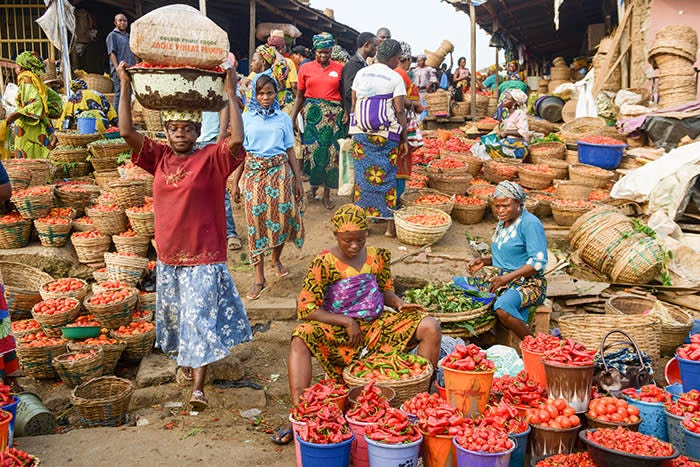
The implication of the above is the significant rise in the cost of transportation nationwide, food prices, and general cost of living in Nigeria.
Although Nigeria is not the only country affected by the global shocks, the country’s situation is dire, with citizens feeling the government is not doing enough.
Nigeria’s situation is more severe due to its import dependency.
It could be recalled that the Federal Government had a rollout import duty review for 127 items, including rice, sugar, vehicles, and numerous others. However, the policy did not roll back inflation’s impact on Nigerians.
The Centre for the Promotion of Private Enterprise, in its policy statement by its Chief Executive Officer, Dr. Muda Yusuf, urged the Federal Government to cut import duty on mass transit buses to 5 percent and grant a Value Added Tax waiver.
The International Monetary Fund, relying on economic realities in Nigeria, reversed the country’s Gross Domestic Product growth rate to 4.1 percent, citing increased pressures due to global economic shocks.
In his words at the World Bank/IMF Spring Meeting in the United States, the director of the African Department at the IMF, Abebe Selassie, said, “The immediate effect will be quite a bit of pressure, including on food security, either through the limited availability of fertilizer, expensive fertilizer, or even more immediately, as transportation costs have gone up, it’s going to raise the cost of food and so quite a bit of dislocation.”
Selassie’s statement validates the realities for the majority of Nigerians grappling with the high cost of living.
While NBS inflation data reflects a slight rise, the former president of the Chartered Institute of Bankers of Nigeria, CIBN, Okechukwu Unegbu, had argued that it does not reflect conditions in local markets.
Meanwhile, Minister of Finance, Wale Edun explained that Nigeria’s inflation is triggered by the Iran-United States-Israel war despite Nigeria’s crude oil blend, Bonny Light, exceeding $110–$120 per barrel.
In exclusive separate interviews with DAILY POST, a professor of accounting and finance at Lead City University, Godwin Oyedokun, and the CEO of SD & D Capital Management, Gbolade Idakolo, gave a comprehensive review of Nigerians’ dilemma.
Tinubu’s reforms appear disconnected from everyday experience of Nigerians – Prof Oyedokun
Oyedokun, while speaking, described Nigeria’s latest inflation figures as a worrisome development that reflects mounting pressure on households already battling weak purchasing power.
He said, “Nigeria’s recent inflation figures present a sobering reality that cannot be ignored or oversimplified.”
“The latest data released by the National Bureau of Statistics, showing a rise in headline inflation to 15.38 percent and food inflation to 14.31 percent, signals a renewed upward pressure on prices at a time when many Nigerians had hoped for sustained moderation.”
Highlighting the severity of the situation, he added, “More troubling is not just the increase itself, but the speed at which essential costs, particularly food and transportation, are rising, placing additional strain on households already grappling with fragile purchasing power.”
Oyedokun acknowledged the Federal Government’s explanation linking inflation to global tensions, stating, “The Federal Government, through the Honorable Minister of Finance, has attributed this resurgence largely to external shocks, particularly the geopolitical tensions involving Iran, the United States, and Israel. There is merit in this position.”
He explained further: “As a largely import-dependent economy with significant exposure to global energy markets, Nigeria is inevitably vulnerable to fluctuations in crude oil prices and international supply chain disruptions.
“Increases in global oil prices often translate directly into higher domestic fuel costs, which then cascade into transportation, production, and ultimately food prices.”
However, he stressed that domestic factors are also at play:
“While external factors provide part of the explanation, they do not tell the full story. The current inflationary trend must also be understood within the context of ongoing domestic economic reforms.”
On policy changes, Oyedokun said, “The removal of fuel subsidies and the liberalization of the foreign exchange market were necessary steps toward fiscal sustainability and economic efficiency.
“Yet, these policies have had immediate inflationary consequences, significantly increasing the cost of energy and weakening the naira, thereby raising the price of imported goods and inputs.”
He described the situation as follows: “What emerges, therefore, is a classic case of cost-push inflation, driven by a combination of global pressures and domestic policy adjustments.”
Raising concerns about implementation, he noted: “The challenge is not whether these reforms are justified—they largely are—but whether they have been adequately sequenced and supported with sufficient social protection measures.”
Oyedokun warned of the burden on citizens, saying: “At present, the evidence suggests that the burden of adjustment is falling disproportionately on ordinary Nigerians, with limited cushioning to mitigate the short-term hardships.”
He also referenced the stance of global financial institutions:
“International institutions such as the IMF and the World Bank have broadly endorsed Nigeria’s reform trajectory, recognizing its potential to restore macroeconomic stability and improve investor confidence.
“Yet, they have also cautioned that these gains are unlikely to translate into immediate improvements in living standards.
“Economic stability at the macro level does not automatically equate to welfare gains at the household level, especially in an environment of rising inflation and stagnant incomes.”
Describing the reality on the ground, Oyedokun said, “For many Nigerians, the reality is stark. Transportation costs have surged, food prices remain elevated, and real incomes continue to erode.”
He added: “The informal sector, which constitutes a significant portion of the economy, is particularly vulnerable, with limited capacity to absorb rising costs.”
The professor concluded with a note of concern: “In this context, the narrative of reform success risks appearing disconnected from everyday experience”, he told DAILY POST.
Reforms only can address hardship in Nigeria – Idakolo
Idakolo, on his part, attributed Nigeria’s latest inflation spike to escalating global tensions and rising logistics costs, warning that more Nigerians are being pushed into poverty.
Speaking in an interview with DAILY POST, he said the increase in headline and food inflation rates to 15.38 percent and 14.31 percent, respectively, is largely driven by external and domestic cost pressures.
“The headline and food inflation surge to 15.38 percent and 14.31 percent can be attributed to the ongoing war between Iran, Israel, and the USA, which has caused an increase in shipping costs and high local logistics costs, as well as transportation costs,” he said.
He explained that the ripple effects of higher shipping and transport costs had worsened the already high cost of living across the country.
“The effect has increased the already high cost of living and has thrown more Nigerians below poverty level,” Idakolo added.
The financial expert stressed that current economic reforms alone were insufficient to cushion the hardship faced by citizens, calling for immediate government intervention.
“These indices have shown that reforms alone cannot ameliorate the hardship Nigerians are currently experiencing, but the federal government needs urgent intervention in areas of transport subsidies and other palliatives that can make an impact before the reforms take root,” he told DAILY POST.