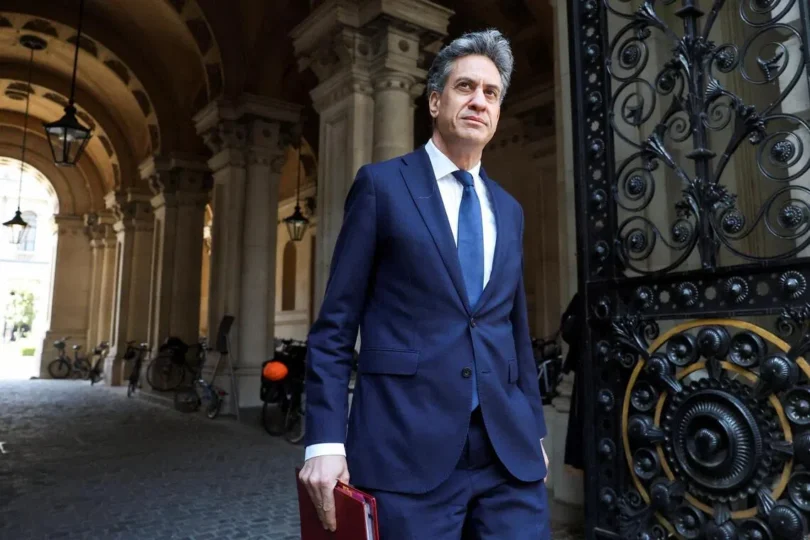
LONDON – More than a decade after failing in his bid to become British prime minister, Energy Secretary Ed Miliband has emerged as a key player in efforts to remove Mr Keir Starmer from the post he once sought.
Mr Miliband’s push to lead Labour to victory in the 2015 general election ended in bitter defeat after a three-year-long lead in the polls fizzled and the electorate delivered then-Conservative Prime Minister David Cameron an unexpected majority.
Eleven years later, he’s at the centre of manoeuvring to install a new leader from the Labour Party’s soft left to replace the badly-damaged Mr Starmer, according to people familiar with the matter.
The energy secretary, 56, believes Greater Manchester Mayor Andy Burnham is the best candidate to replace Mr Starmer, with Mr Miliband potentially slotting into the role of chancellor of the exchequer, replacing Ms Rachel Reeves, according to the people, who requested anonymity discussing internal party machinations.
The prospect of Mr Burnham securing a parliamentary seat that makes him eligible for any leadership contest moved closer on May 14 when a Manchester-area MP quit in order to trigger a by-election, which the mayor indicated he would seek to run in.
However that process will take weeks.
In the event of a leadership contest in shorter order, Mr Miliband could be the soft left’s candidate, the people said.
A spokesman for Mr Miliband declined to comment.
The manoeuvring raises the prospect that a man roundly rejected by British voters in 2015 could become prime minister without facing the electorate.
In the years since that bruising election campaign, Mr Miliband repaired his brand to become an elder statesman – and one of the few ministers with prior Cabinet experience – in the Labour administration that swept to a landslide majority in 2024 after 14 years in the political wilderness for the party.
As energy secretary, Mr Miliband has enacted policies popular with the Labour left to further Britain’s net zero ambitions.
He has been a strong advocate of renewable energy and other efforts to combat climate change, often seeking to go further than the wider government’s position.
His department secured at least three Bills in May 13’s King’s Speech to strengthen Britain’s push into home-grown renewables, buttress the nuclear industry and change the operation of the electricity market.
As a result, the former leader of the opposition has seen his star rise during his second period as energy secretary, after serving in the same role for 18 months through to May 2010 during Mr Gordon Brown’s premiership.
As recently as in April, the LabourList website published Cabinet rankings based on a survey of Labour members that gave him the highest favourability rating, at plus 65.
By Mr Miliband’s own confession, defeat in 2015 “shattered” his confidence.
He responded by growing a (short-lived) beard and also started a podcast called Reasons to be Cheerful, in which he and co-host Geoff Lloyd, a radio presenter, ruminated over major global issues.
That allowed him to embrace his geekiness and make a virtue of it, and he became something of a cult figure within Labour – also hosting a standing-room-only quiz night on the fringes of the party’s annual conference.
Nevertheless, in an interview with the BBC in 2021, he remarked that he was still “recovering” from his tenure as leader.
Mr Miliband’s run for office was characterised by a public perception of him as an awkward figure who was unable to perform every day tasks normally.
A photo of him eating a bacon sandwich with a contorted expression on his face even has its own Wikipedia page.
Satirists compared him unfavourably to Wallace – the likable but clueless and hair-brained inventor from the Oscar-winning Wallace and Gromit animations.
And he was much mocked for commissioning a large tablet engraved with Labour’s six election pledges.
It was promptly dubbed the EdStone, and also earned its own Wikipedia page.
In later years, he was asked his biggest regret on the the How to Fail podcast, replying that he wished he’d been “bolder and more ambitious as Labour leader.”
He’s since written the book Go Big.
“The future for Labour, the best future is to go big: that’s the argument of the book,” he told a Channel 4 podcast. “And it’s the lesson I’ve learned from my time as leader.”
Mr Miliband is the son of Mr Ralph Miliband, a Marxist intellectual who fled Belgium for Britain to escape the Nazis in 1940, and Ms Marion Kozak, a human rights campaigner and Polish Jew who survived the holocaust after being sheltered by Catholics.
Mr Ed Milliband studied at Oxford University and then the London School of Economics, before becoming a TV journalist.
He worked for Mr Brown at the Treasury from 1997 to 2002 before going on a sabbatical to the US to teach economics at Harvard.
He entered Parliament in 2005, after being elected in Doncaster North, a seat he still represents.
He joined the Cabinet in 2007, became energy secretary the following year and drafted Labour’s manifesto for the 2010 election.
His attacks on Mr Tony Blair’s policies, including the Iraq War, helped him win the backing of six labour unions and led the Daily Mail newspaper to dub him “Red Ed.”
Mr Miliband’s harder edge was on display in the wake of Labour’s loss in the 2010 vote, when he famously defeated his older brother, David, in the ensuing Labour leadership contest that was widely seen as the elder sibling’s battle to lose.
Three years later, he said the relationship was still “healing,” telling BBC radio: “It has been incredibly tough; really, really tough. I didn’t take this decision lightly. I knew it would have an impact on my family and on him.”
That fraternal fight was weaponised by the Tories, who during the 2015 election campaign repeatedly accused Mr Ed Miliband of stabbing his brother in the back.
That ruthless side may be coming to the fore once again as leadership contenders circle a prime minister in Mr Starmer wounded by months of missteps, damaging U-turns and last week’s catastrophic local election results in which Labour lost control of the Welsh Senedd for the first time, and shed three in every five seats they were defending in English councils.
In his speech to Labour’s annual conference in October, Mr Miliband ranged far beyond his energy brief, criticising growing American political influence and taking a swipe at Mr Elon Musk, telling the billionaire to “get the hell out of our politics.”
He’s nevertheless on multiple occasions said he’s not interested in the leadership again.
“I’ve had the, if you like, the inoculation technique against wanting to be Leader of the Labour Party because I was the Leader of the Labour Party, and that was a very successful inoculation,” Mr Miliband told BBC radio in November. BLOOMBERG