
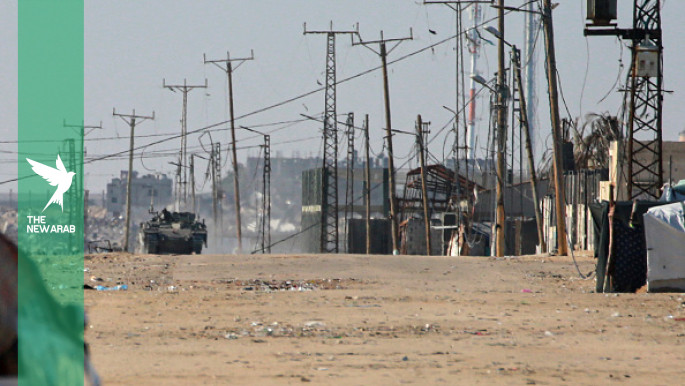
Israel has been building fortifications in and around Rafah, a clear violation of Camp David [Getty]
The decades-old Camp David peace treaty between Egypt and Israel is facing renewed scrutiny after reports of Israeli military fortifications near the Egyptian border prompted Egyptian officials and analysts to question whether Israel is unilaterally altering the agreement’s security framework.
The debate was triggered by reports based on satellite imagery and field monitoring that alleged Israel had established new military positions and fortifications in Rafah close to the Egyptian border, potentially violating restrictions contained in the treaty’s military annexes.
While concerns over alleged treaty violations are not new, Egyptian commentators are increasingly framing the issue around a different question- whether Israel is changing the security reality along the border without the mutual consent that has underpinned the agreement for decades.
The issue is particularly sensitive because Egypt itself expanded its military presence in Sinai during the insurgency by the Islamic State group.
However, those deployments were carried out through coordination mechanisms established under the treaty and with Israeli approval.
Major General Samir Farag, former director of morale affairs for the Egyptian armed forces, told Al Jazeera that the area in question falls within what is known as “Zone D” under the treaty.
“The area referred to is called Zone D in the agreement signed between Egypt and Israel, and the agreement does not permit the presence of any heavy military equipment or the establishment of any military sites,” Farag told the outlet.
Farag said Egypt has mechanisms in place to address alleged violations, explaining that Cairo can submit complaints to the US, which oversees implementation of the treaty and can convene joint investigations into disputes.
He also told Al Jazeera that Egypt had previously lodged a complaint after Israeli tanks were positioned on the Palestinian side of the Rafah crossing during Israel’s military operations in the area.
The controversy comes amid continuing tensions surrounding Israel’s control of the Philadelphi Corridor, known in Arabic as the Salah al-Din Axis, a narrow strip running along the Gaza-Egypt border that Israel has occupied during the war on Gaza, making it a key point of friction between Cairo and Tel Aviv during the Gaza war.
Egyptian analysts have argued that recent tensions should be viewed within the broader deterioration in Egyptian-Israeli relations since the Gaza war, relating not just to the situation around the Philadelphi Corridor, but also to Cairo’s opposition to proposals to displace Palestinians from Gaza.
Despite the tensions, Egyptian officials insist there is no intention to abandon the treaty.
The dispute once again highlights broader questions about the future of the Camp David framework nearly five decades after it was signed.
While the agreement has repeatedly adapted to changing security realities, including Egypt’s counterinsurgency campaign in Sinai, Egyptian analysts are increasingly questioning whether future changes will continue to be governed by mutual consent or by unilateral Israeli actions taken during the war on Gaza.