
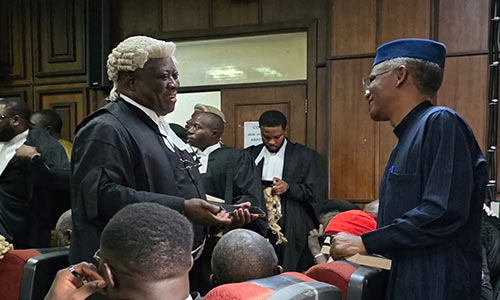
The Department of State Services has closed its case against former Kaduna State Governor, Nasir Ahmad El-Rufai, in the ongoing trial over allegations of unlawful interception of communications involving the National Security Adviser, Nuhu Ribadu.
The development came on Tuesday before Justice Joyce Abdulmalik of the Federal High Court, Abuja, who also dismissed an application filed by El-Rufai’s legal team seeking a variation of the bail conditions earlier imposed on him.
El-Rufai is standing trial on charges linked to comments he allegedly made during a television interview concerning the alleged interception of telephone communications involving Ribadu. He has denied the allegations and pleaded not guilty to all counts.
At the resumed hearing, El-Rufai’s counsel, Paul Erokoro, SAN, urged the court to relax some of the bail conditions, describing them as harsh, stringent and difficult to meet.
Erokoro particularly challenged the requirement that the sureties must be Level 17 civil servants with verifiable properties in Maitama or Asokoro, Abuja, as well as the requirement for verification and attestation letters from the Kaduna State Traditional Council.
He argued that the conditions were excessive and urged the court to review them in the interest of justice.
However, counsel to the DSS, Oluwole Aladedoye, SAN, opposed the application, insisting that qualified public officers capable of meeting the conditions exist.
Aladedoye urged the court to dismiss the application, arguing that the defence had not placed sufficient materials before the court to justify a variation of the earlier bail order.
Delivering her ruling, Justice Abdulmalik refused to vary the bail conditions, holding that suitably qualified civil servants who own properties in the specified Abuja districts exist.
The judge held that there was no sufficient basis to alter the bail terms earlier imposed by the court.
Following the ruling on the bail variation application, Aladedoye informed the court that the prosecution had concluded its case and would not be calling additional witnesses.
“The prosecution closes its case,” Aladedoye told the court.
The announcement marked the end of the DSS’s evidence in the high-profile trial.
Reacting to the closure of the prosecution’s case, Erokoro informed the court that the defence would file a no-case submission.
He maintained that the evidence presented by the DSS was insufficient to sustain the charges against El-Rufai and urged the court to discharge the former governor without requiring him to enter a defence.
The defence requested two weeks to file the no-case submission, while the prosecution also sought a similar period to respond.
Justice Abdulmalik granted both parties time to file and exchange the necessary processes.
The court subsequently adjourned the matter until September 22, 2026, for hearing of the no-case submission and continuation of proceedings.
Recall that the case originated from charges filed by the DSS against El-Rufai in February 2026 following comments he allegedly made during a television interview concerning alleged interception of communications involving Ribadu.
The matter was initially brought as a three-count charge before it was later expanded to five counts when the former governor was arraigned.
El-Rufai pleaded not guilty to all the charges.
The charges border on alleged violations of provisions of the Cybercrimes (Prohibition, Prevention, etc.) Act and the Nigerian Communications Act relating to unlawful interception of communications and matters touching on national security.