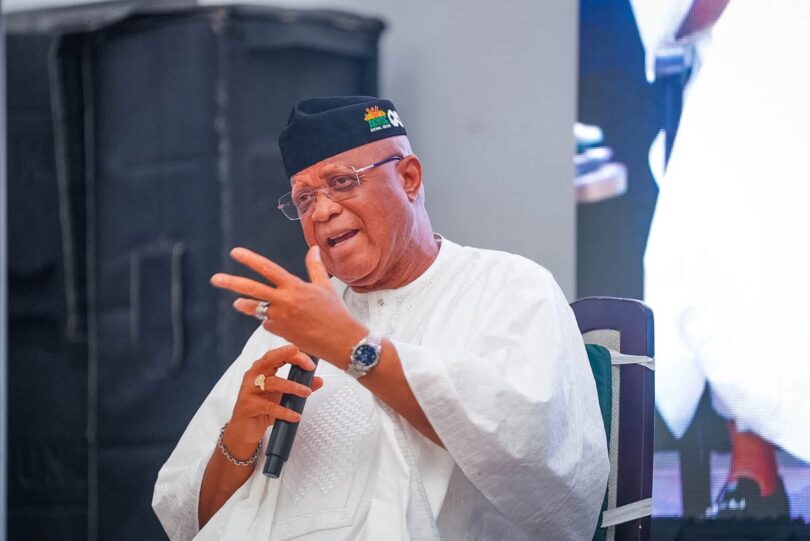
Akwa Ibom residents are questioning Governor Umo Eno’s performance as criticism intensifies over how the state has deployed N2.934 trillion, amid growing demands for more projects, jobs and opportunities.
The outcome of the Osun State governorship election has triggered a fresh debate in Akwa Ibom State over Governor Umo Eno’s performance, with some residents and commentators questioning whether the administration has done enough with the huge resources that have accrued to the state since he assumed office.
Mr Adeleke secured 511,067 votes against 444,815 scored by his closest challenger, the All Progressives Congress (APC) candidate, Bola Oyebamiji.
Although the Osun election was not a referendum on Akwa Ibom, its timing, which is less than a year before the 2027 general elections, appears to have provided a fresh political lens through which some Akwa Ibom residents are assessing their own government.
The election was closely watched nationally as the last major off-cycle governorship contest before 2027 and as a possible indicator of voter sentiment, political alliances and the strength of incumbent administrations.
For some Akwa Ibom commentators, Mr Adeleke’s victory has prompted the question: how much does visible performance matter to an incumbent governor seeking to retain political support, especially when voters can point to what they consider tangible results?
That question has now been directed at Mr Eno, whose administration has received at least N2.934 trillion in public resources between May 2023 and June 2026, according to PREMIUM TIMES analysis of the state’s financial records.
The question moves beyond the claim that the Eno administration has done nothing. PREMIUM TIMES has independently verified several projects completed or commissioned by the government, including roads, healthcare facilities, model schools, shelter for the less privileged and other interventions.
Rather, the central criticism is whether the scale, pace and quality of those projects match the resources available to the government, and whether citizens have sufficient information to determine what individual projects cost and how contracts were awarded.
Within hours of Mr Adeleke’s victory, social media discussions in Akwa Ibom began shifting from the Osun result to the performance of the Eno administration.
A professor of communication at the University of Uyo, Herbert Batta, wrote on Facebook on Sunday that the Osun result offered a lesson for Akwa Ibom.
“Who says dancing does not pay? This man has danced his way back to power!” Mr Batta wrote, before questioning the extent to which Akwa Ibom had benefited from its “alignment” with the APC, the ruling party at the centre.
The Peoples Democratic Party was the ruling party in Akwa Ibom for 26 years, from the return of democratic governance in 1999, until Governor Eno defected to the APC on 6 June 2025.
Mr Batta listed several federal projects in Akwa Ibom, which he said remained stalled or progressed slowly, including sections of the East-West Road, the proposed Ibom Deep Seaport, the Aluminium Smelting Company of Nigeria at Ikot Abasi, and the Nigeria Maritime University in Oron, the Aba-Ikot Ekpene Road, the Calabar-Itu Road and the Uyo-Port Harcourt Road.
He then turned the argument towards the Eno administration.
“All Governor Umo Eno needed and still needs to do is to stupefy the people of Akwa Ibom with programmes, projects, and products in the 10 federal constituencies and three senatorial districts to the extent that the people have no choice but to vote massively for him and his party,” he wrote.
“But with what we see on the ground: the dead slow pace of contract/project delivery, the LGA-grade bungalow projects, the abandonment or non-funding of signature projects four years down the road; it appears the state simply wants to take undue advantage of federal might and return itself to power.”
The professor’s argument is that political loyalty alone may not be enough if voters believe government performance is inadequate.
The reactions in the Facebook comment section showed that the argument resonated with many residents.
A journalist, Emem Nkereuwem, wrote: “Prof, our people have been stripped of their tongues. Our hearts are heavy and bleeding within. Our frail humanity is slowly becoming the norm.”
Another commenter, Chris Essang, said the Eno administration was “very busy doing nothing”, while Courage Nda questioned why local government areas receiving substantial allocations could not adequately grade rural roads.
“The governor has to sit up. It is going to be hot. Mark my words,” Edemson Anwana wrote.
Eyo Udoh said Mr Eno was “very slow in some critical sectors, especially education.”
The argument critics are making moves beyond whether Akwa Ibom and Osun have identical political or economic circumstances.
Rather, the Osun election has provided a fresh example of an incumbent governor securing another term at a time when voters’ assessment of performance is becoming increasingly important in Nigeria.
Mr Adeleke’s Accord Party has insignificant political strength nationwide compared with the APC, which controls the government at the centre and 31 of Nigeria’s 36 states. Yet, the governor defeated the APC candidate by more than 66,000 votes.
For Akwa Ibom critics, that outcome has sharpened the argument that an incumbent cannot rely indefinitely on party structure, political alliances or the weakness of opposition without demonstrating visible improvements in citizens’ lives.
It is this argument that has now been imported into the debate over Mr Eno’s administration.
A separate Facebook post on Sunday by Bobby Bassey, whose profile says he is a tailor, software engineer and social media writer, asked Mr Eno’s supporters to identify “one befitting completed project” executed by the administration.
By 10 a.m. on Monday, .. had attracted 147 comments, with most of those commenting expressing dissatisfaction with the utilisation of public resources in Akwa Ibom.