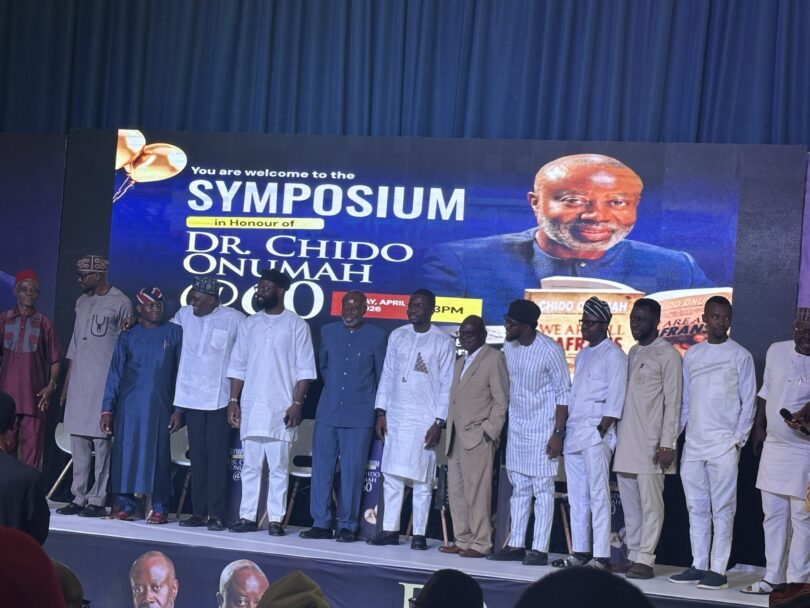
The occasion was an evening of tributes attended by academics, politicians, university administrators, technocrats, newspaper editors, associates, friends, family, and mentees of Mr Onumah who clocked 60 on Friday.
Academics, politicians, technocrats, journalists, and civil society leaders gathered in Abuja on Friday evening to honour veteran journalist, author and rights activist Chido Onumah, as he turned 60.
The symposium was themed “Formation or Nation Building: Nigeria’s Troubled Quest for a Modern Federal Republic,” and brought together some of the country’s most respected voices in democracy, media, and civil society.
Born in April 1966, Mr Onumah has built a career spanning more than three decades across journalism, rights activism, academia, and social mobilisation — work that has taken him across Nigeria, West Africa, North America, and Europe.
National Security Adviser Nuhu Ribadu, a close associate of Mr Onumah, paid tribute to the activists.
“I am so happy to be here. Chido is special and he means a lot to me. He was part of my life at the most critical moments and went through the most difficult period with me,” Mr Ribadu said.
“I had to come and identify with him. Chido was with me at the EFCC, at Oxford, and later at Maryland. He is very dear to me.”
Earlier, Former Ekiti State Governor Kayode Fayemi, in his goodwill message, said Nigeria’s project of nationhood remains work in progress.
“Nation building is unfinished business. We have to keep working to ensure the Nigerian project is achievable,” he said.
“We need a genuine democracy. Citizens must hold politicians’ feet to the fire and demand that they do the right thing.”
Mr Fayemi also acknowledged Mr Onumah’s consistent contributions to Nigeria’s democratic struggles, dating back to the years of military rule.
In his keynote address, Yakubu Ochefu, a professor, challenged the country to look beyond the well-worn explanations for its failures.
“For decades, the discourse surrounding Nigeria’s challenges has remained trapped in familiar diagnoses — corruption, poor leadership, and the so-called oil curse. While these explanations capture some symptoms, they fail to probe the underlying maladies,” he said.
“A new wave of scholarship is reframing the conversation, bringing structural, systemic, and psychological perspectives to the fore. This shift is essential if we are to understand not just what ails Nigeria, but why previous remedies have consistently missed the mark.”
Mr Ochefu urged Nigerians to move beyond diagnosing symptoms and begin envisioning cures that address the root causes of the nation’s enduring crisis.
On the Nigeria youth question and the digital republic, the speaker argued that every significant democratic breakthrough in Nigeria’s history had been driven by young people — from the 1930s West African Students’ protests against colonialism in London, the 1961 Anti-Anglo-Nigerian Defence Pact protests, the 1978 “Ali Must Go” demonstrations, the 1989 Anti-SAP riots, and the pro-democracy struggles of the 1990s through NADECO, the June 12 agitations, and the 2020 EndSARS movement.
“Time and again, when parliament failed, the streets became the true legislature,” the speaker said.
Yet, the speaker noted a generational disconnect between baby boomers forged in street battles, and today’s Gen Z, described as the “Homo Digitalis”: a generation born into a digital world, carrying the legacy of three generations and operating at speeds that leave traditional institutions behind.
“Their strengths are transformative — digital nativism that pushes for transparency and global awareness, network effects that turn a single tweet into a movement more powerful than any media campaign, and a data-driven mindset that demands evidence over rhetoric,” the speaker said.
The speaker argued that as Nigeria evolves, its vision of a modern federal republic must account for citizens increasingly disconnected from ancestral origins and more united by shared economic and digital interests. The tension between a 19th-century bureaucratic structure and a 21st-century digital population, the speaker noted, has become one of the defining challenges of the nation-building project.
“While the government clings to Federal Character in physical appointments, a new generation is creating a borderless nation online, with the tech and fintech ecosystem emerging as Nigeria’s most successful export,” the speaker said.
Concluding, the speaker issued a stark warning and a challenge: “Our greatest threat is the absence of a true social contract. The frameworks exist, but what is missing is the political courage to act.”
“Our capitalist ruling class must understand that the raid is over — the forest has been seriously depleted. The only sustainable path forward is to build the estate. If they persist as raiders, what legacy are we leaving our children? But as landowners of a thriving Nigerian estate, we protect our wealth and, for the first time, build a true home.”
The symposium’s panel session was moderated by Farida Salihu and featured former Minister Oby Ezekwesili, Samson Itodo, executive director of YIAGA Africa, and journalist Ebenezar Wikina.
Ms Ezekwesili called for a decisive shift in civic posture. “It is not enough to criticise leaders. We need to move from complaining to demanding action,” she said.
Mr Itodo said Nigeria has drifted remarkably into a “no red line”culture where power, money, and status override values, institutions, and the rule of law.
“In healthy societies, there are clear boundaries that even the most powerful cannot cross. But the Nigerian case reveals a deeper moral fracture. In Nigeria, there is no price for crossing the line because there is no line. This pervasive culture destroys the moral fabric of society and it makes the country operate like a banana republic. Redrawing red lines is therefore the beginning of politics of accountability.”
Mr Wikina observed that Nigeria has been defined by several missions but has consistently lacked a unifying vision for the future. “After the colonialists left, we did not really have a vision of what we wanted to achieve,” he said.
“What we need to do is question our political leaders — tell them what we want. We have tried for too long to develop Nigeria from Abuja. We need a process that moves from the states to the federal level, not the other way around.”
To mark the occasion, Mr Onumah’s associates announced the publication of a book in his honour.