
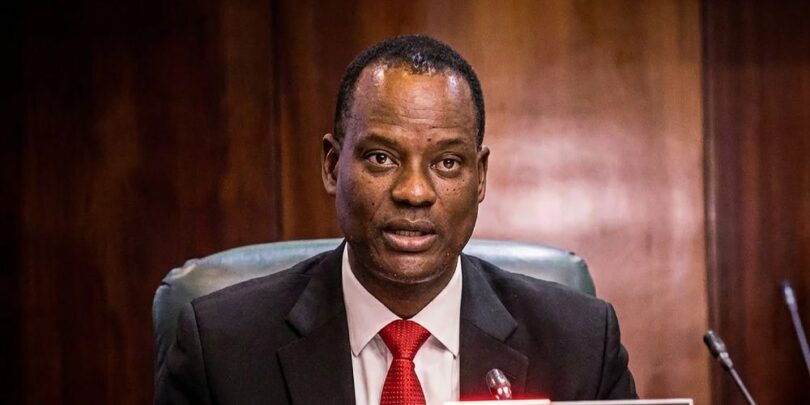
The Minister of Finance and Coordinating Minister of the Economy, Taiwo Oyedele, has cautioned governments against introducing new taxes or increasing existing tax burdens on vulnerable citizens and productive businesses amid current economic pressures.
Oyedele made the remarks on the sidelines of the 2026 annual meetings of the International Monetary Fund (IMF) and the World Bank in Bangkok, Thailand, where he presented the communiqué of the Intergovernmental Group of Twenty-Four (G24).
He said governments needed to balance efforts to generate revenue with measures to shield vulnerable groups and businesses from additional financial strain.
“This is the wrong time to impose new taxes or increase the tax burden, particularly on vulnerable populations and productive sectors of the economy,” the minister said.
Responding to a question on how developing countries could manage rising debt servicing costs without reducing essential public expenditure, Oyedele advised governments to identify areas where spending could be reduced and improve revenue collection without placing further pressure on citizens and businesses.
He said such efforts should begin with a review of public spending and existing revenue sources, while ensuring that additional taxes did not worsen the difficulties facing vulnerable households and productive sectors.
On borrowing, the minister acknowledged that debt financing remained important for economic development but stressed that borrowed funds should generate broad-based economic benefits, particularly through employment creation.
“Borrowing and debt financing are necessary conditions for growth, and every emerging and developing country must be able to use debt financing in a way that has an overall positive impact, particularly by stimulating job-rich and inclusive growth,” he said.
Oyedele also called for available public funds to be prioritised for critical services, including healthcare and education, while encouraging private capital to support other investment needs.
Explaining the trade offs between taxation and borrowing, he said excessive taxation could leave vulnerable households with less money to meet basic needs such as food, healthcare and education.
“If you collect taxes, you raise the money now, and that itself has a lot of trade-offs. What taxes are you collecting? If you collect taxes from the most vulnerable, you deprive them of money to provide food, healthcare and education,” he said.
He added that borrowing and taxation were interconnected, as debt obligations would eventually have to be met through future revenue.
“Debt is future taxes, so it’s not one or the other. It’s about striking a balance, bearing in mind that, ultimately, the purpose of taxation and borrowing is to cater for the people,” Oyedele said.
The IMF and World Bank annual meetings are holding from October 12 to October 18, 2026, in Bangkok, Thailand, with delegations from more than 190 countries participating.
Nigeria’s delegation includes chief executives of financial institutions, private sector representatives, civil society organisations, non governmental organisations and other stakeholders.
The meetings provide a platform for discussions on global economic and financial stability, economic policy coordination and financial assistance for countries experiencing balance of payments difficulties.