
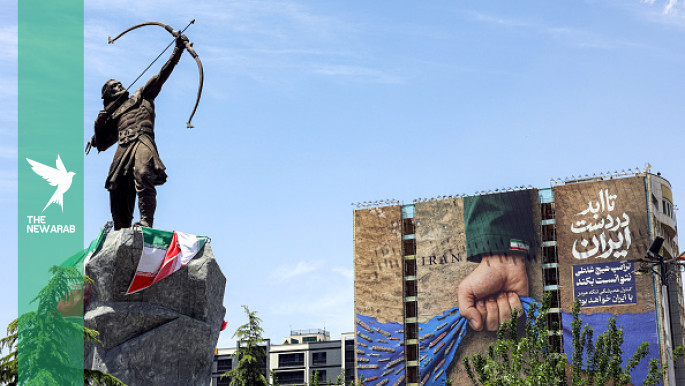
A billboard in Tehran declaring the Strait of Hormuz “Forever in Iran’s Hand” amid renewed hopes for US-Iran talks [Getty]
Negotiations between Tehran and Washington mediated by Pakistan have made progress but “have not yet reached a level that could produce an agreement”, Iranian sources familiar with the talks told The New Arab on Wednesday, dismissing recent US media reports about the contents of a possible deal as inaccurate.
The sources stressed that reports in US media about the details of negotiations and elements of a proposed agreement “do not reflect the reality of what is happening”.
They added that the talks still faced “an intransigent American approach and excessive demands”, accusing US media of presenting “American demands and wishes as though they were agreed provisions”.
According to the sources, the current negotiations are focused primarily on ending the war rather than Iran’s nuclear programme.
The sources also denied reports suggesting there were discussions about transferring Iran’s enriched uranium reserves to the United States, insisting that such an issue was “not on the Iranian agenda”.
Iranian political analyst Mostafa Najafi described the negotiations as being marked by “a high degree of uncertainty, doubts and disagreements”, adding that it was too early to speak of a breakthrough before any agreement was formally signed.
Najafi told TNA that the two sides were exchanging a 14-point draft framework, with Tehran having recently amended the text and sent it back to the American side.
He argued that the recent focus in US media on the prospect of a deal, along with President Donald Trump’s latest statements, suggested Washington had either already submitted or was preparing to submit its own amendments to the Iranian revisions.
According to Najafi, the latest remarks by Trump and the reports circulating on Wednesday appeared aimed at increasing pressure on Tehran to accept the proposed text.
Despite some convergence between the two sides on certain issues, Najafi stressed that no agreement currently existed and that major disagreements remained unresolved.
The comments came after Axios reported on Wednesday, citing US officials and informed sources, that the White House believed it was nearing a one-page memorandum of understanding with Iran aimed at ending the war and establishing a framework for more detailed negotiations over Tehran’s nuclear programme.
According to the report, the US expected an Iranian response on several key points within the next 48 hours.
Axios reported that Trump’s envoys Steve Witkoff and Jared Kushner had been negotiating directly and indirectly with Iranian officials over the proposed 14-point memorandum.
Under the reported framework, the war would formally end, and a 30-day negotiation period would begin, potentially in Geneva or Islamabad, to reach a broader agreement covering the reopening of the Strait of Hormuz, limits on Iran’s nuclear activities, and the lifting of US sanctions.
While Axios noted that no agreement had yet been reached, it reported that the two sides were closer than at any point since the war began on 28 February.
One of the key unresolved issues remains the duration of a suspension of uranium enrichment. According to Axios, Iran initially proposed a five-year pause, while the US demanded a 20-year suspension.
Three sources cited by the outlet indicated current discussions centred on a suspension lasting at least 12 years, while another source suggested it could extend to 15 years.
The report also noted that Washington wanted the memorandum to include a clause extending the suspension period in the event of any Iranian violation.
After the suspension period ends, Iran would reportedly be permitted to resume low-level uranium enrichment up to 3.67%.
Under the proposed memorandum, Iran would also commit not to pursue nuclear weapons or engage in weaponisation-related activities, while discussions continue over a provision barring Tehran from operating underground nuclear facilities.
The framework would additionally require Iran to accept an intensive inspection regime, including surprise inspections by UN inspectors.
In return, the United States would gradually lift sanctions on Iran and release billions of dollars in frozen Iranian assets.
Despite the reported progress, some US officials remain sceptical about the prospects of even reaching a preliminary agreement, according to Axios.
The report added that Trump’s decision to halt the recently announced “Project Freedom” naval operation in the Strait of Hormuz and avoid the collapse of the fragile ceasefire was linked to progress made in the negotiations.