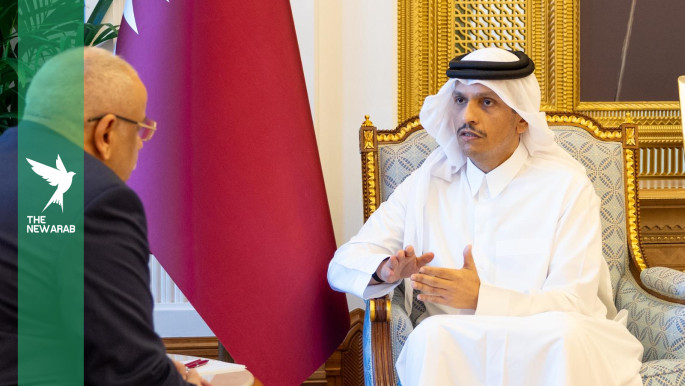
In an exclusive interview with Al-Araby Al-Jadeed, Qatari Prime Minister Sheikh Mohammed bin Abdulrahman Al Thani pointed to “positive progress” in US-Iran communication. [Getty]
Qatari Prime Minister and Foreign Minister Sheikh Mohammed bin Abdulrahman Al Thani has pointed to a high possibility of a diplomatic solution between Washington and Tehran despite continuing tensions and publicly divergent positions between the two sides.
In excerpts from an exclusive interview with The New Arab‘s Arabic language sister publication, Al-Araby Al-Jadeed, Sheikh Mohammed highlighted “positive progress” in the exchange of messages between the United States and Iran, while stressing that any agreement must safeguard the interests of Gulf countries and the wider international community.
“We are monitoring developments and communicating with all parties, and despite the divergence in positions in both Tehran and Washington, we see a high possibility of reaching a diplomatic solution,” he said. “We are encouraged by the positive progress taking place in the exchange of messages between Washington and Tehran, and there are indicators of this.”
The Qatari premier added that Doha remained in contact with Pakistani mediators to help bridge gaps between the two sides.
His remarks came as US President Donald Trump warned Iran it would face renewed and more intense bombing if no agreement was reached, amid reports that Washington and Tehran were nearing a framework understanding aimed at ending the conflict.
Coexistence with Iran amid tensions
Sheikh Mohammed stressed that any future US-Iran agreement should safeguard regional security and address the economic fallout from the continuing crisis in the Strait of Hormuz.
“Any US-Iran agreement must take into account the interests of the countries of the region, and the entire world, which has been directly harmed by the closure of the Strait of Hormuz,” he said.
He also renewed Qatar’s rejection of using the strategic waterway as leverage in any conflict.
“The whole world is paying the price for the closure of the Strait of Hormuz,” Sheikh Mohammed said. “We reject its use as a pressure card in any conflict, whether political or military. Freedom of navigation is a fixed principle of international law. It is non-negotiable.”
The Qatari prime minister stressed that Doha had continued to prioritise diplomacy and de-escalation despite recent Iranian attacks on Qatari territory and infrastructure.
“When the unjustified attacks against us took place, as a sovereign state that was not a party to the war, we declared our clear condemnation and our right to self-defence in accordance with international law,” he said. “Our sovereignty is a red line that will never be compromised.”
At the same time, Sheikh Mohammed stressed the need for coexistence with Iran based on mutual respect and regional stability.
“Iran and we are neighbouring states connected by one geography and intertwined interests between our peoples,” he said.
“We must find a framework for coexistence based on respect for sovereignty, good neighbourliness, and non-interference in the security of any party. This is the only path to regional stability,” he added.
The Qatari premier also condemned threats against civilian and energy infrastructure in the Gulf following attacks targeting facilities in Ras Laffan and Mesaieed.
“These facilities are not targets,” he said. “They are a source of livelihood for our peoples, the backbone of our economies, and part of global energy security.”
Gulf unity and strategic US alliance
Sheikh Mohammed also pointed to growing momentum for closer Gulf cooperation in response to mounting regional threats.
“Recent developments in the region have confirmed that the security of the Gulf Cooperation Council states is indivisible,” he said. “Confronting shared threats requires genuine Gulf integration that rises to the level of the challenges.”
On Qatar’s relationship with Washington, Sheikh Mohammed dismissed suggestions that Doha could reconsider its military ties with the United States.
“Our strategic relations with the United States are based on a comprehensive partnership, shared interests, and well-established understandings,” he said.
Resilient Qatari economy
Addressing the economic impact of the conflict and disruptions linked to Qatari LNG exports, Sheikh Mohammed said Qatar remained financially resilient despite regional instability.
“Our economy has repeatedly proven capable of absorbing shocks and dealing with them,” he said. “We have clear plans, flexible strategies, and financial reserves sufficient for long periods.”
He added that the coming phase would include measures “enhancing the efficiency of public spending and rationalising it”, alongside policies to support private-sector growth and accelerate economic diversification.
Sheikh Mohammed also reaffirmed Qatar’s support for the ‘Board of Peace’, established by Trump to oversee Gaza’s reconstruction and transitional governance, stressing that Doha had backed “the implementation of its mission as a transitional body”.
To read the full interview with Sheikh Mohammed bin Abdulrahman Al Thani published by The New Arab and Al-Araby Al-Jadeed, click here.