
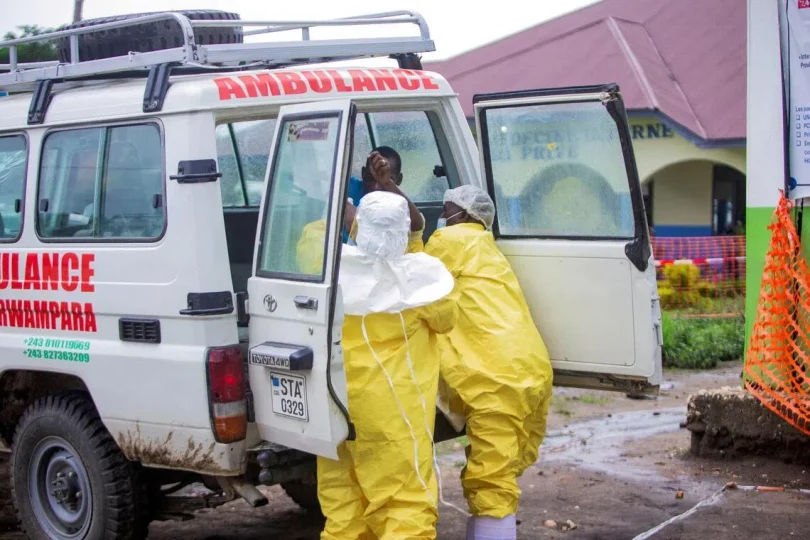
KINSHASA – Patients with the Bundibugyo strain of Ebola have started receiving experimental treatments in a clinical trial that aims to improve care for the rare viral disease, which has killed more than 500 people in Democratic Republic of Congo.
The World Health Organization-sponsored (WHO) trial will test Mapp Biopharmaceutical incorporated’s monoclonal antibody cocktail MBP134 and Gilead Sciences incorporated’s antiviral remdesivir alongside optimised supportive care in Congo’s Ituri province, where the outbreak is concentrated.
Designed as an adaptive platform trial, it can continue across future Ebola outbreaks if the current epidemic ends before enough patients are enrolled to produce definitive results.
The so-called partners trial was established with national authorities and scientific partners in record time and “offers real hope that we can deliver concrete results for – and with – the communities at the heart of the outbreak,” WHO Director-General Tedros Adhanom Ghebreyesus said in a social media post last week.
The platform allows researchers to add or remove treatments as evidence emerges, pause enrollment when outbreaks end and restart during future epidemics – allowing evidence to accumulate across outbreaks caused by different Ebola viruses and the related Marburg virus until definitive answers are reached.
The outbreak has already infected almost 1,600 people in Congo and neighbouring Uganda, making it the largest on record caused by Bundibugyo, for which there are no approved vaccines or specific treatments.
While the daily number of newly confirmed infections has eased in recent days, transmission remains intense in Ituri, where treatment centers have struggled to keep pace with demand.
The trial’s primary endpoint is all-cause mortality 28 days after enrollment. Secondary measures include how quickly patients clear the virus, changes in viral load and organ function, with pregnant women followed through delivery.
Researchers aim to recruit several hundred patients over time. Rather than setting a fixed enrollment target for the current epidemic, the protocol allows recruitment to continue across future outbreaks if this one ends before enough participants have been enrolled to answer the study’s central questions.
Eligible patients may be randomised independently to receive MBP134, a single-dose monoclonal antibody infusion; remdesivir, given daily for up to 10 days; both therapies; or optimised supportive care alone.
Children, pregnant women and breastfeeding women are eligible to participate, reflecting a deliberate effort to include groups historically excluded from outbreak research despite facing some of the highest mortality risks.
MBP134 has shown broad activity against multiple Ebola species in laboratory and animal studies, including Bundibugyo, but has only limited experience in humans. Remdesivir, marketed as Veklury, has broad antiviral activity against filoviruses in laboratory testing and extensive safety data from Covid-19, although its benefit against Ebola remains uncertain after earlier studies in Zaire Ebola.
Oxford University serves as the trial’s central coordinating office, with WHO sponsoring the study and Kinshasa-based physician-scientist Placide Mbala Kingebeni leading it nationally.
The study begins as responders contend with mounting challenges beyond the virus itself.
Reports from Congo’s National Institute of Public Health in the past week describe attacks on response teams, vandalism of Ebola infrastructure and persistent insecurity disrupting field operations. An infection-prevention team was attacked and its vehicle stoned during decontamination work in North Kivu over the weekend.
Health authorities also continue to report gaps in contact tracing, community resistance to screening and treatment, and overcrowded Ebola treatment centers.
Even so, the response is expanding. New diagnostic laboratories have opened closer to transmission hotspots, additional treatment capacity is under construction and authorities have begun offering free health-care in several of the hardest-hit areas to encourage patients to seek care earlier. BLOOMBERG