
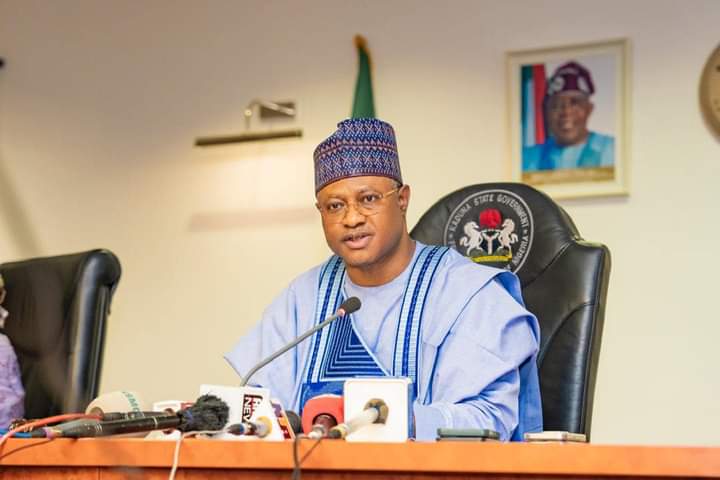
Kaduna Governor Uba Sani’s claim that he has borrowed “not one kobo” since taking office is at odds with state records showing ₦10.03bn in loan receipts under his administration, while FAAC data also challenge his ₦6.7bn monthly deduction claim.
Kaduna State Governor, Uba Sani, says his administration has not borrowed a kobo since he assumed office in May 2023 and that the state pays ₦6.7 billion monthly from its Federation Account allocation to service loans inherited from previous administrations.
The state’s debt profile also shows an increase in domestic debt towards the end of 2025, while its external debt continued to rise during the period.
Mr Sani made the claim on Channels Television’s Politics Today on 27 August 2026.
“We pay ₦6.7bn every month from the loan we inherited. Since I became Governor, I have not borrowed one kobo,” he said.
“It is about being prudent. We are paying ₦6.7bn every month from our FAAC allocation, which will continue until 2048. That is what is in the Debt Management Office. It is not me. You can cross-check tomorrow morning.”
The governor added, “When I talk, I talk on data and statistics. Whatever I say to you, you must go and verify.”
Based on that invitation, PREMIUM TIMES examined data from the Debt Management Office (DMO), Kaduna State’s budget performance reports, and Kaduna State audited financial statements and Federation Account Allocation Committee (FAAC) disbursement records.
The records show that while Mr Sani inherited a substantial debt burden, his claim that his administration has not borrowed “one kobo” requires qualification and evidence from the government to contradict the documents.
Mr Sani became governor on 29 May 2023, succeeding Nasir El-Rufai.
As of 30 June 2023, about a month after Mr Sani assumed office, Kaduna’s domestic debt stood at ₦87.28 billion.
The figure fell marginally to ₦86.59 billion by 30 September 2023 and ₦85.52 billion by 31 December 2023.
It then declined substantially throughout 2024, standing at ₦29.38 billion in March, ₦28.60 billion in June, ₦26.61 billion in September and ₦25.76 billion by December.
The downward trend continued into 2025, with domestic debt falling to ₦25.01 billion by March and ₦24.09 billion by June. By September, it was ₦23.13 billion. But the position changed aggressively thereafter.
By 31 December 2025, Kaduna’s domestic debt had risen to ₦84.64 billion, an increase of ₦ 61.51 billion, or more than threefold, from the ₦23.13billion recorded three months earlier. It rose further to ₦87.87 billion by 31 March 2026.
The March 2026 debt stock is the last domestic data published by the DMO. This implies that, according to the DMO data, Kaduna domestic debt has increased by ₦590 million (0.68 per cent) over the ₦87.28 billion inherited from Mr El-Rufai’s administration.
The increase raises questions about what liabilities were added to the state’s domestic debt stock during that period.
Kaduna’s external debt also rose during Mr Sani’s tenure.
The state’s external debt stood at $569.38 million as of 30 June 2023, ranking Kaduna second among the most indebted states, including the Federal Capital Territory, in terms of foreign debt.
It increased to $587.07 million by December 2023 and $640.99 million by June 2024.
Although it fell to $625.10 million by December 2024, it rose again to $658.71 million by June 2025.
By 31 December 2025, Kaduna’s external debt had reached $684.29 million. The state remains the second most indebted in Nigeria in terms of external debt.
Thus, Kaduna’s external debt increased by $114.91 million between June 2023 and December 2025.
Kaduna State’s own budget performance reports and audited financial statements record loan receipts during Mr Sani’s tenure.
Although the 2024 audited financial statements recorded no loan, the 2025 audited financial statements recorded a loan of N876 million.
The second-quarter 2026 budget performance report recorded N9.15 billion in international loans.
The third- and fourth-quarter budget performance report for 2023, which covers financial activities between July and December 2023, is not publicly accessible; thus, PREMIUM TIMES is unable to independently assess whether loans were obtained under Mr Sani’s administration in 2023.
The two figures amount to ₦10.03 billion in reported loan receipts between 2025 and the first half of 2026.
These figures appear, on their face, to conflict with the governor’s categorical statement that he has not borrowed “one kobo” since assuming office.
However, the existence of loan receipts in the fiscal documents, by itself, does not establish that the Sani administration contracted entirely new loan facilities.