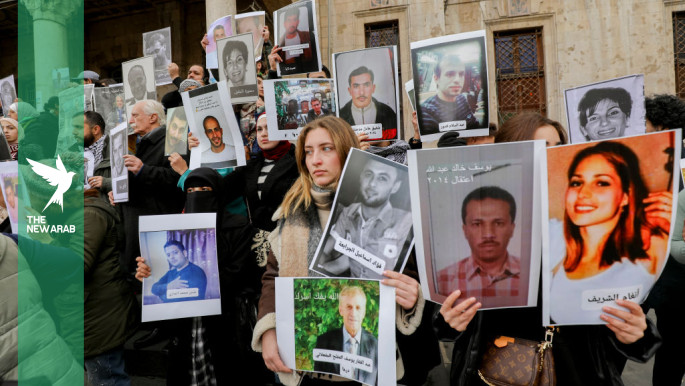
Relatives of tens of thousands of people detained by the Assad regime have been unable to locate their loved ones, who are presumed dead [Getty]
After waiting for years to find out the fate of their loved ones who died in the prisons of the Assad regime, thousands of Syrians are now struggling to obtain official documents proving the deaths of their deceased relatives.
Adel Haj Othman never expected that the search for his brother, who he found out died in the notorious Sednaya prison, would lead him, after six months of going from one official institution to another to obtain a death certificate, to an impossible and incomprehensible demand.
He was told he had to bring two witnesses who had been in Sednaya prison to confirm his death.
“The judge shocked us by demanding that we bring two witnesses who saw my brother being killed in detention. We do not know what to do to meet this absurd request. If the judge himself had a brother or son who died in Sednaya, would he be able to find two witnesses?” Haj Othman told The New Arab.
“The request was not only impossible but also deeply hurtful. The people who killed my brother were members of the former regime, and many of those who were part of that system still work in the institutions handling the files of families of missing detainees. We stopped the procedure two months ago, but this farce must end,” he said.
Haj Othman’s case is not an isolated one, as thousands of Syrian families have been trying for over a year to register the deaths of detainees who died or went missing in Assad regime prisons.
The struggle is almost as cruel as the years they spent waiting to learn the fate of their loved ones. Families are facing judicial and administrative procedures originally designed for natural deaths, not for victims of detention, torture, and enforced disappearance.
Last year, the Syrian Network for Human Rights (SNHR) said that 45,342 people had died since March 2011 under torture in the Assad regime prisons, including children and women. Tens of thousands more have disappeared and are presumed dead.
‘Practically impossible’ to obtain death certificates
Zain Badra, who is from the city of Jableh on Syria’s coast, said that only a handful of people in his city have managed to obtain death certificates for former detainees.
“Out of 360 people from our city killed in regime prisons, only three or four families managed to get death certificates for their relatives because of the complications families face in court,” Badra told The New Arab.
“Some judges demand a certificate of good conduct for the deceased, others ask for a movement record from immigration and passport authorities proving the deceased did not leave the country during detention, and some judges ask for witnesses from the prison,” he said.
“All of these are unreasonable requests, especially since the victims spent long years in enforced disappearance, and in most cases, their families have no information whatsoever about the circumstances of their deaths,” he added.
Even those with legal training have not been able to obtain death certificates for their relatives.
Syrian lawyer Fatima Harmoush lost two of her brothers in Sednaya prison during the early years of the uprising against Assad’s rule.
She said she began procedures around six months ago to obtain death certificates for them, but eventually decided to abandon the effort after losing hope.
“I could not complete the process even though I am a lawyer. Courts are handling these cases through rigid procedures that ignore the specific nature of victims of detention and enforced disappearance,” she told The New Arab.
Harmoush highlighted the Kafkaesque demands made by judges, as well as the demands for money.
“The judge requested a movement record from the Immigration and Passports Department for my brother—a document nobody can obtain. Then he requested a police report, which requires a forensic doctor’s report, which in turn requires a certificate of good conduct from the local mukhtar. All of these documents are extremely difficult to secure,” she said.
“What shocked me even more was a phone call from someone asking for one thousand dollars to facilitate obtaining the death certificates,” she added.
Falsifying records to cover up torture
Fadel Abdul Ghany, director of SNHR, said the judicial and administrative complications described by families reflect a crisis that has accumulated over many years and is tied to the nature of detention and enforced disappearance cases.
“Requirements such as witnesses or certificates of good conduct are disconnected from reality. The detainee died in an unknown place under unknown circumstances, and asking the family of a victim of enforced disappearance to provide two witnesses to the death effectively means forcing them to prove what the state itself committed,” Abdul Ghany told The New Arab.
He said that much of the problem stemmed from the Assad regime previously issuing falsified death certificates designed to hide the fact that detainees died under torture.
“The Assad regime used falsified death certificates as a tool to erase the truth. In some cases, certificates listed fabricated causes of death. The Syrian Network for Human Rights documented hundreds of these fake certificates claiming natural causes, while evidence proved the victims died under torture,” he said.
“This means the system was not dysfunctional—it was actively engaged in falsifying the truth and concealing evidence of crimes committed against thousands of detainees.”
Abdul Ghany said the current government should urgently issue an exceptional regulation for victims of torture, execution and forced disappearance in regime prisons that exempts families from witness requirements, certificates of good conduct, and similar demands.
He said that new procedures should instead rely on databases from human rights groups, rulings issued by religious courts in areas which were outside regime control during the Syrian conflict, and confiscated archives from Syrian regime security forces.
He also stressed that the true cause of death should be stated in official documents because recording deaths under torture as “natural deaths” violates the right to truth and conceals criminal evidence necessary for accountability.