
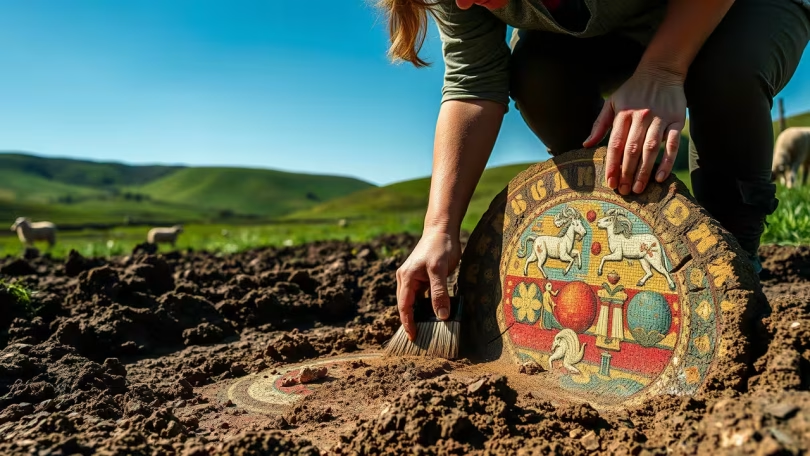
Archaeologists working on farmland between the villages of Halberton and Sampford Peverell in Devon have uncovered a striking mosaic floor from a fourth-century Roman villa, along with an elaborate bathhouse that suggests the site once belonged to a family of considerable wealth. The discovery is the latest breakthrough from the Saving Halberton’s Ancient Roman Environment project, known as SHARE, a joint effort between the University of Exeter and Cotswold Archaeology. Roman villas remain extremely rare finds in Devon, with only a small number ever confirmed through excavation, which makes this particular site an important addition to understanding how deeply Roman influence had spread into southwest Britain by this period.
How the site in Devon was first discovered
The story behind this excavation stretches back over two decades. According to Devon County Council, the site was first flagged in 2004 by local metal detectorist John Hill, whose early finds prompted a geophysical survey that later confirmed the presence of enclosures and likely buried structures. Community volunteers subsequently carried out fieldwalking and small-scale excavations that turned up tiles, mosaic fragments and roofing slate, laying the groundwork for the larger dig that followed. Further investigation carried out by a University of Exeter PhD student eventually confirmed that mosaics were present at the site, setting the stage for the current excavation phase.
What makes this mosaic so significant
The centrepiece of the discovery is a polychrome mosaic built from thousands of tiny stone cubes measuring just twelve millimetres square, arranged in red, white and dark blue grey tones. At its heart sits a stylised flower design formed from eight overlapping teardrop-shaped petals, bordered by an interlaced pattern of overlapping squares known as guilloche, a design commonly seen on Roman floors across the empire. According to University of Exeter News, the mosaic is believed to date to the fourth century AD and represents the most westerly example of this decorative style ever recorded in a Roman villa in Britain, a distinction that places the Devon countryside firmly within the reach of Roman civic and domestic culture.
An unexpected bathhouse and other rich finds
Beyond the main dwelling, archaeologists uncovered a substantial bathhouse containing at least two plunge pools built using opus signinum, a waterproof form of Roman concrete, with walls that still carried traces of painted plaster. Dr Susan Greaney, project lead from the University of Exeter’s Department of Archaeology and History, said the team had not expected to find a bathhouse of this scale, adding that the villa was undoubtedly home to people of wealth and high standing. Other notable finds recovered during the dig include a delicate copper alloy bangle resting on top of the mosaic, a finely crafted silver-plated spoon, and an intaglio, a small carved gem originally set into a ring and used to press seals into wax, decorated with an image of the goddess Victory.
Community involvement at the heart of the project
The excavation has drawn heavily on local participation, with scores of community volunteers working alongside around sixty-five archaeology students and professional project staff over the course of the dig. The SHARE project is supported by a grant from the National Lottery Heritage Fund and brings together the University of Exeter, Cotswold Archaeology, Devon County Council, the Tiverton Archaeology Group and the Sampford Peverell Society. Devon County Archaeologist Bill Horner noted that the mosaic and other signs of Roman-era affluence found at the site show just how thoroughly even this far flung corner of the province had been absorbed into Roman life.
What happens to the mosaic next
With excavation work now complete for this phase, conservation specialists are carefully lifting the mosaic in sections so that it can be preserved and eventually placed on public display at Tiverton Museum of Mid Devon Life, alongside the other Roman artefacts recovered from the site. Councillor Jacqi Hodgson, Devon County Council’s cabinet member for the environment and biodiversity, described the project as a once-in-a-lifetime opportunity for local residents to take part in a genuinely significant excavation, noting that public involvement has shaped the project from its earliest stages through to the conservation work now underway.