
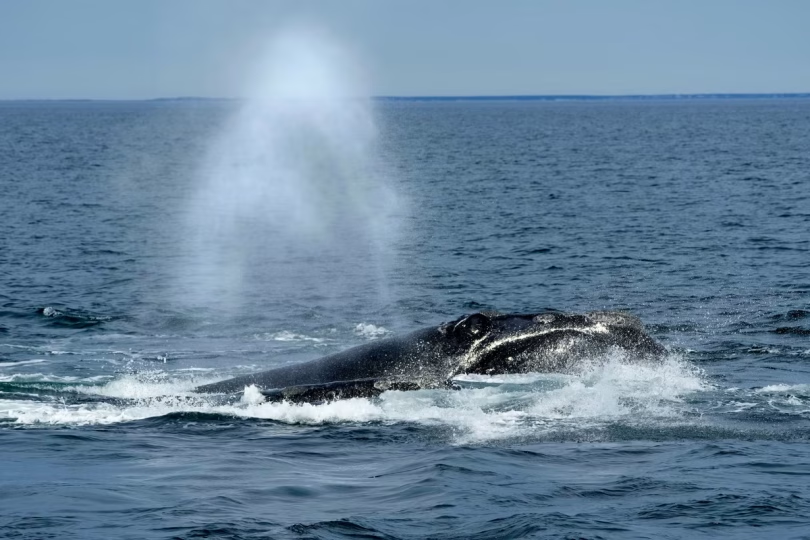
New protections for the endangered North Atlantic right whale could be postponed for nearly a decade following a vote in Washington last week that garnered strong support from the fishing and lobster industries.
Environmental groups warn this delay could prove catastrophic for the vanishing species that is vulnerable to entanglement in fishing gear and collisions with boats, with only about 380 whales remaining.
Once prevalent off the East Coast, right whales were hunted to near extinction during the commercial whaling era. Beyond entanglement and ship strikes, scientists also highlight ocean warming due to human-caused climate change as a significant threat to their survival.
The federal government had already paused new right whale regulations until 2028. However, the House Natural Resources Committee voted on July 15 to extend this moratorium to 2035. A vote by the Republican-controlled Congress is anticipated as early as this summer and is widely expected to pass.
The Trump administration has backed U.S. Representative Jared Golden, a Democrat from Maine, in his efforts to further delay these protective measures. Golden introduced the bill alongside Republican Representative Mike Lawler of New York.
Much of the opposition to stricter regulations stems from the lobster and crab industries in New England states like Maine and Massachusetts. These industries contend they already adhere to some of the world’s most comprehensive conservation practices and argue that additional rules could jeopardize their livelihoods.
Representative Golden stated the pause is also intended to allow more time for data collection on effective whale protection strategies.
“Mainers are not asking for much. We just need more time,” he said.
The current moratorium has been in effect since 2022. Conservationists caution that amid ongoing delays and studies, right whales continue to perish from encounters with commercial fishing equipment. The whale population declined by approximately 25% between 2010 and 2020. While numbers have slightly recovered recently, they remain significantly below the roughly 480 whales recorded in 2010.
“They needed more protections in 2022 when Congress ignored a mountain of evidence and decided that insufficient efforts were enough,” said Gib Brogan, senior campaign director with Oceana. “Now, once again, lawmakers are trying to pass the buck.”
The fishing industry maintains that existing regulations are adequate and will remain unchanged if the moratorium is extended.
“The current conservation framework remains fully in place, and this legislation does not weaken protections for the North Atlantic right whale,” said Beth Casoni, executive director of the Massachusetts Lobstermen’s Association.