Stephen Alex had barely returned to Abuja after spending eight months at the Medium Security Custodial Centre, Keffi, Nasarawa State, when he found himself back at the same place where he had taken refuge before his arrest.
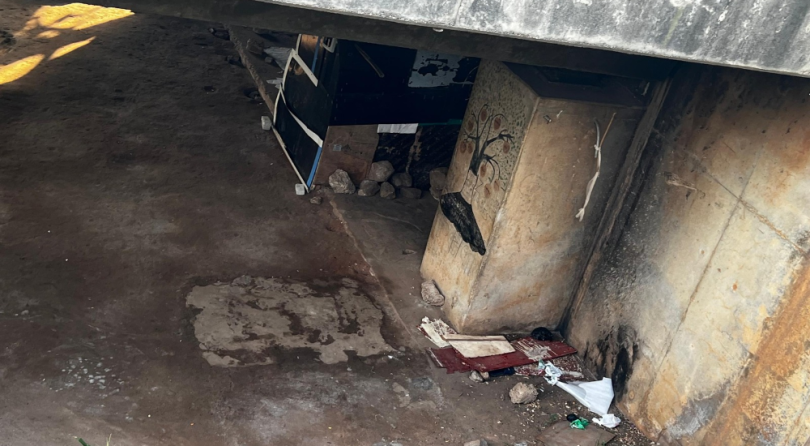
On Friday, November 6, Alex returned to the Wuse Market bridge, near Cachez Garden, not because he had found a new opportunity in the nation’s capital, but because he could not afford the journey back to his hometown in Barkin Ladi Local Government Area of Plateau State.
With no home in Abuja and no money for transport, the bridge offered him somewhere familiar to start again.
Speaking to NEWSNGR, Alex said he was arrested after he was caught smoking, and he spent eight months in custody.
His return to the area also brought him back into an environment where, according to him, drug consumption and police raids were recurring features.
“They do drugs and smoke under here. Police come time to time to raid here. Most times, they arrest people,” Alex said.
Alex, who sleeps in front of a plaza in Wuse, survives by helping customers locate items in the market. He earns commissions from traders whenever he directs buyers to their shops.
He described the area as a drug hub, mostly in the early hours of the morning, when people unfamiliar with the location may find it difficult to approach those involved in the trade or understand how they communicate.
Meanwhile, activities beneath the bridges extend beyond providing shelter to people without homes.
Some have become informal settlements or makeshift business and gathering places. In others, drug consumption is common. People familiar with the areas allege that thieves use the bridges and adjoining roads as hiding places and escape routes after attacking commuters.
NEWSNGR‘s reporter visited some of the bridges across the Federal Capital Territory to observe some of the activities.
At the Setraco flyover, parts of the space beneath the bridge have been put to different uses. A refuse dump occupies one section, while a makeshift football pitch has been carved out nearby. Abandoned industrial water pipes also lie around the area, where people without shelter were seen sleeping.
At the Efab bridge along the Kubwa Expressway, people without accommodation were seen using the space as shelter.
At the Area 11 intersection, shortly before Gimliya Junction and around Rochas Foundation, the space beneath the bridge serves purposes beyond providing shelter for people without homes.
A passerby, Michael Ugwu, who said he was familiar with the area, described it as a settlement with its own informal economy, including carpentry workshops and makeshift restaurants.
“They have a carpentry shop. They have a restaurant. There at night is a beehive of activities where women of easy virtues sometimes take their clients to,” Ugwu told NEWSNGR.
He added that police officers occasionally raid the area, while petty robbery incidents have also been reported around the location.
The security concerns are more pronounced around the bridge near the Bureau de Change area in Zone 4.
A resident familiar with the location described it as one of the more notorious spots where thieves sometimes target motorists and pedestrians before escaping beneath the bridge.
According to him, criminals take advantage of moments when motorists wind down their windows to snatch phones and other valuables before escaping through the adjoining roads.
A young man in his early twenties, who spoke on condition of anonymity, said the problem was not confined to the bridge.
He identified the area around Bolingo Hotel as another location where people allegedly exploit the network of intersections and adjoining roads to escape after snatching valuables.
He said, “The Bolingo axis is particularly concerning because of its connection to routes used by commuters going towards Lugbe.”
He added that the interconnected roads and spaces beneath the bridge serve as escape routes, while also attracting “one-chance” robbers.
In January 2024, the Federal Capital Territory Administration (FCTA) commenced raids on bridges, subways and other locations identified as criminal hideouts within the Central Business District, Maitama and Wuse.
The operation followed complaints from residents that some people were using public infrastructure as hiding places before emerging to rob passersby and motorists.
During the exercise, the FCTA Joint Task Force arrested three persons over drug-related offences beneath bridges and handed them over to the National Drug Law Enforcement Agency (NDLEA) for further investigation.
The then Coordinator of the Task Force on City Sanitation, Mukhtar Galadima, described the sanitary conditions around some of the affected facilities as disturbing.
The Secretary of the FCT Security Services Department’s Command and Control Centre, Peter Olumuji, also said residents had complained about criminals emerging from hiding places to rob people before escaping beneath bridges.
The issue resurfaced in July 2025 when the FCTA launched ‘Operation Sweep’ targeting street beggars, scavengers, traders, alleged criminal elements and other groups considered security or environmental concerns.
The administration said those apprehended would be profiled and returned to their states of origin.
In August 2025, FCT Commissioner of Police, Ajao Saka Adewale, disclosed that 273 destitute persons had been taken to the Bwari rehabilitation centre for profiling and care ahead of their relocation to their home states.
In May 2026, the NDLEA announced that it had arrested 132 suspects and recovered 220 kilogrammes of assorted illicit substances during a two-week operation targeting drug joints and bunkers within and around Abuja.
The operation, conducted between April 11 and 25, covered locations including Wuse Zone 4, Gwarinpa, Banex, Kubwa, Jabi, Apo, Garki Area 10 and Gwagwalada, among others.
The agency said the raids followed weeks of intelligence gathering and surveillance aimed at dismantling drug distribution networks.