
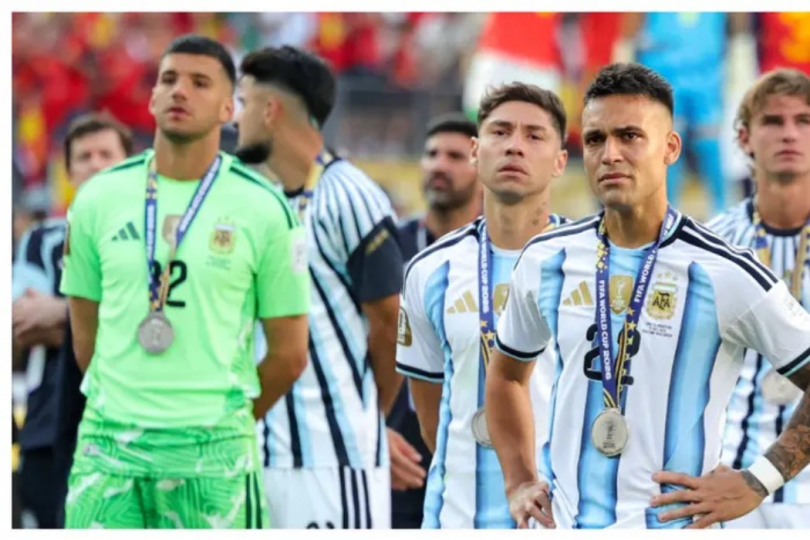
FIFA has officially opened disciplinary proceedings against the Argentinian national team following their conduct during and after the World Cup final, where they were defeated by Spain.
Argentina lost the World Cup final 1-0 to Spain in extra time, with the aftermath of the game ending in a chaotic incident, leading to an investigation.
The investigation was prompted by altercations involving several Argentinian players and staff members with their Spanish counterparts.
The charges stem from incidents involving discriminatory chants and gestures, late kick-offs, the display of inappropriate messages by the team and fans, and objects being thrown by spectators.
Argentina face investigation
The world’s governing body for football appointed a disciplinary and ethics prosecutor last week to examine the events that unfolded after the final whistle at the New York-New Jersey Stadium.
Based on the prosecutor’s recommendation, FIFA will now investigate specific individuals for alleged assault under Article 14 of its disciplinary code.
Argentina players and Spain players clash after the final
The players under scrutiny are Argentina’s Nahuel Molina, who faces two counts, and Leandro Paredes, who faces three. Argentina’s assistant coach, Roberto Ayala, is also being investigated on one count of assault.
Molina is also accused of one count of unsporting behaviour, an allegation also levelled against his teammate Thiago Almada and Spain’s midfielder Gavi.
According to FIFA’s disciplinary code, unsportsmanlike conduct carries a minimum suspension of one match, while assault results in a ban of at least three matches.
The Argentinian Football Association (AFA) itself is facing a broader range of charges for potential breaches across several matches.
These include using a sporting event for a non-sporting demonstration (Article 13), team misconduct (Article 14), discrimination and racist abuse (Article 15), and failing to maintain order and security at matches (Article 17).