
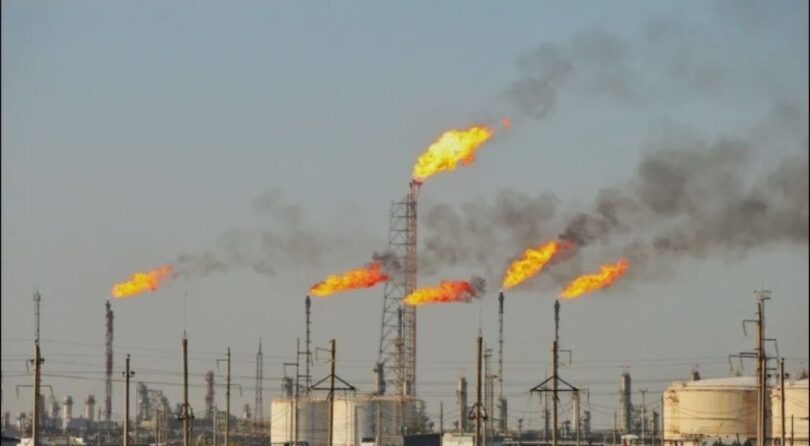
…Flared Gas Could Generate 148,000GWh Electricity
…Gas Waste Could Fetch Up To N10tn In Commercial, Export Markets
Nigeria wasted about 1.02 trillion cubic feet (Tcf) of gas to flaring between 2021 and 2025, analysis of data obtained from the Nigerian Upstream Petroleum Regulatory Commission has shown.
In the years covered by the flaring, oil companies in the country paid penalties of N1.22tn for their failure to put in place the infrastructure and the mechanism for gathering, processing, and marketing of the gas burnt during their operations.
Experts reckon that the 1.02Tfc of gas burnt in the five-year period could produce 148,000 GWh of electricity.
For perspective, this quantity of gas can keep a 5,000-MW power plant running for 3.38 years. Nigeria’s current electricity generation hovers between 3,000 MW and 5,000 MW per day.
In terms of market value, using Nigeria’s domestic gas-to-power pricing, the quantity of gas burnt in the past five years can fetch as much as N3tn while using commercial and export pricings, the wasted gas could generate between N5tn and N10tn.
NUPRC’s reported flaring fell from 252.58 Bcf in 2021 to 181.52 Bcf in 2023, a decline of about 28.1 per cent. It then reversed direction, rising to 191.84 Bcf in 2024 and 203.97 Bcf in 2025. The 2025 volume is about 19.2 per cent below 2021, but 12.4 per cent above 2023.
Data obtained from NUPRC showed that in 2021, the country collected a total of N98.55bn as penalty for gas flaring. The following year, the collection reduced to N70.42bn. This shows a reduction of N28.13bn or 28.54 per cent.
In 2023, the collection jumped to N140.54bn. This shows a difference of N70.12bn. In terms of percentage difference, the penalties paid by oil producers jumped to 99.57 per cent within a period of one year.
The quantum leap continued the following year when the collection jumped to N391.26bn. This shows a difference of N250.72bn. It also means that within a period of one year, the collection jumped by 178.4 per cent.
Gas flaring penalty as a stream of government revenue did even better in 2025 when the country collected a total of N521.87bn. This means that the revenue increased by N130.61bn showing that within 12 months, the country collected 33.38 per cent more revenue from gas flaring.
These show that within a period of five years, the country collected a total of N1.22tn from gas flaring penalties. Between 2021 and 2025, the revenue from gas flaring rose from N98.55bn to 521.87bn, showing an increase of N423.32bn or 429.54 per cent.
The penalties paid by the oil producing companies do not only reflect the volume of gas wasted by flaring, they also reflect an attempt to deter them to move from flaring gas to harvesting it for economic purposes.
Before 2023, companies were charged based on the volume of their productions. Thus, for 2021 to 2023, oil companies producing less than 10,000 barrels per day were charged $0.50/1,000 standard cubic feet of gas wasted by flaring.
Those producing 10,000 barrels per day and above were charged $2/1,000 standard cubic feet of gas wasted by flaring.
Following the transition to the Petroleum Industry Act of 2021, the charges for gas flaring changed for all operators to $3.50 per 1,000 standard cubic feet of gas flared.
Thus, the PIA prescribed a higher rate of penalty as a measure to discourage gas flaring and encourage operators to gather and harness the gas for economic purposes.
This is partly responsible for the jump in revenue made by the government between 2024 and 2025, two years that accounted for 74.83 per cent of the revenues made by the government from gas flaring within the five years under review.
With gas flaring not reducing as the penalties paid by oil producers, questions have been raised on whether imposing penalties is capable of eliminating the wastage of resources through gas flaring.
Opinions are high that oil operators may have adapted to gas flaring, considering penalties as part of incidental business expenses.
Industry regulator, NUPRC, is reported to be considering the revocation of the licences of operators who keep defaulting on government’s target of eliminating gas flaring. The current elimination target is 2030.
According to a recent World Bank report, Nigeria ranks eight among gas flaring nations of the world. The report also indicated that rather than reducing, Nigeria gas flare increased by eight per cent between 2024 and 2025.
In 2025 alone, the country lost eight billion cubic metres of gas valued at $2.59bn. On the global scale, the world lost 167 billion cubic metres of gas valued at $54bn.
Details of the report which varied from the NUPRC statistics showed that Nigeria flared 7.3bcm of gas valued at $2.36bn in 2021. In 2022, the quantity and value increased slightly to 7.4bcm and $2.39bn respectively.
Again, the quantity and value rose slightly to 7.5bcm and $2.42bn in 2023. They decreased marginally the following year, 2024, to 7.4bcm and $2.39bn respectively.
However, by 2025, the gas flared by the country rose significantly to 8bcm valued at $2.59bn.
According to the report, Nigeria is one of the nine countries responsible for 83 per cent of global gas flaring. The top nine countries, however, account for only 46 per cent of global oil production.
The top gas-flaring countries for 2025 are Russia, 30bcm; Iran, 24bcm; Iraq, 24bcm; Venezuela, 14bcm; Mexico, 10bcm; Libya, 9bcm; Algeria, 9bcm; Nigeria, 8bcm; United States, 5bcm; and 10, Saudi Arabia, 2.5bcm, according to the World Bank.
Thus, Libya, Algeria, and Nigeria are Africa’s three largest gas-flaring countries with Nigeria being the largest gas-flaring nation in sub-Saharan Africa.
Angola and the Republic of Congo were also reported to flare significant quantities with 2.5bcm and 2.3bcm respectively.
According to the report, Africa continues to lose valuable energy resources through flaring.
The report noted that gas flaring increased by eight per cent for Nigeria compared with 2024. Within the same period, Nigeria’s oil production also rose by about eight per cent.
This means that the increase in flaring largely tracked higher production rather than worsen efficiency.
The key causes of gas flaring in Nigeria were attributed to inadequate gas gathering and transportation infrastructure, insufficient capacity to bring associated gas to market, and aging gas-processing plants with frequent downtime.