WASHINGTON – Anthony Fauci, the former top US infectious disease expert, declined to answer questions at a Senate hearing on July 29, invoking his constitutional right against self-incrimination and accusing Republican Senator Rand Paul of an “unhinged” campaign to see him imprisoned.
“Under the advice of my attorneys, I will invoke my right under the Fifth Amendment of the Constitution to refrain from answering your questions,” Fauci told the Senate Homeland Security and Governmental Affairs Committee, which Paul chairs, in his opening statement.
Fauci declined to answer 15 questions from Paul, invoking his Fifth Amendment rights for each of them.
Paul said Fauci was not allowed to plead the Fifth, that a pardon issued by former President Joe Biden would not protect him, and that there would be consequences for his refusal to answer the questions.
Fauci, who led the National Institute of Allergy and Infectious Diseases for 38 years and became the face of the US pandemic response, long has been the target of criticism by President Donald Trump and many American conservatives.
Trump before the hearing wrote of Fauci on social media: “His ideas were CRAZY!”
Biden pardoned Fauci on Jan 19, 2025, for any offences he may have committed since 2014 in connection with Covid-19 or in his role as director of the National Institute of Allergy and Infectious Diseases. The pardon does not cover subsequent conduct.
“The committee will have to consider after this hearing what appropriate action should be taken against you for the failure to testify after being directed to do so. It’s against the law to obstruct an investigation of Congress. There will be repercussions to your refusal to testify today,” Paul said.
Paul then had one of Fauci’s lawyers removed from the hearing after refusing to recognise his attempts to speak.
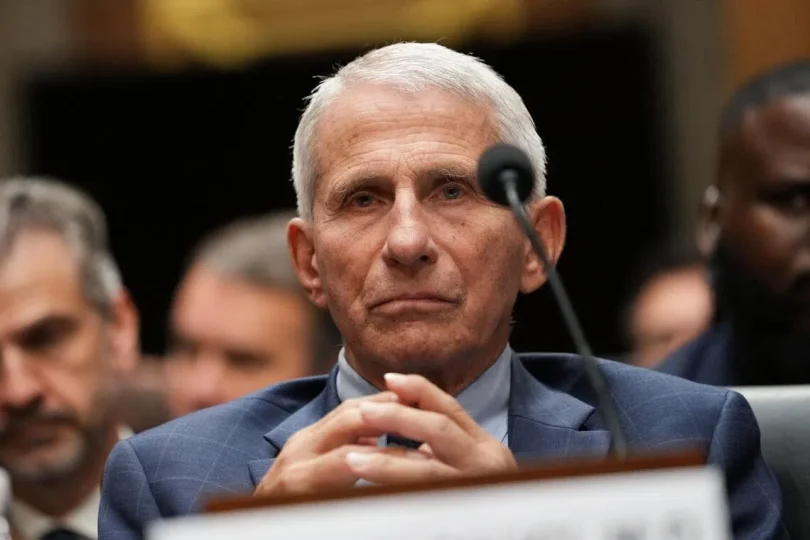
Anthony Fauci, the former Director of the National Institute of Allergy and Infectious Diseases and medical advisor to several US presidents, attends a US Senate Homeland Security and Governmental Affairs Committee on Capitol Hill in Washington, on July 29, 2026.
PHOTO: REUTERS
In a statement, Fauci’s attorney David Schertler called Paul’s pursuit “an obsessive vendetta” and said the accusations “are false and disgraceful, and we will examine all options to hold him accountable”.
Schertler said a verbal clash between Fauci and Paul at a 2021 hearing triggered “an intense and seemingly pathological course of retribution, revenge and obsession”, by the Kentucky senator toward Fauci.
Paul for years has called for Fauci to be indicted and accused him of lying to Congress about whether the National Institutes of Health funded “gain-of-function” research in Wuhan, China, and of helping cover up the origins of Covid-19.
‘Slanderous comments’
Fauci denies both claims and says he has testified truthfully multiple times before Congress on these issues.
“Given Senator Paul’s obvious obsession with calling for my prosecution, his repeated slanderous comments about me, and recently his publicly releasing my unredacted personal diary aimed at embarrassing and intimidating me,” Fauci said, “the only conclusion I can reach is that the sole reason he is calling me before this committee is to get me to say something that could vindicate his repeated public pledges that I end up, in his words, ‘behind bars’.”
“Any reasonable person who has followed his unhinged obsession with me would readily come to the same conclusion,” Fauci said.
Senator Gary Peters, the committee’s top Democrat, said in his opening statement that the hearing was biased and criticised the investigation for having predetermined conclusions.
“This hearing appears to be a culmination of months of biased and selected efforts by the majority, under the guise of a committee investigation, to basically legitimise a predetermined conclusion that was reached years ago,” Peters said.
“It’s not just what we investigate that matters, but how we conduct that investigation that also matters. One-sided investigations designed to validate predetermined conclusions do not serve the American people, who sent us to actually uncover the truth and to solve problems,” Peters said.

Anthony Fauci, the former Director of the National Institute of Allergy and Infectious Diseases and medical advisor to several US presidents, attends a US Senate Homeland Security and Governmental Affairs Committee on Capitol Hill in Washington, on July 29, 2026.
PHOTO: REUTERS
Gain-of-function research is, broadly, work that modifies a pathogen in ways that could make it more transmissible or dangerous, though scientists disagree over how narrowly the term should be defined.
That disagreement is the crux of the Paul-Fauci dispute: Paul says the NIH funded such work in Wuhan and that Fauci lied when he denied it, while Fauci says the research did not meet the government’s formal regulatory definition.
Covid-19 origins
Covid-19‘s origins remain unresolved. The FBI said in 2023 that a leak from a laboratory in the central Chinese city of Wuhan likely caused the pandemic, a claim China said had “no credibility whatsoever”.
The CIA said in January 2025 it had shifted its assessment and concluded a lab leak was likely, but with “low confidence”, while four other US intelligence agencies and the National Intelligence Council believe the virus most likely emerged via natural transmission.
Paul this week published a 1,141-page tranche of Fauci’s pandemic-era diary entries, spanning December 2019 through December 2022.
“Many entries in Fauci’s daily historical account completely undermine the official narrative that Fauci and other public health officials espoused,” he said in a statement.
A fact-check document provided by a representative of Fauci said the diary entries match what he said publicly at the time. He has said since 2021 he kept an “open mind” that Covid-19 could have leaked from a lab, and spoke publicly in early 2020 about asymptomatic transmission and China’s lack of transparency, the very matters Paul says the diary reveals.
Chronicle of Fauci’s media appearances
US Health Secretary Robert F. Kennedy Jr, an anti-vaccine activist and, like Paul, a frequent critic of Fauci, told Fox News on July 27 he handed the files to the senator after finding them on government servers.
Both Kennedy and Paul have signaled Fauci’s testimony could expose him to a perjury charge despite Biden’s preemptive pardon.
Paul has for years pledged to see Fauci imprisoned.
The entries largely chronicle Fauci’s media appearances and fame. A review of his public record provided by a representative of Fauci shows his positions were consistent with the diary.
The Trump administration issued a policy on Tuesday barring federal funding for “dangerous gain-of-function” research, the category at the heart of the Fauci dispute.
In April, former Fauci adviser David Morens was indicted on charges of concealing federal records about research grants and the origins of Covid-19, though Fauci was not charged. Biden preemptively pardoned Fauci in January 2025 to guard against “unjustified and politically motivated prosecutions”. REUTERS