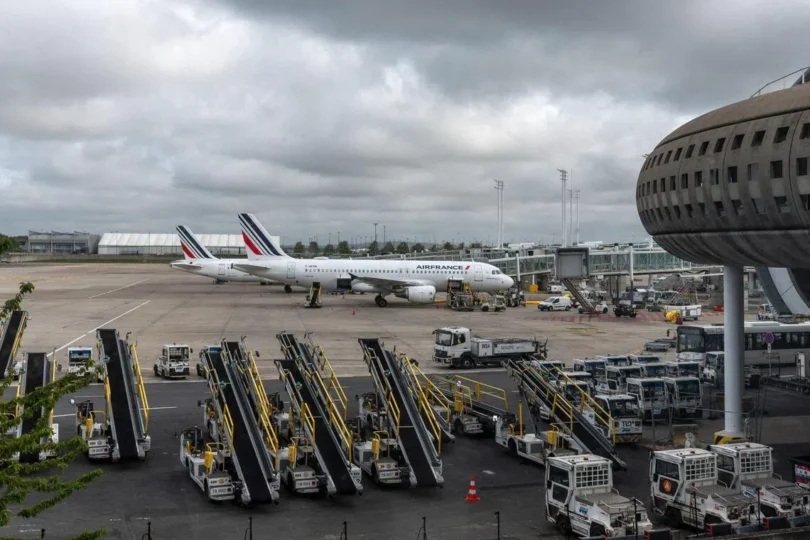
PARIS – France’s forecasting office flagged suspected tampering with weather sensors at the country’s largest airport and referred the case to the police, after detecting unusual readings alongside heavy betting on a popular prediction market.
Automated temperature readings taken at Meteo France’s weather station at Charles de Gaulle International Airport spiked 4 deg C and 5 deg C unexpectedly in the evenings of April 6 and April 15, respectively, reaching the highest temperature recorded at the site on those days, data from the installation show.
Readings from the site are important for the safe operation of the airport. They are also used to settle contracts for daily high temperatures on Polymarket, according to information on the website where traders place bets on real-world outcomes.
Weather betting has boomed on prediction markets like Polymarket and Kalshi, where individual traders and weather experts have flocked to put money behind their predictions for temperatures, or the amount of rain or snowfall in particular areas on specific dates.
Boosters say prediction markets create economic and social value by providing better information about what will happen in the world. Detractors call them glorified gambling vulnerable to manipulation, insider trading and other shenanigans.
Concerns have emerged for other contracts on prediction markets, including claims from an Israeli journalist that Polymarket users pressured him to change a story about missile strikes outside Jerusalem.
Prediction market traders and independent meteorologists in a French weather discussion forum flagged the data irregularities and questioned the results of the contracts, which attracted roughly US$1.4 million (S$1/8 million) in combined bets, according to Polymarket data. Total betting for each was more than double the typical volume for other daily Paris temperature contracts in April.
A spokesman for Meteo France, Mr Laurent Becler, said technicians examined sensor data and inspected the weather station, and the forecasting office subsequently filed a complaint for tampering with the operation of an automated data processing system to airport police.
Mr Becler declined to answer additional questions about the possible tampering and data irregularities. The airport police declined to answer questions about the complaint and referred questions to court officials, who declined to answer a request for more information. Charles de Gaulle International Airport declined to comment.
Representatives for Polymarket did not respond to questions about the weather contracts. Betting on Paris temperatures switched to using data collected at Paris-Le Bourget Airport instead of Charles de Gaulle on April 19, according to Polymarket’s website.
Meteorologist Ruben Hallali, chief executive officer and co-founder of Paris-based weather intelligence firm HD Rain, said he was among those who reported the anomalous data to Meteo France, where he previously worked.
Dr Hallali said he closely monitors the airport weather station because his firm certifies parametric insurance – policies that do not require proof of loss and pay out when specific conditions are met – for clients there. “That’s why I was able to spot very quickly the fact that there was a data manipulation,” he said.
The April 15 data are particularly unusual, Dr Hallali said. On that day, temperatures hit 18.8 deg C in the late afternoon and started to taper off before surging from 16.9 deg C to 21.9 deg C in 12 minutes, data from the weather station show. Humidity levels also plunged abruptly around this time, he said
On Polymarket, one trader made more than US$21,000 betting that 18 deg C would not be the highest temperature recorded that day, data from the prediction market show.
The consequences of tampering with sensors at an airport could be severe, Dr Hallali said. The data give pilots and air traffic controllers critically important readings on temperature, wind, visibility and other conditions.
Those data are used for take-offs and landings, to determine which runways are used and helping air traffic controllers set routes and spacing between aircraft. Weather station data are also used to calibrate altitude and fuel use for other aircraft, Dr Hallali said.
“If there is a mistake in this data, it can be dangerous,” he said. BLOOMBERG