
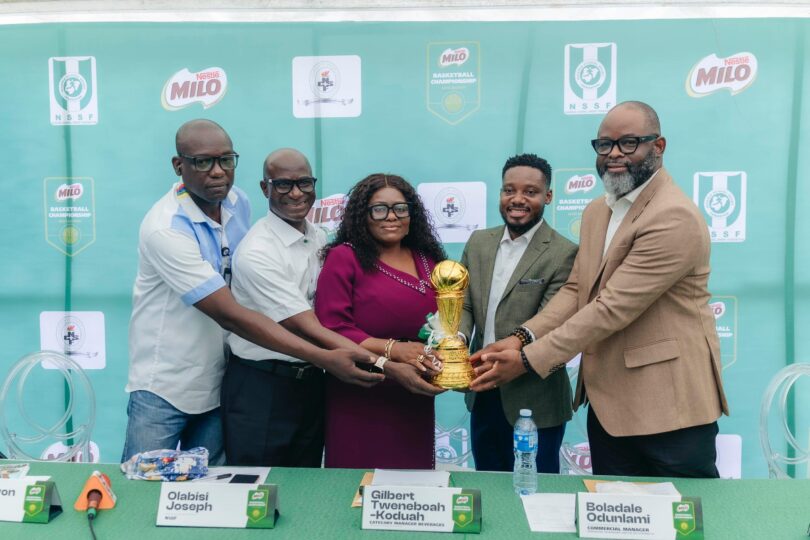
The championship, which began in 1999, has grown into one of Africa’s most enduring school sports competitions
New finalists from Katsina, Ekiti and Taraba have emerged as the biggest talking points ahead of the 26th edition of the Nestlé MILO Secondary School Basketball Championship, underlining the growing reach of one of Nigeria’s longest-running grassroots sports development platforms.
However, the emergence of states making their first appearances at the national finals has added a fresh dimension to this year’s competition.
Speaking during the championship’s press conference and draw ceremony in Lagos on Wednesday, the President of the Nigerian School Sports Federation (NSSF), Bisi Joseph, said the appearance of new teams reflects the steady growth of the competition across the country.
“We have new states coming on board,” she said. “We have Katsina coming to the finals; we have Ekiti coming to the finals. And even at the conference level, we had the likes of Taraba playing at the finals, which is unusual. It shows the extent of growth that we have in the Nestlé Milo Basketball Championship.”
She also welcomed the return of established school basketball powers.
“Government Secondary School, Gboko used to win back-to-back and even represented Nigeria at international school events,” Joseph said, “and we are happy that they are back this time.”
The championship, which began in 1999, has grown into one of Africa’s most enduring school sports competitions. According to Nestlé Nigeria, the platform now reaches more than 30,000 schools annually.
Mrs Joseph disclosed that this year’s edition attracted 13,256 registered schools nationwide, with only 12 teams eventually qualifying for the national finals.
Nestlé Nigeria’s MILO Category Manager, Gilbert Tweneboah-Koduah, said the company remains committed to youth development through grassroots sports.
“At Nestlé Nigeria, our core purpose is to unlock the power of food to enhance the quality of life for everyone, both today and for generations to come,” Mr Tweneboah-Koduah said. “Supporting the growth and development of children through grassroots platforms like the Milo Secondary School Basketball Championship is one of the primary ways we bring this commitment to life.”
Boladale Odunlami, Nestlé’s commercial manager, who represented the company’s managing director at the event, said the championship has evolved beyond a sporting competition.
“It is a platform where young Nigerians can discover their talent, build confidence and develop the values needed to become champions both on and off the court,” Mr Odunlami said. “Over the years, that ambition has grown into dynamic partnerships and collaboration with sports stakeholders — bringing together young athletes, schools, coaches, teachers and families across the country.”
Several players who passed through the championship have gone on to compete internationally, including Precious Achonwa, Chimezie Metu and Oluchi Ogbu.
For Mr Tweneboah-Koduah, the competition’s greatest impact extends beyond basketball.
“Beyond the trophies, what matters most is the confidence these young people gain from discovering that they are capable of achieving more than they ever imagined,” Tweneboah-Koduah said. “When a young person unlocks their potential, that impact extends far beyond the basketball court — influencing how they approach their education, future careers and their broader contribution to society.”
Mr Odunlami also praised the efforts of coaches, teachers and parents who support the athletes throughout their journeys.
“Behind each performance lies the journey behind everything — the countless hours of practice before and after school, the coaches who continue to guide these young athletes, the teachers and parents who provide support, and the players who learn that progress comes through consistency, teamwork and resilience,” he said.
The NSSF president said the national finalists now carry the hopes of entire regions.
“These teams are no longer representing just their school, and not just their state — they are representing their region,” she said. “So it is expected that they will play hard, play fair, and the best team will emerge as champion.”
She also recalled the dramatic finishes witnessed during the regional qualifiers.
“We should expect a similar experience,” Joseph said, recalling the heart-stopping moments that characterised this year’s regional conferences. “For the match between Katsina and Adamawa, we were almost on our feet all through — we witnessed matches that ended at the last second with one point winning.”
The championship also continues to promote inclusion through its partnership with the National Association of Special Educators (NASET).
Representing the association, Olusola Okanlawon said sport remains an important platform for students with disabilities.
“There is ability in disability,” Mr Okanlawon said, pointing to the example of Temitope Victoria, a former championship participant who went on to compete at the Paralympic Games. “We will continue to partner with Nestlé Nigeria PLC to showcase the talent of our students.”
NSSF Secretary Funsho Oba Usman said educational and mentoring activities remain central to the championship.
“We equally have the educational moment where we have ex-internationals to talk to the children, to mentor them,” Mr. Usman said. “Education is as important as the sport they are getting. So, this is part of the things we do.”
Mrs Joseph offered words of encouragement to the players ahead of the finals.
“You are champions already,” she said. “The values that you take away from participating in this event already make you a champion. The fact that you are now at the National Finals already makes you a champion.”
Mr Tweneboah-Koduah concluded with a message to all participants.