
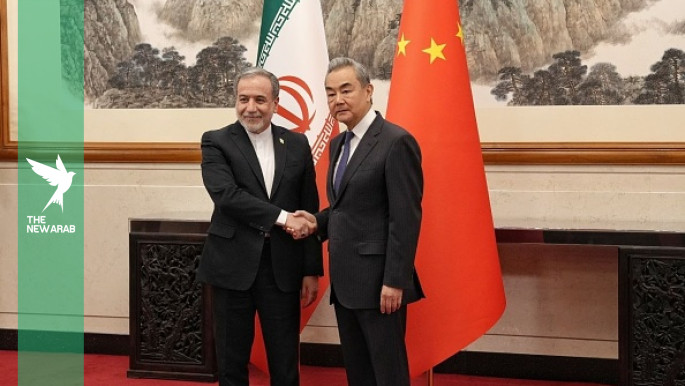
Araghchi arrived in the Chinese capital early Wednesday for meetings with senior officials, amid growing diplomatic activity surrounding the US-Israeli war on Iran and the escalating crisis in the Strait of Hormuz. [Getty]
Iran will only accept a “fair and comprehensive agreement” in negotiations with the United States, Foreign Minister Abbas Araghchi told his Chinese counterpart Wang Yi during talks in Beijing on Wednesday, as China urged a full ceasefire and renewed diplomacy to end the war.
Araghchi arrived in the Chinese capital early Wednesday for meetings with senior officials, amid growing diplomatic activity surrounding the US-Israeli war on Iran and the crisis in the Strait of Hormuz.
During the meeting, Araghchi thanked Beijing for condemning what he described as the “aggression” against Iran, describing China as a “close friend” of Tehran, according to Iran’s ISNA news agency.
“The war launched against Iran was a blatant act of aggression and a violation of international law,” Araghchi said. “We are doing everything in our power to preserve our rights and legitimate interests in the negotiations.”
He added that cooperation between Tehran and Beijing would continue to deepen under the current circumstances.
Wang, meanwhile, described the US-Israeli war on Iran as “illegitimate” and stressed the need for a comprehensive ceasefire and direct dialogue between the parties involved.
“We believe that a comprehensive ceasefire is urgently needed, that a resumption of hostilities is not acceptable, and that it is particularly important to remain committed to dialogue and negotiations,” Wang said, according to remarks carried by Chinese state media.
The Chinese foreign minister also warned that the region was at a “critical turning point” and called for direct meetings to help reduce tensions.
Araghchi’s visit comes ahead of an expected trip by US President Donald Trump to China on 14 and 15 May, and at a time when Beijing remains one of the main importers of Iranian oil despite increasing Western pressure.
The trip also coincides with discussions at the UN Security Council over a proposed resolution concerning freedom of navigation in the Strait of Hormuz, with Washington reportedly seeking to persuade China and Russia not to veto the measure.
Earlier on Wednesday, Trump announced a temporary suspension of “Project Freedom”, the US-led naval operation launched on Monday to reopen the Strait of Hormuz after Iran effectively shut it down during the conflict.
In a post on Truth Social, Trump said the pause followed an agreement with Tehran and was intended to determine whether a broader deal to end the war could be reached.
“We reached a mutual agreement that while the blockade remains in full force and effect, ‘Project Freedom’ will be paused briefly to determine whether it is possible to conclude and sign the agreement,” Trump wrote.
He added that the pause came “at the request of Pakistan and several other countries”, citing what he described as major military successes against Iran and progress toward a “comprehensive and final agreement” with Iranian representatives.
The Strait of Hormuz, through which around one-fifth of the world’s oil and liquefied natural gas supplies pass, has become a key pressure point in the nine-week conflict between Washington and Tehran.
Shipping traffic through the strategic waterway has fallen dramatically from around 135 vessels per day before the war to near zero, with only two US-flagged tankers reportedly crossing under American naval protection.
Other commercial vessels have largely avoided the area amid fears of being caught in crossfire between the two sides.