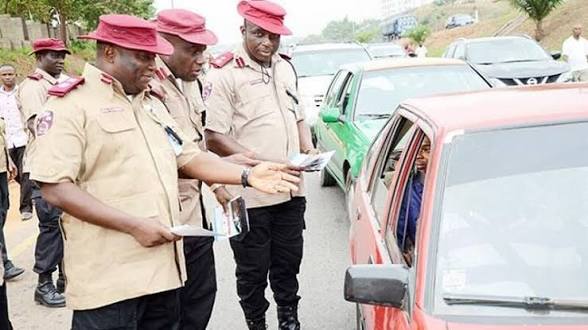
The Federal Road Safety Corps (FRSC) has rolled out a multi-pronged strategy to tackle one-way driving and other traffic violations in the Federal Capital Territory (FCT).
Osondu Ohaeri, the corps public education officer disclosed this in an interview, stating that the agency has intensified enforcement, public education, and stakeholder collaboration to address the growing trend.
He said the corps now conducts targeted patrols at identified hotspots, especially along high-risk corridors.
“On the enforcement front, we conduct targeted patrols at identified hotspots, including the Lugbe-Airport road axis towards Nyanya and other routes within the FCT.
“We also carry out special intervention patrols based on intelligence to address specific violations,” he said.
Ohaeri added that the FRSC is working closely with stakeholders to ensure strict enforcement and prosecution of offenders.
According to him, the corps is collaborating with the mobile court and the federal ministry of justice to ensure swift prosecution.
“Sanctions include fines, licence penalties, and in severe cases, offenders who fail to comply may face prosecution that could lead to imprisonment,” he said.
He noted that beyond enforcement, attitudinal issues among motorists remain a major cause of one-way violations.
“One-way violations are fundamentally attitudinal. Some motorists are not even aware of the implications of their actions.
“That is why we have intensified sensitisation campaigns through media engagement,” he said.
The FRSC spokesman explained that the corps also engages communities through grassroots advocacy to promote compliance with traffic regulations.
“We carry out community outreach programmes and meetings at the grassroots, including engagements at motor parks and with local leaders.
“When you take these engagements down to the grassroots, you deepen understanding and strengthen compliance.
“However, compliance is improving in several corridors, but sustained efforts are still needed to achieve long-term results,” he said.
Ohaeri emphasised that road safety remains a shared responsibility, urging motorists and other road users to act responsibly.
“This change must start with every road user. Safety is a collective responsibility,” he said.