Since a ceasefire was reached on 9 October 2025, Israel has been steadily working to impose new territorial realities on the ground in Gaza, expanding westward beyond the agreement’s initial demarcation boundary to seize more land.
Israeli forces withdrew behind a ‘yellow line’ as part of the US-mediated truce deal, which saw 53% of Gaza fall under Israeli control and more than two million Palestinians crowded into the remaining territory.
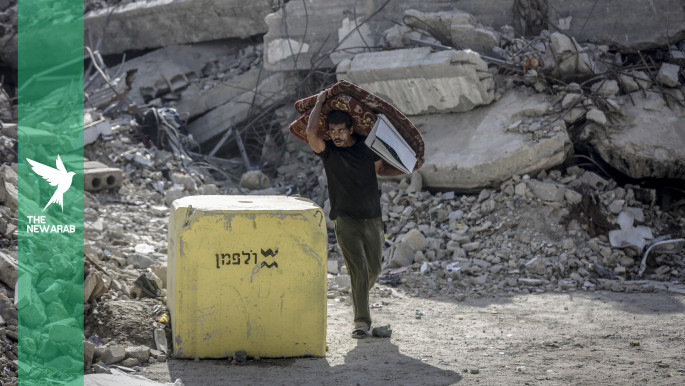
With no physical markers initially, Israeli forces enforced the ‘yellow line’ through a shoot-to-kill policy on Palestinians. Later, concrete blocks were placed to delineate the route, although from the start they deviated from the agreed-upon limits and have continued to shift westwards ever since.
New maps issued by Israel’s military in late April revealed an expanded restricted area encompassing a further 11% of Gaza’s territory beyond the ‘yellow line’ marked in orange.
The new markings were reportedly sent to aid groups in March and show two-thirds of Gaza’s territory effectively cordoned off from Palestinians, according to the Gaza Centre for Human Rights.
“They want to put as many Palestinians as possible in the smallest area in order to drive them out because of the absence of any viability or any sustainability in what’s left of Gaza,” Jad Isaac, director general of the Applied Research Institute-Jerusalem, an independent Palestinian think tank in the occupied West Bank, said.
‘Orange line’
The expansion of the ‘orange line’ means 2.1 million displaced Palestinians have been forcibly crowded into an area of Gaza no larger than 35% of its former size.
Amid the collapse of basic services and already dire health conditions, in addition to regular Israeli bombardments, Gaza’s humanitarian catastrophe is set to worsen.
This unilateral expansion on the ground has coincided with intensive negotiations and meetings held in Cairo since 15 April between Hamas and other Palestinian factions and the high commissioner of US President Donald Trump’s ‘Board of Peace’, headed by Nikolay Mladenov.
Talks were aimed at moving to Phase Two of the ceasefire deal, but have not led to a breakthrough, with Palestinian factions insisting that Israel first abide by the terms of Phase One.
Since October 2025, Israel has killed at least 800 Palestinians in Gaza, including the assassination of senior Hamas leaders and the head of its military wing.
Israel is insisting on the disarmament of Hamas and Palestinian factions while failing to comply with its obligations under the truce’s first phase, including allowing the entry of aid and beginning the reconstruction of the devastated territory.
Hamas political bureau member Abdel Jabbar Said said the movement had repeatedly indicated in meetings with mediators its rejection of “this expansion on the ground and the attempt to impose a fait accompli” by Israel.
Speaking to The New Arab, he said Hamas would not enter Phase Two negotiations unless Israel fulfils its obligations under Phase One, which include the entry of aid, a military withdrawal, the entry of a Palestinian technocratic committee, and a halt to military attacks on civilians and officials.
“For us, it must end, and there must be a withdrawal and no stopping at the so-called ‘yellow line’. Therefore, we certainly reject expansion into the so-called ‘orange line,’” he said.
“We insist on this position and do not accept a policy of imposing a fait accompli on us under any circumstances.”
Youssef Mousa, an Islamic Jihad official based in Lebanon, said that the movement views the creation of the ‘orange line’ and the expansion of prohibited areas in Gaza as part of an Israeli policy of creating facts on the ground by force.
“These measures on the ground are part of Israeli efforts to create security belts that strengthen its control and military movements, while politically they reflect an attempt to pressure the resistance and impose new equations that serve its objectives in any future arrangements or negotiations,” he told TNA.
Israel has long used ‘buffer zones’ and accompanying military measures as preparatory tools to establish control over newly-occupied land, whether in the Golan Heights, south Lebanon, Syria, or the West Bank.
A new reality
According to political writer and analyst Iyad al-Qarra, Israel is attempting to engineer facts on the ground in Gaza in parallel to ceasefire talks, in which territorial withdrawal from eastern-occupied territories is being discussed.
This builds on the policy of Israeli-backed militias being allowed to operate in newly occupied areas, protected and supported by Israel’s military.
Together with ongoing demolitions, particularly in areas east of Shujaiya in northern Gaza and Khan Younis in the south, Israel is deepening the scope of its control of occupied territory.
Al-Qarra explained that the ‘yellow line’ previously included several residential buildings and homes, which have now been demolished. According to rights groups, large tracts of agricultural land, homes, and businesses east of the yellow line have also been destroyed, in addition to structures west of it.
The army has established at least 32 outposts along the yellow line, with reported plans to create a physical barrier. In December 2025, the chief of staff of the Israeli army was recorded telling soldiers that the ‘yellow line’ is the “new border”.
Article translated from Arabic by Afrah Almatwari. To read the original, click here
Edited by Charlie Hoyle