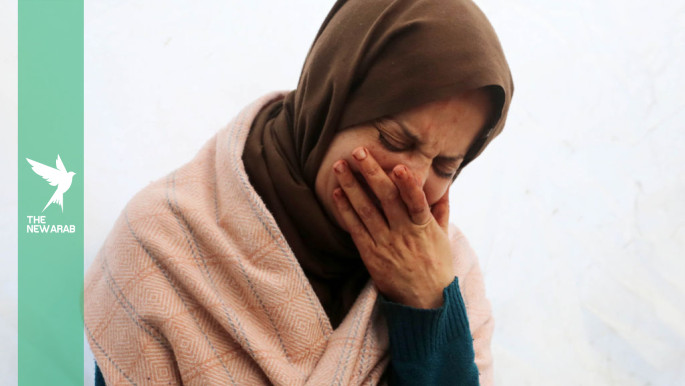
“There is no time to stop. Women continue to cook, clean, care for children, and search for necessities while still in shock. The trauma does not pause, so the body and mind cannot recover,” said Najla Abu Khater, a Gaza-based psychologist. [Getty]
On Monday, in Khan Younis’s al-Mawasi, Rasha Yousef Abu Jazar, 36, was preparing food in a tent with her four daughters when clashes erupted nearby between Israeli-backed militias linked to Ghassan al-Dahini and Palestinian security forces.
Local sources and eyewitnesses told The New Arab the confrontation quickly erupted, and during the chaos, Israeli drones reportedly struck the area, killing Rasha instantly along with her unborn child.
One of her daughters, according to relatives, remained beside her mother’s body in a state of shock, unable to process what had happened. Another was described as crying uncontrollably, her grief coming in waves that did not settle. A third stood frozen, unable to comprehend the scene unfolding in front of her.
For their aunt, Buthaina Abu Jazar, the memory remains difficult to recount.
“Rasha was very simple […] Her entire life was her children. She didn’t think beyond them,” she told TNA.
“She used to dream of them going to school safely, of the end of war, of a normal life like any other children in the world. Even when she smiled, you could feel the fear behind it. All mothers here live with that fear,” she said.
“How do you tell children their mother is not coming back? How do you explain that the person who made them feel safe has suddenly become a memory? The emptiness she left is not only in this tent. It is in every detail of their lives,” the aunt added.
That absence is most visible in Hiba, Rasha’s 16-year-old daughter. She told TNA, “At first, I didn’t understand […] I thought she was injured and would return. I kept waiting.”
“When they told me she was gone, it felt like everything stopped. My mother was my closest person. She was my friend. I used to tell her everything. She always told me the war would end, and we would live normally again. Now I don’t know what life is without her,” the young girl described.
Women bearing the brunt
Rasha’s death was part of a broader pattern in the Gaza Strip.
On Tuesday, the Israeli army also shot and killed another Palestinian woman in the al-Atatra area, west of Beit Lahia, following reports that Israeli gunboats fired at tents in the al-Salatin area, where displaced families take shelter.
On the same day, local sources in Khan Younis reported the killing of three Palestinians after an Israeli airstrike targeted a police post.
The strike was part of an ongoing bombardment across the Gaza Strip, which continues alongside a deteriorating internal security situation and fragmented control on the ground.
Since the start of the Israeli genocidal war, Palestinian women have borne a disproportionate share of its consequences, far beyond direct exposure to bombardment. It includes repeated displacement, the loss of family members, the collapse of health and social systems, and the transformation of daily survival into a continuous struggle.
According to UN Women, more than 38,000 women and girls have been killed in Gaza since the beginning of the war. However, the organisation notes that the true figure may be higher due to bodies remaining under rubble and the breakdown of documentation systems.
UN Women also estimates that around 11,000 women and girls have sustained permanent disabilities as a result of injuries, delayed medical access, or the inability of the health system to respond in time.
Beyond the figures lies a deeper transformation. Pregnancy and childbirth—already high-risk in Gaza before the war—have become life-threatening in the absence of functioning hospitals.
Many women are currently giving birth in tents or overcrowded shelters, without adequate medical care or follow-up, leading to preventable complications and deaths.
The report also highlights another dimension of the crisis: women have increasingly become the primary providers for their families, particularly after the loss of husbands or male breadwinners.
At the same time, they are expected to navigate extreme shortages of food, clean water, and basic services.
This convergence of roles—caregiver, provider, survivor—has placed women under sustained physical and psychological pressure, with little to no access to recovery or support.
A cycle of trauma with no pause
Najla Abu Khater, a Gaza-based psychologist, told TNA that the situation is a “continuous cycle of trauma that never pauses.”
“What we are seeing is no longer just the impact of war; it is the daily reproduction of pain,” she said.
She explained that women in Gaza are not experiencing isolated incidents of loss, but an ongoing accumulation of trauma, “It is displacement after displacement, death after death, fear after fear. Women are carrying grief that is constantly renewed, without any space to process it.”
“There is no time to stop. Women continue to cook, clean, care for children, and search for necessities while still in shock. The trauma does not pause, so the body and mind cannot recover,” she added.
Over time, the psychologist warned, this sustained pressure leads to long-term consequences.
“We are already seeing widespread psychological exhaustion, depression, and anxiety. But these are not temporary effects. They will continue long after the war ends,” Abu Khater concluded.
Back in al-Mawasi, Rasha Abu Jazar’s story has become part of a wider pattern—one in which women’s lives are reshaped not only by death, but by the conditions of survival that follow it.
Her dream, like that of many mothers in Gaza, was simple: to raise her children in safety, to see them grow without fear, to imagine a future beyond displacement. Instead, her daughters are left navigating a world abruptly stripped of its centre.