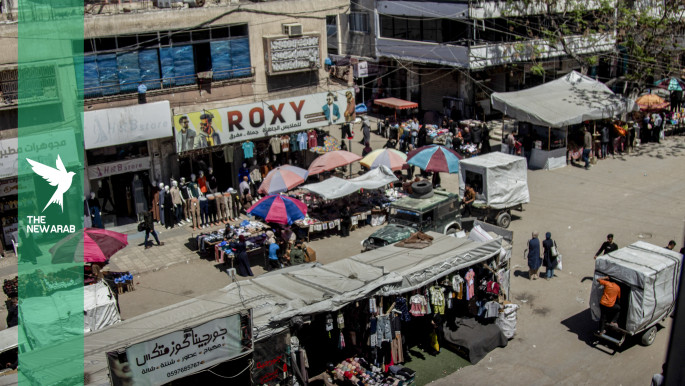
In Gaza, when doors close, people open windows. When electricity disappears, they create light from the sun. When roads and markets collapse, a tent becomes a kitchen, a sidewalk becomes a shop, and a mobile phone becomes a portable business.
In a place the world often sees only through the lens of war and destruction, there is another angle rarely captured by cameras: that of people who chose to live despite everything, building livelihoods from the depths of the rubble.
Inside camps, between torn tents, in besieged alleyways and within homes stripped of windows and doors, small businesses are born.
From simple solar energy units to alternative internet services and home kitchens inside displacement shelters, these enterprises are not merely sources of income, but daily acts of resistance, a message that life is stronger than war.
In Gaza today, many people no longer wait for formal jobs or fixed salaries. Israel’s war on the enclave has imposed a new model of work.
A young man charges phones for a small fee. A young girl sells handmade school notebooks. A mother bakes pastries from limited ingredients. A young man offers delivery using an animal-drawn cart.
Every viable idea becomes a business. Every simple skill becomes a means of survival.
These businesses do not create fortunes, nor do they appear in stock market reports. But they form what can be called a survival economy, built around essential needs such as light, communication, food, water, transport, repairs, education and phone charging.
When electricity vanished, the sun appeared
For years, Gaza’s residents have known what electricity outages mean; however, during the latest war, the power crisis became far harsher.
Electricity disappeared for days; generators stopped running due to fuel shortages; charging a phone became a luxury, and turning on a small light at night became a dream.
In one camp west of Gaza City, 29-year-old Mohammed Abu Ouda sits outside his tent surrounded by small solar panels, wires and used batteries he collects from destroyed homes.
“Before the war, I worked in an electrical supplies store. When it was destroyed, I lost everything,” Mohammed tells The New Arab.
“But I know how to connect wires and repair batteries, so I started charging neighbours’ phones for free, and then people asked me to install small systems inside their tents.”
What started as a simple gesture of help became a small business within months.
Mohammed started buying used solar panels, repairing damaged ones, and then installing them for families at heavily subsidised prices. Some systems power a single bulb, others run a small fan or charge several phones.
In the camp, people now call Mohammed’s tent ‘The Light Station.’ Women and children line up daily to charge phones, power lighting batteries, and sometimes print papers or connect a small router.
Smiling, he adds, “I don’t just sell solar panels: I sell people a little peace of mind.”
When an internet connection becomes a lifeline
During war, the internet is not a luxury — it is how people learn who survived, who was killed, where bread is available, when aid convoys are moving, and it is how a mother in North Gaza stays connected to her son in the south.
But with damaged networks and constant power cuts, internet access in Gaza has become a daily battle. That is when unconventional micro-businesses appeared, led by young people who understand that connectivity could be both a livelihood and a humanitarian service.
In Deir al-Balah in central Gaza, 24-year-old Ahmed Al-Najjar established an alternative internet point using a wireless transmitter, a car battery and a strong subscription from a local provider.
He says, “I saw people walking for kilometres just to find a signal. I thought, ‘Why not bring the network to where they live?'”
Ahmed mounted the device on a metal pole near his tent and began selling daily passwords at very low prices, sometimes even for free, to students, journalists, patients, or families with relatives abroad.
Within weeks, the place became known as ‘The Network Corner.’ People gather at certain hours when the battery is charged, sit on the ground, raise their phones in the air and send brief messages to the world.
“Once a woman told me while crying, ‘Through your connection, I learned my son is alive,’” he says, “That made me realise that my project was bigger than money.”
He adds, “Yes, I sell subscriptions. But sometimes I sell news that revives a mother’s heart.”
Tent kitchens: Turning hardship into hot meals
For 45-year-old Samaah Al-Khudari, who wakes up before dawn, lights a fire with wood or cardboard and begins cooking, the modest income has helped her buy diapers, medicine and winter clothes. But more importantly, she says, it has restored her sense of capability — that she is not merely a recipient of aid.
Children arrive carrying plastic containers while women wait for their turn. With a tired smile, she says, “I don’t only sell food; I sell one hour of relief to an exhausted mother.”
Inside displacement centres, one of the greatest crises has been food — not only its shortage, but the difficulty of cooking it.
Many families have no tools, no gas and inadequate space. Out of that need came dozens of tiny home kitchens inside tents or partially damaged houses run by women who have lost husbands, jobs or homes, choosing to turn their culinary skills into a source of income and support for others.
In Khan Younis in southern Gaza, 43-year-old Umm Louay lives in a tent with five children. Before the war, she prepared meals for neighbourhood events. After being displaced during the latest war, she began cooking a large pot of lentils each day and selling portions.
“At first, I only cooked for my family,” she says, “Then neighbours asked to buy my food because they had no firewood and no time. That’s how the idea for my tent kitchen began.”
Gradually, she developed a daily menu which includes rice and vegetables, lentil soup, simple taboon bread and maqluba when the ingredients are available.
One striking feature of these ventures is that women are at their forefront. With many men losing jobs, being injured or killed, women have carried the burden of supporting families.
In camps, one finds women making soap, selling tea and coffee, sewing clothes, tutoring children for small fees, or running small kitchens.
Social researcher Samar Al-Kahlout from Gaza says, “In major crises, women’s capacities become especially visible. The Gazan woman does not wait long. She immediately asks herself: What do I have? What can I do? How do I protect my children?”
The challenges of finding capital
Despite their spirit of initiative, these businesses face severe challenges. Many lack capital, launching only with what the business owners already own.
There is a shortage of raw materials as borders remain closed and heavily controlled; without regular imports, the supply of goods is unstable.
Then there is the issue of weak purchasing power, as Gazans can barely afford essentials. As airstrikes continue to take place intermittently, business owners risk losing everything in a matter of moments. And yet these enterprises continue — because the alternative is total emptiness.
These small businesses are not simply a collection of uplifting stories; they are profound social evidence of the human ability to rebuild lives under the harshest conditions.
When a young man builds an energy system from war debris, he is saying destruction can be recycled into light. When a woman opens a kitchen in a tent, she is saying home can begin with a pot over a fire. And when a young man creates an alternative internet network, he is saying isolation is not destiny.
These small ventures may seem modest to the outside world, but inside Gaza, they mean the difference between despair and endurance, between total dependence on aid and the ability to stand, even slightly, on one’s own feet.
In a place the world has grown used to seeing only through images of devastation, there is another image that deserves to be seen: people lifting their shops from the dust, turning a crisis into an idea, an idea into income and income into dignity.
Haya Ahmed is a doctor and freelance writer from Gaza