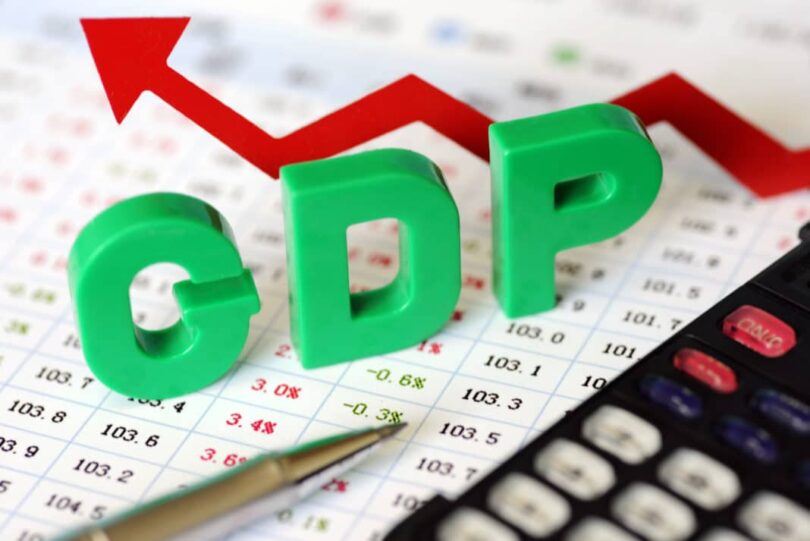
Some economic experts have expressed mixed reactions to Nigeria’s 4.43 per cent Q2 2026 Gross Domestic Product, GDP, growth, with some saying it is yet to translate into improved living standards for most Nigerians.
The experts spoke with the News Agency of Nigeria in Abuja on Tuesday, while reacting to the latest GDP figures released by the National Bureau of Statistics, NBS.
The NBS had reported that Nigeria’s real GDP grew by 4.43 per cent year-on-year in Q2 2026, higher than the 4.23 per cent recorded in quarter two of 2025.
The NBS report also showed that the agriculture sector grew by 4.39 per cent in Q2 2026, compared with 2.82 per cent in Q2 2025.
The industry sector, however, recorded a lower growth rate of 3.96 per cent, down from 7.46 per cent in Q2 2025, while the services sector grew by 4.60 per cent, compared with 3.94 per cent in the corresponding period of 2025.
The services sector remained the largest contributor to GDP, accounting for 56.62 per cent of aggregate GDP in Q2 2026, slightly higher than its 56.53 per cent recorded in Q2 2025.
In nominal terms, aggregate GDP stood at N119.29 trillion in Q2 2026, compared with N100.73 trillion in Q2 2025, representing an 18.43 per cent year-on-year increase.
The experts agreed that the 4.43 per cent Q2 growth represented an expansion in economic activity but cautioned that it should not, on its own, be taken as evidence of a broad-based recovery.
They said stronger and more sustainable growth would require improved productivity in the real sector, greater job creation, lower production and transportation costs.
They said it would also require increased investment in human capital and measures that would raise the purchasing power of households.
They stressed the need for policies capable of ensuring that growth is translated into better living conditions for the majority of Nigerians.
Prof. Ken Ife, a development economist, said although GDP growth remained an important measure of economic performance, it did not necessarily reflect the welfare of citizens.
Ife said GDP measured aggregate production and consumption but did not adequately capture poverty, income disparities, purchasing power and differences across sectors of the economy.
“The GDP growth does not reflect the state of the economy in respect to citizen welfare.
“It does not reflect poverty issues or disparities in the many sectors and subsectors of the economy,” he said.
He expressed concern about the performance of the industrial sector, particularly manufacturing, saying the sector was not growing strongly enough to drive employment creation.
“When you look at manufacturing, you see that it was pathetic, around 1.3 per cent to 1.5 per cent, while overall industry is 3.96 per cent, which is much lower than 4.43 per cent.”
Ife said the development suggested that the real sector was not yet playing a sufficiently strong role in driving economic expansion.
“The real sector should be generating employment and creating jobs, but it is not driving growth,” he said.
The economist also drew attention to the wide gap between nominal and real GDP growth.