
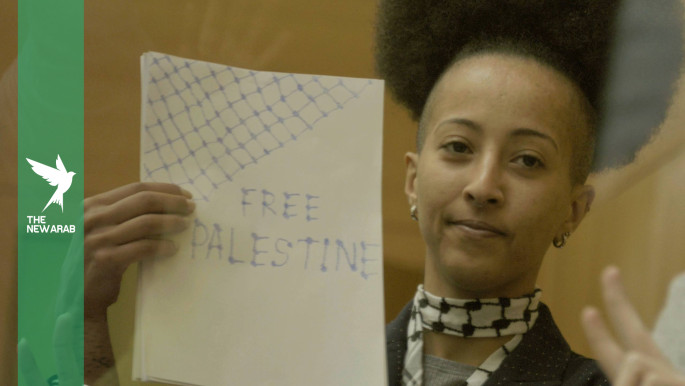
The Ulm5 represent the best of us, unwavering in their acknowledgement of Palestinian suffering, writes Hebh Jamal. [Photo: Hubertus Koch]
I sat alongside dozens of other supporters of the Ulm5, five pro-Palestinian activists who allegedly destroyed an Elbit Systems factory in Ulm to protest Germany’s complicity in the genocide of the Palestinians. When we saw Vi, Zo, Leandra, Crow and Daniel for the first time, the entire court erupted in applause.
Some defendants, such as Daniel, are effectively subjected to solitary confinement, spending 23 hours a day locked in their cell and receiving only one hour of gym time per week. Leandra is confined to their cell for 20 hours a day. Daniel is permitted just two 30-minute visits per month, and any discussion of the case during those visits is prohibited.
Zo spent the first six hours after their arrest stripped naked and wearing only a diaper. Meanwhile, at Schwäbisch Gmünd prison, where Vi is being held, visitors, mail, and phone calls are all subject to monitoring and censorship. Vi is allowed only one visit per month, and any correspondence not written in German is withheld.
Nearly nine months into their detention, the activists remain incarcerated before any verdict has been reached, a disproportionate and uncommon response by the German state that can only be seen as a political stunt to punish the moral convictions of the activists themselves.
Yet what is arguably even more preposterous than the defendants’ pretrial conditions is the show trial currently unfolding before our eyes. The decision to hold the trial of the Ulm5 at Stuttgart-Stammheim, a venue inseparably associated with Germany’s terrorism trials of the 1970s, appears designed to send a political message long before any verdict has been reached.
The defence team has repeatedly asked the court, in writing, to explain why the proceedings are being held at the Stuttgart-Stammheim courthouse. This is not a regular courthouse in any meaningful sense. Rather, it consists of courtrooms annexed to the prison and used by the Stuttgart Higher Regional Court. For decades, Stammheim has occupied a unique place in the German political imagination as the site where members of the Red Army Faction (RAF) were tried under extraordinary security measures.
By choosing this venue, the state prejudices public perception from the outset, creating the impression that the defendants pose an exceptional danger before the court has even examined the evidence against them.
The most unreasonable figure in the courtroom, and the one whose conduct appears most consistently aligned with the state prosecution, is Judge Kathrin Lauchstädt, effectively the showrunner of this trial. Judge Lauchstädt has repeatedly refused to rule on defence applications concerning seating arrangements that would allow lawyers to sit near their clients and communicate effectively. At the same time, she has subjected both the defence and members of the public to a series of unexplained interruptions, prolonged recesses, and, what many observers, myself included, experienced as unnecessary harassment upon entering the courtroom.
I was frisked and sexually harassed by court officers, even with clear press accreditation and evidence, I visited these proceedings just days earlier.
Nonetheless, Judge Lauchstädt and State Prosecutor Ronny Stengl maintain that it does not infringe upon the activists’ rights for them to remain handcuffed behind bulletproof glass, unable to communicate properly with their legal team. Repeated requests from the defence have been met with hours-long recesses supposedly intended to consider applications, only for those applications to be routinely rejected.
The audience is not allowed to use pens and paper to take notes and serve as documented witnesses to this travesty of justice. Both the prosecution and the court have suggested that those attending the proceedings are viewed as a potential threat. As a result, the public is restricted from bringing basic items justified on grounds of “security” and the alleged fear that these objects could pose a danger or even become a weapon to the prosecution.
Pens and paper are thus treated as prohibited items, despite the presence of thick bulletproof glass separating the audience from the judge and the prosecution.
The court has even added 28 additional hearing dates, extending the trial until 8 January 2027.
Why would a court require 28 extra trial dates when the activists openly filmed themselves carrying out the action at the Elbit Systems factory and then waited to be arrested by police? The primary beneficiary of such a prolonged process appears to be the German state, which can use the extended proceedings to exhaust both the defendants and their supporters, while draining momentum from the broader pro-Palestinian movement and the campaign supporting the Ulm 5.
This is a political spectacle, and its function is to impose a broader punishment on the pro-Palestine movement itself. To the prosecutor, to Judge Lauchstädt, it is we, the audience, that are all on trial.
I sat there exhausted, listening time and time again to applications with legally sound arguments face rejection- meanwhile looking over to the Ulm5 activists, Vi specifically, since they are the closest to me- and witnessing what became the symbol of pro-Palestinian activism in Germany: the handcuffed heart. Unable to bring their hands together through the glass, Vi formed a heart shape with their restrained hands and held it toward the people watching.
Then came their statements presented on the fifth day of trial. The defendants’ statements, taken together, draw a single line through the proceedings. Daniel situates the action in a framework of urgent humanitarian necessity and complicity in atrocity, arguing that material support for Israel’s military operations cannot be separated from the realities of mass civilian suffering and systematic destruction.
Crow places the case within a broader history of colonial violence and international law violations, framing the action as part of a global demand for accountability and an end to ongoing occupation. Leandra describes participation in years of protest met with repression, and insists that direct action becomes the remaining ethical response when legal and political channels fail to stop mass killing.
Zo situates the proceedings within a wider structure of state power, arguing that repression of dissent, criminalisation of solidarity, and courtroom practices themselves reveal the political nature of the trial and the system that produces it. Vi focuses on the material reality of Elbit Systems’ role in producing the weapons and surveillance technology used in Gaza and the occupied West Bank, describing a direct chain between corporate production, state policy, and civilian destruction, and arguing that the presence of such a company operating freely in Germany makes the location of the trial itself part of the same system being contested.
Across all statements, the same position is repeated with different emphases: this is not an isolated criminal case, but a confrontation with a system that enables and protects large-scale violence, and which now turns its attention inward toward those actually attempting to abide by international law.
Shackled, the Ulm5 represent the best of us, unwavering in their acknowledgement of Palestinian suffering; they shine their handcuffed love back to us, and, in their statements, reaffirm that they are on the right side of history.
The court and the state believe they can use spectacle as deterrence. They believe that by grinding the Ulm5 through pre-trial detention, by burying the defence in procedure, and by turning the courtroom into a controlled space of intimidation, they can break the movement before it grows stronger.
What they are trying to do to the Ulm5 is meant for all of us. It is meant to discipline solidarity with Palestine and criminalise those who refuse complacency. Elbit Systems will not appear in the sentencing. The machinery of violence they are connected to will remain untouched in the record.
However, what the state cannot contain is what this trial has already exposed: that the defendants are not alone in their hatred of injustice, but they are a part of an international reckoning and political rupture that is demanding an end to decades of systematic imperial violence against oppressed people. The state is struggling to suppress it.
In the end, this trial doesn’t just judge the Ulm5; it puts the state itself on trial before all who witness it.
Hebh Jamal is a Palestinian American journalist based in Germany.
Follow Hebh on X and Instagram: @hebh_jamal
Have questions or comments? Email us at: editorial-english@newarab.com
Opinions expressed in this article remain those of the author and do not necessarily represent those of The New Arab, its editorial board or staff.