When we talk about the Nakba, viewing it as a single date is a mistake. May 15, 1948, is the formal date associated with it, but that is actually the date of the creation of the State of Israel.
To understand the Nakba properly, one must see it as a much longer process that started years before 1948 and continued for years after. It wasn’t a sudden disaster where everything was fine on May 14 and ruined on May 16; rather, it was the result of the Zionist movement working to gain control of Palestine.
The physical expulsions began in 1947 and continued actively through 1949. My family was expelled in April 1948, but the process for others continued long after we were gone.
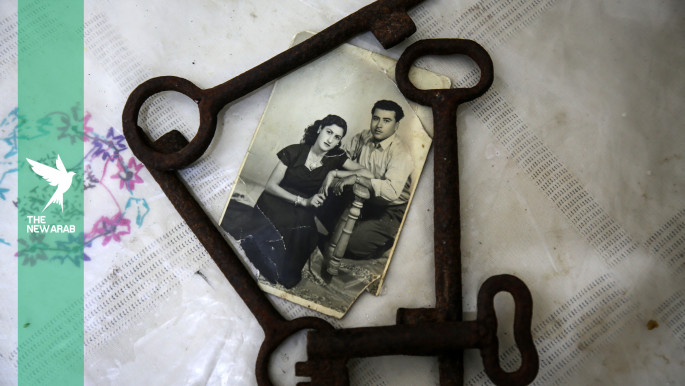
What does the Nakba mean to me? I have no words to describe the rupture that overtook my life as a child. I knew nothing of politics; I only knew my home and our village helper, Fatima. I could never have foreseen that my world would be shattered and never return. I never saw Fatima again, and when I finally saw my home years later, an Israeli family was living in it — an experience that was extremely painful.
While the impact was immediate for those in refugee camps, for families like mine who found employment in London, the trauma was more subtle. It was the “subtle exile” of feeling like you don’t belong anywhere — growing up in England but not being English, while your country of origin is occupied by others.
We didn’t have the luxury to sit and process our trauma; we had to survive. We had to “run with the herd,” but we paid a heavy price that I am still paying today. There is a tragic irony in the fact that we took refuge in Britain, the very country responsible for the loss of Palestine.
As a child, I asked my father why we were living in the country that “sold” our land to the Zionists. He was likely embarrassed or ashamed, but the reality was that survival was the only priority. In 1948, you couldn’t choose your job or your location; you went where there was work. My father found work in London to ensure our well-being, even though it meant living in the heart of the power that authored our tragedy.
As I grew up and received an education, I began to understand the history, which made me — and still makes me — extremely angry. Europe, which had persecuted Jews for centuries and produced the Holocaust, sought to ease its own conscience by exporting the people they had wronged to a third country: Palestine.
We had nothing to do with Nazism or European anti-Semitism, yet we became the “dumping ground” for an unwanted people because Europeans felt guilty but did not want the Jews in their own countries. I cannot forgive or forget that we were made to pay for Europe’s crimes.
When I look at the Nakba today, it is heartbreaking to realise it never ended — it only got worse. In my opinion, the genocide in Gaza and the ethnic cleansing in the West Bank today are worse than the original Nakba. During the events of 1947-1949, most of us at least survived to fight and eventually create the PLO. Today, the very survival of Palestinians is threatened. We face a formidable enemy in the “Israel-U.S.” alliance, supported by Western states that continue their backing despite the genocide. It leaves one with a profound sense of helplessness.
To stop our erasure, we must unite. Israel has been successful in fragmenting us — separating people like me in London from refugees in UN camps. We must reject this fragmentation and realise we are the same people.
I believe the only long-term solution is to replace the Zionist apartheid state with a single democratic Palestinian state. This state would offer equality of citizenship to everyone, including the descendants of the settlers. While it is difficult to say we must live with those who deprived us of our country, I believe it is the only realistic and humane path forward.
I genuinely believe that Israel, in its current form, cannot survive. It is a state that defines itself through war; it cannot function in peace because its identity is built on having enemies to kill.
If the fighting stopped for five minutes, the state would be forced to confront its lack of authenticity and the reality that everyone around them is alienated. It is not a sustainable way to live. While they have the support of the United States for now, a nation that survives only by “biffing” and killing anyone who speaks out cannot last.
A final memory illustrates how my father viewed our situation. We lived in Golders Green, a very Jewish area of North London. When I asked him why we were living among the people who caused our displacement, he gave me an analogy: If a householder leaves their windows and doors open at night and thieves steal their belongings, whose fault is it? He argued that Britain was the householder who left the doors open, and the Zionists were the thieves who simply walked in. To him, the primary blame lay with the British for allowing the tragedy to happen in the first place.
Ghada Karmi is a former research fellow at the Institute of Arab and Islamic Studies, University of Exeter. She was born in Jerusalem and was forced to leave her home with her family as a result of Israel’s creation in 1948. The family moved to England, where she grew up and was educated. Karmi practised as a doctor for many years, working as a specialist in the health of migrants and refugees. From 1999 to 2001, Karmi was an associate fellow of the Royal Institute of International Affairs, where she led a major project on Israel-Palestinian reconciliation.
Follow Ghada on X: @ghadakarmi
Have questions or comments? Email us at: editorial-english@newarab.com
Opinions expressed in this article and video remain those of the author and do not necessarily represent those of The New Arab, its editorial board or staff.