Palestinian militant group Hamas has dissolved the body that has governed the Gaza Strip for nearly two decades, paving the way for a United States-backed technocratic committee to assume civilian rule, in a move analysts describe as largely symbolic but politically significant.
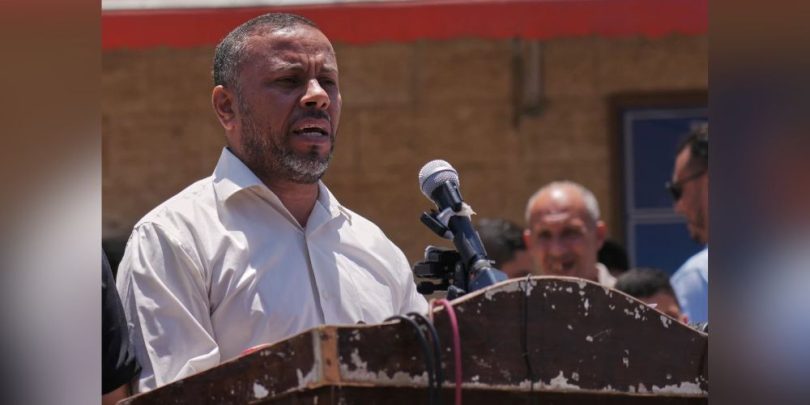
The head of Hamas’s Governmental Emergency Committee, Mohammed al-Farra, formally submitted his resignation on Monday and dissolved the committee, according to Ismail al-Thawabta, head of Hamas’s Government Media Office, who addressed a press conference at Al-Aqsa Hospital in Deir al-Balah.
“He has also decided to dissolve the committee to facilitate the administrative and governmental transition to the National Committee for the Administration of Gaza,” al-Thawabta said.
Hamas spokesperson Hazem Qassem said the group had taken the step to remove any obstacle to Gaza’s administration.
“Hamas has taken a new step in that it will no longer be in charge of the Gaza Strip, in order to remove any pretexts for the occupation, which continues its aggression,” he said.
The National Committee for the Administration of Gaza, known as the NCAG, was established under a United Nations Security Council resolution and headed by Palestinian technocrat Ali Shaath.
It has remained based outside Gaza for months due to Israeli objections to its entry into the territory.
Hamas said the decision was coordinated with mediators in Egypt, Qatar and Turkey.
The group called on all parties to accelerate the entry of the NCAG into Gaza to “strengthen the resilience of our noble Palestinian people and heal their wounds.”
Notably, Hamas made no mention of disarmament in its statement, which remains the central requirement under the second phase of U.S. President Donald Trump’s 20-point peace plan.
Senior Hamas leaders including Khaled Mashaal and Musa Abu Marzouk have rejected disarmament in recent months despite agreeing to the plan in October 2025.
All current employees of Hamas’s civilian apparatus will continue to serve under the NCAG, raising questions about how much has practically changed on the ground.
An Israeli official dismissed the move, telling public broadcaster Kan that it was “a spin that means absolutely nothing.”
The official added: “Hamas fears it will be found to be in violation of the agreement, so it is buying time and engaging in spin.”
Israeli forces have expanded their presence in Gaza in recent months, now controlling nearly 70 per cent of the territory.
The transition to the ceasefire’s second phase, which requires Hamas’s disarmament and a gradual Israeli withdrawal, has been stalled for months.
Hamas has governed Gaza since seizing control from the Palestinian Authority’s Fatah movement in 2007, following its victory in legislative elections the previous year.