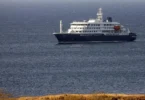
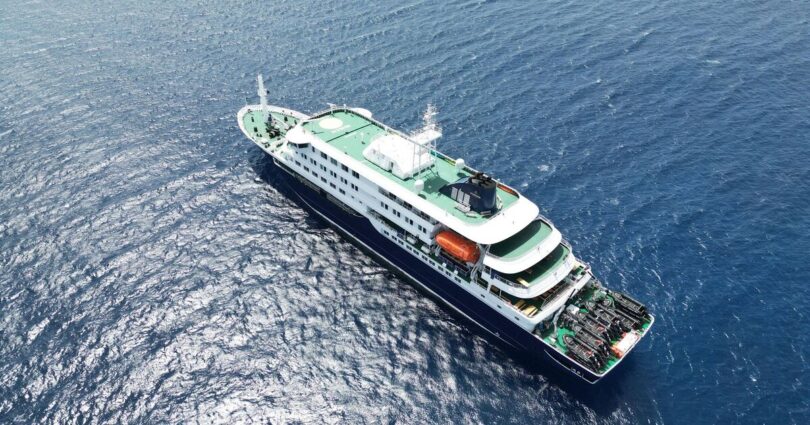
Seven people have been struck down by a deadly virus — and three people have died — after an outbreak on a luxury cruise ship in West African waters packed with British holidaymakers.
The World Health Organisation confirmed on Monday that two cases have been laboratory-confirmed and five are suspected following the outbreak on the Dutch-flagged MV Hondius, which is currently held off the coast of West Africa.
One passenger is in a critical condition while three others have so far shown only mild symptoms. A British man who fell ill on 27 April left the vessel and is currently being treated at a private clinic in Johannesburg, South Africa.
Around 150 passengers remain stranded after Cape Verde authorities barred the ship from docking over safety concerns.
Oceanwide Expeditions said it was exploring whether passengers could be screened and disembarked on the islands of Las Palmas and Tenerife.
Who has died in the MV Hondius hantavirus outbreak?
Of the three people who have died – two are a Dutch couple and one a German national. The Dutch victims were a 70-year-old man who passed away on St Helena on 11 April and his 69-year-old wife, who collapsed at Johannesburg’s O.R. Tambo International Airport and died in South Africa weeks later. A German passenger on board died on 2 May.
Operator Oceanwide Expeditions said it has not yet been confirmed whether the Dutch couple died from hantavirus. The cause of the German passenger’s death has equally not been established.
The ship is attempting to arrange the repatriation of two crew members with symptoms — one British and one Dutch — along with the body of the German national and the return of a surviving travelling companion who does not have symptoms, reports the Canadian news outlet CBC.
What is hantavirus and how is it spread?
Hantavirus is a potentially deadly disease affecting the respiratory system. It is typically contracted by inhaling airborne particles from infected rodent waste and rarely passes from person to person. No antiviral treatment exists – doctors focus on keeping patients stable, using ventilators in the most serious cases.
The illness can take between one and eight weeks to develop, initially presenting with flu-like signs including tiredness and high temperature.
A spokesperson for the Netherlands’ National Institute for Public Health and the Environment, which is assisting with the outbreak, said the source remained unclear.
“You could imagine, for example, that rats on board the ship transmitted the virus,” he said. “But another possibility is that during a stop somewhere in South America, people were infected, for instance via mice, and became ill that way.”
What happens next for passengers on the MV Hondius?
The WHO played down fears of a wider outbreak, saying the public health risk was minimal and that neither panic nor travel restrictions were warranted.
The Hondius departed Ushuaia in southern Argentina in March on a voyage marketed as an Antarctic nature expedition. Berth prices ranged from 14,000 to 22,000 euros — roughly £12,000 to £19,000 — for a route taking in mainland Antarctica, the Falklands, South Georgia, Nightingale Island, Tristan, St Helena and Ascension before reaching Cape Verdean waters on 3 May.
US travel blogger Jake Rosmarin, posting from the ship, said in an emotional video: “We’re not just headlines. We’re people with families, with lives, with people waiting for us at home.”