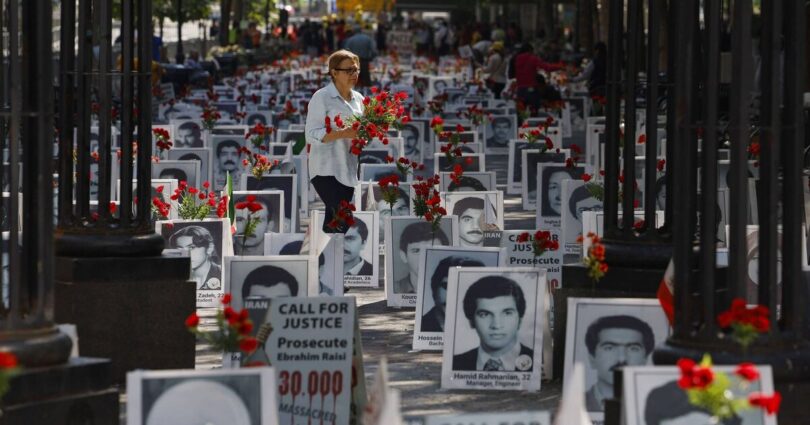
Iranians and allies all over the world have demonstrated and held memorials for political prisoners (Image: Getty)
As the United States prepares to sign a ceasefire memorandum with Iran’s Islamic Republic, the Islamic Revolutionary Guard Corps (IRGC) has executed two demonstrators detained in connection with the January 8 protests — an uprising during which regime forces deployed machine guns, killing between 12,000 and 30,000 people.
Javad Zamani and Abolfazl Saedi, accused of causing property damage during the protests, were put to death by Iranian authorities on June 16, 2026.
Iran Human Rights (IHRNGO) has revealed that state media broadcast coerced confessions ahead of announcing the executions. Many detainees face fabricated charges and are rushed through sham court proceedings, where they frequently “confess” under duress.
Since March 19, at least 20 protesters have been executed in relation to the January 2026 unrest, which first erupted on December 28, 2025.
Iranian authorities responded with what human rights organisations have described as an unprecedented and deadly crackdown, severing all internet access from January 8, 2026. Security forces deployed live ammunition and other prohibited weapons against protesters, resulting in mass casualties and severe injuries.
Verified video footage and eyewitness accounts reveal that security forces positioned in streets and on rooftops — including atop homes, mosques and police buildings — repeatedly discharged rifles and shotguns loaded with metal pellets at demonstrators, frequently targeting their heads and chests. Those engaged in the crackdown included the IRGC and its Basij units, multiple branches of Iran’s police force (known by the Persian acronym FARAJA), as well as plainclothes operatives.
Authorities conducted large-scale killings of protesters, particularly on Jan. 8 and 9, when the death toll soared into the thousands. Amnesty International research indicates that January 2026 represented the bloodiest period of repression by Iranian authorities in decades.
In the wake of the violence, hundreds were detained, and many remain facing execution. Condemning the death sentences, IHRNGO called upon the international community to take coordinated action to halt executions in Iran.
IHRNGO Director Mahmood Amiry-Moghaddam said the two executions, like others, followed proceedings that “did not meet even the minimum standards of a fair trial” and were designed to intimidate the public and discourage future protests. He went on to say that with an agreement now in place to bring the war to a close, governments professing to champion human rights – particularly those across Europe – ought to prioritise Iran’s human rights record and an end to executions as paramount concerns.
He urged that an immediate halt to the death penalty should form a fundamental condition of any normalisation of ties between the European Union and the Islamic Republic.

Fires are lit as protesters rally on Jan. 8, 2026 in Tehran, Iran (Image: Getty Images)
Maryam Rajavi, the President-elect of the National Council of Resistance of Iran, also paid tribute to the protesters on X. “We honor these courageous souls. The people of Shahroud, Semnan, and the brave youth of Iran will not meet such brutal crimes with silence. Executing those who rise for their country’s freedom only strengthens the resolve of Iranian youth to end this illegitimate regime,” she wrote.
Rajavi additionally called upon the UN and the wider international community to denounce the IRGC’s execution of political protesters and prisoners.
Former Crown Prince Reza Pahlavi also weighed in on the executions, adding his voice to appeals for the international community to condemn the killings.
“The Islamic Republic, simultaneously with the signing of the “peace” memorandum of understanding, executed two more protesters from Jan. 8 and 9 named Javad Zamani and Abolfazl Saedi. This is the outcome of deals and compromises with a criminal regime,” Pahlavi began.
The former royal warned, “Agreeing with a regime that, in just two days, murdered more than 40,000 protesters is not only morally wrong but also a catastrophic strategic error. Engagement with this regime is doomed to fail, and we will all pay the price for its consequences.”

Iran’s Jan. 8 protests led to government forces confronting citizens with machine guns (Image: Getty)
Meanwhile, both Iran and the United States are presenting their provisional agreement to end the conflict as a victory. However, neither party has yet publicly outlined what the deal entails.
According to Pakistani officials, the memorandum of understanding — largely brokered by Pakistan — commences with Iran simultaneously reopening the Strait of Hormuz while the US lifts its blockade of Iranian ports.
The two parties would subsequently enter a 60-day negotiating period concerning Iran’s nuclear programme and the potential relaxation of sanctions, officials told the Associated Press on condition of anonymity as the document remains confidential.
This would broadly return the rivals to the position they occupied approximately three and a half months ago — prior to Israel and the US launching their Feb. 28 war on Iran, a conflict that has claimed thousands of lives across the region, stoked a global energy crisis, and destabilised the US economy with a sharp rise in inflation.