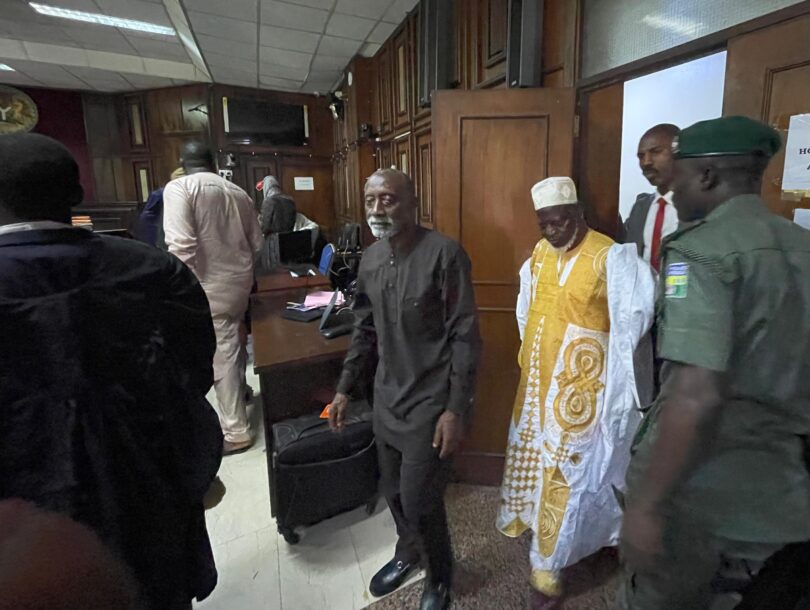
The witness, who said he serves in the Nigerian Army Corps of Military Police, gave evidence in the trial of a retired major-general and five others facing charges of treason, terrorism, failure to disclose information and money laundering.
An army officer on Wednesday testified before the Federal High Court in Abuja, detailing how investigators allegedly uncovered a plot to overthrow President Bola Tinubu and the financial and operational links between suspects.
They are being tried before Judge Joyce Abdulmalik of the Federal High Court in Abuja.
The officer, whose details including name were not given as part of a court-ordered witness protection measure, was codenamed AAA.
He told the court that intelligence reports linked Mohammed Ma’aji, a colonel, to an alleged conspiracy involving some serving and retired military officers, as well as former governor of Bayelsa State, Timipre Sylva.
AAA, who is the fourth prosecution witness, said the report, received by the then Chief of Army Staff, Olufemi Oluyede, now Chief of Defence Staff, pointed to coordination between Mr Maa’ji, Mr Sylva and other suspects standing trial.
According to him, the intelligence was assessed, found credible, and formed the basis for the investigation that led to Mr Ma’aji’s arrest and the recovery of electronic and documentary evidence allegedly linking the suspects to the plot.
PREMIUM TIMES earlier reported that the judge granted permission to the prosecution witness to testify under protective conditions. The judge gave the order after the prosecution said the measure was needed for security reasons as the trial progressed.
The measure includes allowing the prosecution witness to testify behind a shield that blocked him from being seen by the court audience. Also, the real name of the witness was not disclosed under the protective measure.
The federal government filed 13 counts of treason, terrorism, failure to disclose information and money laundering against a retired army general and five others over an alleged plot against President Bola Tinubu.
The defendants are Mohammed Ibrahim Gana, a retired major-general; Erasmus Ochegobia Victor, a retired navy captain; Ahmed Ibrahim, a police inspector; and Zekeri Umoru, an electrician at the Presidential Villa.
Others are Bukar Kashim Goni and Abdulkadir Sani, a Zaria-based Islamic cleric. They were arraigned on 22 April and all six pleaded not guilty when the charges were read in court.
At Wednesday’s proceedings, which marked the start of trial, prosecution lawyer Rotimi Oyedepo told the court that four witnesses were present and the prosecution was ready to proceed.
Three witnesses, drawn from Jaiz Bank, SunTrust Bank and Providus Bank, tendered letters obtained from the Economic and Financial Crimes Commission and their organisation responses to those letters. The letters were admitted in evidence and the witnesses responded to questions under cross-examination by defence lawyers.
When the fourth witness was called, Mr Oyedepo, a Senior Advocate of Nigeria (SAN), applied for protective measures. He prayed that the witness should be shielded to prevent “unnecessary attack” and protect the officer’s identity. He relied on Section 232 of the Administration of Criminal Justice Act (ACJA).
Lawyers to the defendants did not oppose witness protection. However, they insisted that the defence must still know the identity of the witness to ensure fair hearing.
The judge, however, granted the application and ordered that the witness’s identity be shielded. She further directed that the name must not appear in court records or proceedings accessible to parties or the public.
Led in evidence by Mr Oyedepo, the fourth prosecution witness said he knew the defendants before the court. Mr Oyedepo called the six defendants one after the other and AAA responded with “I know him, my lord.”
He told the court that individuals mentioned during investigation included Colonel Maaji and that former serving and retired officers conspired to overthrow President Tinubu.
At this point, Muhammed Ndayako, a SAN, lawyer to the first defendant, Mr Gana, objected. He said the witness should frame his testimony as allegations by using “allegedly” to describe his findings and not say it as a fact that the defendants planned to overthrow the government, as the case has not been established.
Responding, the judge, Ms Abdulmalik, told the defence lawyer that he could address it in his written address or during cross-examination, so as not to waste the time of the court.
Continuing, the witness reiterated that the “then Chief of Army Staff, Olufemi Oluyede, now Chief of Defence Staff, received an intelligence report that Mr Ma’aji was planning with some officers and former governor of Bayelsa State, Mr Sylva, to overthrow the democratically elected government of President Bola Tinubu.”
He said: “Upon receipt of the intelligence report, the report was analysed, processed and found to be credible and Mr Oluyede gave the direction to our team to investigate the allegations.”
AAA said Mr Ma’aji was arrested and his phone, a Samsung Galaxy Z series, was recovered from him.
“We also proceeded to his residence, conducted a search and recovered a jotter. Inside the jotter, we found operational plans, names and designation of ranking members of the current regime as well as officers that were to assassinate them.”
“Also, inside the jotter, we found political and structural changes to be made upon execution of the coup,” AAA testified.
He said forensic analysis of the phone revealed alleged links between Mr Ma’aji, some officers and civilians standing trial before the court.
The witness also confirmed a forensic analysis document from the Nigerian Military Police.
Lawyers to the defendants objected to the tendering of the documents but opted to canvass arguments in their final addresses at the end of trial.
The documents, volumes three and four of the proof of evidence containing thousands of pages, were admitted in evidence and marked as exhibits P7 and P8 by the judge.