
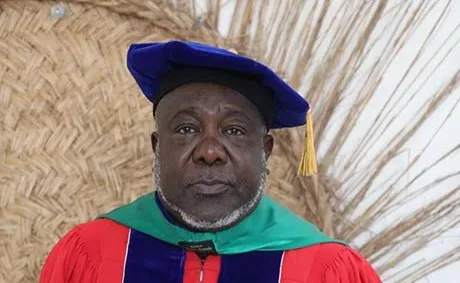
Twenty-nine years ago, a military court convicted this former army officer of sodomy. Eighteen years ago, the Supreme Court upheld the verdict. But he never served the sentence. Instead, he cleaned up his profile to become a prized academic recruit in Nigeria and abroad.
When a court convicts individuals for offences and sentences them to prison as punishment, it is expected that they immediately serve their time in jail.
But in his case, as this PREMIUM TIMES investigation found, Bello Magaji, a former military officer, never served his five-year prison sentence for sodomy imposed by the General Court Martial (GCM), a conviction later upheld by the Supreme Court.
Instead, former President Goodluck Jonathan granted him a presidential pardon many years after the conviction was affirmed by the Supreme Court. The Nigerian Army also changed his dismissal record to voluntary resignation, gave him a certificate of military service, and restored to him all entitlements for retired military officers.
Mr Magaji went ahead to further his education, secure teaching jobs in higher institutions in Nigeria and Uganda, and only last year became the Dean of the Faculty of Law at the American University of Nigeria (AUN), Yola, Adamawa State. The university, where he serves as an associate professor and recently the Dean of Faculty of Law, said it was not aware of the conviction and is looking into it.
But Mr Magaji continues to maintain his innocence in the conviction. Since the Supreme Court affirmed his conviction and sentence, nothing could be done to reverse them; therefore, he grasped at opportunities offered by various avenues to blunt retribution.
He pursued the case through Nigeria’s court hierarchies – from the General Court Martial, the Court of Appeal to the Supreme Court – the National Human Rights Commission (NHRC), and the Human Rights Violations Investigation Commission (HRVIC) popularly known as the Oputa Panel set up in 1999 by then-President Olusegun Obasanjo upon Nigeria’s transition to civil rule.
Although the Supreme Court affirmed his conviction and sentence for the offence of sodomy, he never served the five-year sentence.
“At no point did I serve any sentence pursuant to a conviction by a General Court Martial in 1997,” Mr Magaji told PREMIUM TIMES. “What occurred was an initial military detention at the Officers’ Mess, after which a stay of execution of the court martial proceedings was granted. I was subsequently released and continued to challenge the matter through all available legal and constitutional avenues.”
A professor of law at the Usmanu Danfodiyo University, Sokoto, Momoh-Jimoh Umaru, told PREMIUM TIMES in an interview that Mr Magaji ought to have served the five-year jail sentence after the Supreme Court’s ruling before the presidential pardon that came five years later.
Mr Umaru said the fact that he remained out of prison for years after the Supreme Court affirmed the sentence highlights a major weakness in the administration and enforcement of criminal justice, and how it can be exploited.
He noted that many members of the public may view such situations as evidence that influential individuals can evade punishment, whereas the reality often lies in the workings of the legal and judicial processes themselves.
“It’s the justice system that gives the leeway for him to work around as if he is a free man, but he is not a free man, because the conviction is still hanging on his neck,” he told our reporter via telephone.
But with the presidential pardon, Mr Umaru said, “There’s no way he can be asked to go and serve because there’s already a presidential pardon.”
On responsibility for enforcing prison sentences, Mr Umaru explained that where a convicted person is already in custody, correctional officials are expected to return the person to prison following the court’s decision.
In many instances, prosecution agencies like the Economic and Financial Crimes Commission (EFCC) have taken charge of apprehending and sending a convict to prison as ordered by court. Recently, the agency tracked down former Minister of Power, Saleh Mamman, who was convicted and jailed for 75 years in absentia, and sent him to prison to serve his jail time. If EFCC’s action is the standard, then, the Nigerian military authorities which successfully prosecuted him was responsible for ensuring that he went to jail on the terms of his sentence.
In 1996, Mr Magaji, then a military police officer in the Nigerian Army, was accused of sexual offences against four men, including a 17-year-old, according to court documents reviewed by this newspaper. Though he was not charged with rape, two victims and one witness testified that he intoxicated them with alcohol before having carnal knowledge of them.
The military charged him with sodomy, and the General Court-Martial (GMC) on 6 February 1997 found him guilty and convicted him to seven years’ imprisonment, later reduced to five years.
According to the court documents, Mr Magaji committed the offence luring the four young boys with a false promise of employment.
In his pre-trial statement, Mr Magaji admitted to what the Supreme Court described as a “naked romance” with the boys, adding that they massaged him, including his private parts while they were naked, but pleaded not guilty to the act of sodomy.
“… I had some passes with them short of sexual intercourse,” he wrote, adding “…they massaged me. I have to state that on the day in question the massage they did to me included my private parts and I had romances with them. We were naked.”
At the time, he was married with two wives and seven children. He blamed his actions on “psychological and psychiatric problems”, which he said began two years before the date of the act that led to his trial and conviction.
During the trial before the General Court Martial, he chose not to testify or call any witnesses in his defence and rested his case entirely on the evidence presented by the prosecution.
However, he rejected the ruling after the GCM convicted him. He first appealed to the Armed Forces Disciplinary Appeal Committee (AFDAC) and later to the Lagos Division of the Court of Appeal, according to a petition he wrote to the Human Rights Violations Investigation Commission, also known as Oputa Panel, in July 1999.
The appellate court dismissed the appeal on 30 June 2004.
Still dissatisfied, he approached the Supreme Court, where the matter was heard on 13 December 2007.
In its ruling on 7 March 2008, the five justices of the Supreme Court led by Justice Niki Tobi unanimously dismissed the appeal for lacking merit.
One of the judges, Ikechi Ogbuagu, was so furious in his contributory opinion that he said the initial sentence of five years was, in fact, insufficient.
Justice Ogbuagu said Mr Magaji’s request for reinstatement and payment of entitlements is “evidence” that he has no remorse for “his shameful and condemnable acts against these young boys who were given the impression that they were going to be employed for work from where they will earn some income.”
“Speaking for myself, since there is an appeal against (the) sentence, I should have increased/enhanced the term,” Justice Ogbuagu said in his ruling, of the four contributions supporting the lead judgement delivered by Justice Tobi.
“It is my humble and firm view that the Appellant deserves to be put away from society and to be in prison custody in a secluded and single cell for a very long time, where his alleged problem will be taken care of by a Psychiatric Doctor.”
More details here…