
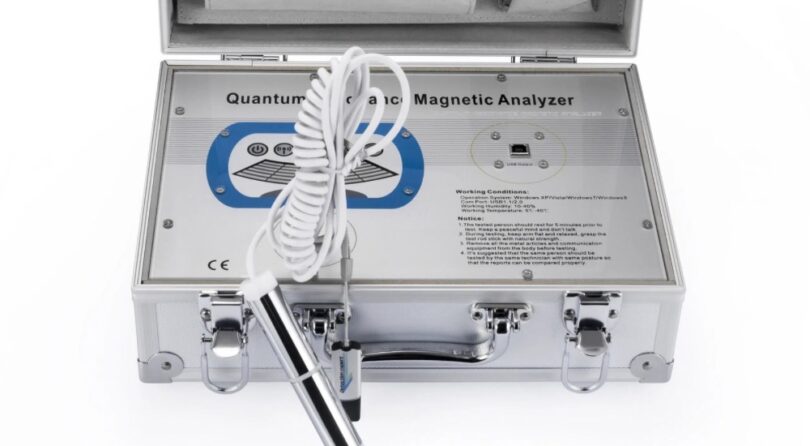
Ada Uzodi, a resident of Kubwa in the Federal Capital Territory, first heard about the Quantum Resonance Magnetic Analyser (QRMA), when a lady walked up to her on the roadside and said explained about a ‘machine, that could test her body and reveal every illness in it.
The QRMA according to vendors, is a handheld, computer-connected device marketed as a non-invasive tool for analysing health.
The test usually involves holding a metal sensor for a few minutes while the device captures electrical signals from the body, then the software generates a report across different health parameters.
“I was intrigued when she told me about it and I promised to visit their office,” Uzodi told THE WHISTLER.
She also exchanged contacts with the lady who introduced herself as Angela, a decision she later regretted because Angela would not let her rest.
“She kept ‘flashing’ me. When I later called her, she said she was only reminding me to come for the test,” she said.
Uzodi said she did not need much convincing since it was about her health. But the day she visited the office; she started to have doubts.
“I met two women at the staircase who kept asking if someone invited me. I was wondering, invited for what? They only left me alone when I told them I was already in contact with someone,” she narrated.
It did not end there. Immediately she got upstairs, she was again swarmed by people asking what she wanted and who invited her.
“I didn’t see Angela. I asked after her and was told she stepped out. When I told the three people standing with me that I only came to make enquiries about the ‘machine’, you could see disappointed written all over their faces,” she said.
She was told she would have to pay N10,000 for the test and after the test, she would be introduced to herbal drugs sold right there in the office.
“They said buying the drugs is not compulsory, but who won’t want to buy drugs for an illness the ‘machine’ says you have?” Uzodi queried.
She told THE WHISTLER she believes the ‘machine’ is just a strategy to sell herbal products and fears it could be a way to scam unsuspecting people.
Like Uzodi, Desmond Eze is also skeptical about the device.
Eze, who spoke to THE WHISTLER about his own experience in Jos, Plateau State in July this year, said the test was supposedly free.
“The test was free because they said our professional organisation had paid for it,” he said.
According to him, the process involved holding a device while the operator facing a laptop checks it out.
“You hold on to it and there is a laptop facing them which they are looking into and asking you questions like, ‘do you feel any pain in your joints?’ ‘Do you experience frequent urination’ ‘do you ejaculate quickly?’” he said.
After the questioning, Eze said the operator told him everything looked good in his body, with just a few minor issues, noting that his kidney and liver were fine.
But he dropped the bombshell… “he told me that I needed to buy some drugs worth N12,000.”
Desmond said he told the operator he would buy them later as he was not informed earlier about a test, a strategy he used to convince him to run the test in the first place.
According to him, most people who came for the test did not buy the drugs, which made the operator hesitant to run the test for him.
“He said he keeps doing this test for free and nobody is buying his drugs. Everybody is doing free test and going,” Eze recalled.
Eze said what made him more suspicious was that the same questions were asked to everyone.
He noted that the questions he was asked were exactly the same as those asked to the person before him and another person, they sent after him.
“I can’t say the machine is working, because how is it possible that the three of us were suffering from the same problem?” he queried.
However, not everyone is skeptical about the device. Elder Bode Gbadija who ran his test in Abuja said he was quite convinced by the test.
“Yes. To a large extent. Most of the things they told me were things I already knew.
“And the expert advice they gave me did not include visiting the hospital, unlike some others who were advised to see the doctor,” he said.
Gbadija also said those who were tested alongside him were not asked to buy drugs.
He however noted that at the bottom of the result, tucked in small print, was a disclaimer that reads: “The test results for reference only and not as a diagnostic conclusion.”
Experts say the disclaimer, in simple terms, means the makers and operators of the machine do not want the result to be trusted as a real medical diagnosis.
“It is a legal shield. It means even if the report says a person has kidney failure, liver disease or a mineral deficiency, the result is not final, it cannot be used to make treatment decisions, and the operators cannot be held responsible if it turns out to be wrong.
“It also means anyone who relies on the report is expected to still go to a proper hospital for confirmation; a contradiction to the way the test is marketed on the streets as a machine that ‘reads every illness in your body,’” Seyi Adams, a lawyer, explained to THE WHISTLER.
Also speaking in an interview with THE WHISTLER, a researcher and pharmacist at the National Institute for Pharmaceutical Research and Development (NIPRD), Valentine Adegoke, stated that there is widespread scientific skepticism about the device in the health sector, as mainstream medical practitioners and regulatory bodies generally consider it pseudoscience.
He pointed out that it lacks proof, as there is no robust, peer-reviewed clinical evidence that holding a rod can accurately diagnose internal organ diseases, vitamin deficiencies and other medical conditions.
He warned that the device should never replace genuine laboratory tests, ultrasounds or professional medical diagnosis.