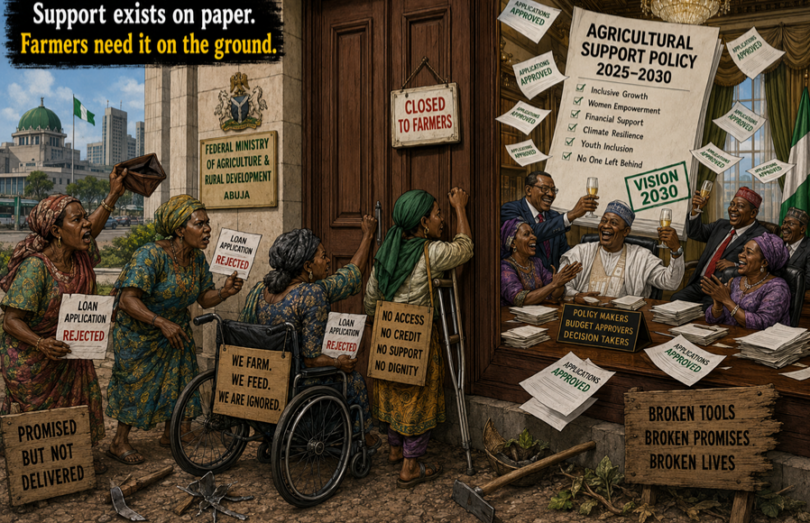
A study conducted by the Advocacy for Women with Disabilities Initiative found that at least 1,118 women with disabilities engaged in agriculture across 27 states reported facing significant barriers to farming and livelihoods.
Standing in knee-deep floodwater, Viviane Tavershima gazed over her farm in Agada, Benue State. Her farm manager had called, earlier that morning in September 2021, to inform her that the farm was deluged.
“I didn’t know that place was prone to flooding until the previous year,” she said.
It is not easy wading through a flooded farmland. For Ms Tavershima, it is even more complicated. Due to a spinal condition that affects her mobility, she walks with the aid of crutches and wears specially adapted sandals. In a muddy terrain, movement becomes even more difficult for her.
Ms Tavershima said she begged the villagers to help salvage the crops.
“The flood hadn’t covered it completely. I asked the locals around to assist because we could dig. They refused. What they did was steal the crops instead,” she said.
The flood eventually destroyed about eight hectares of crops. She was only able to save some tubers, including yam and orange-fleshed sweet potato.
Despite the losses and her physical challenges, she speaks calmly about her experiences, often breaking into a smile while describing some of the most difficult moments of her farming journey.
A study conducted by the Advocacy for Women with Disabilities Initiative found that at least 1,118 women with disabilities engaged in agriculture across 27 states reported facing significant barriers to farming and livelihoods. The challenges are compounded by climate change, which is increasing flooding, extreme heat and erratic rainfall. The study found that women farmers face a 30 per cent yield gap compared to men due to limited access to land, agricultural inputs and extension services.
Most respondents earned less than ₦50,000 per month, while many lacked accesses to credit, assistive technologies and disability-inclusive agricultural programmes, leaving them particularly vulnerable to climate-related shocks.
A climate change expert, Esther Ajah, said rising temperatures, prolonged heat waves, erratic rainfall patterns, and flooding have significantly worsened conditions for Nigerian farmers in recent years.
She noted that data and seasonal climate predictions from the Nigerian Meteorological Agency (NiMet) have consistently warned of extreme weather events, including delayed rainfall and heat stress.
“The heatwaves recorded in the last two to three years have been particularly severe. Farmers are increasingly experiencing crop losses as a result of excessive heat, while food spoilage has become more common,” she said.
According to her, climate change has accelerated land degradation and contributed to declining agricultural yields. Citing global statistics, she said one-third of the world’s agricultural land is already degraded, while more than 700 million people lack access to basic food, underscoring the growing link between climate change and global hunger.
In Nigeria, she said, the consequences are evident across multiple sectors. Farmers are losing livestock, crop production has declined in several areas, and fishing communities are recording reduced catches.
“Many fishing communities report that fish stocks are no longer what they used to be. Climate change is affecting aquatic ecosystems and reducing productivity,” she said.
Ms Ajah also highlighted inadequate storage and cooling facilities as a major factor contributing to post-harvest losses. She noted that poor storage infrastructure continues to undermine both food security and the country’s agricultural export potential.
She cited the cocoa sector, one of the largest contributors to Nigeria’s non-oil export earnings, as an example of an industry affected by insufficient investment, land degradation and poor storage systems. Similar challenges, she said, are affecting the oil palm sector.
Beyond climate-related factors, Ms Ajah identified several human-induced problems worsening environmental degradation. These include poor waste management, indiscriminate land clearing, inadequate environmental assessments, and poorly designed infrastructure projects.
She explained that blocked drainage systems, waste disposal into waterways and poorly terminated flood-control structures often exacerbate flooding in vulnerable communities.
“Climate change is not acting alone. Anthropogenic activities such as poor waste management and unsustainable land-use practices are amplifying its impacts,” she said.
The expert further warned that climate change is deepening existing social and economic challenges, including insecurity and rural poverty. According to Ms Ajah, smallholder farmers, indigenous populations, women and other vulnerable groups remain among those most affected.
She said climate-related disruptions are contributing to declining food production, increasing food prices and reducing access to nutritious food for millions of people.
“Climate change is amplifying existing vulnerabilities and increasing the number of people who do not have access to adequate food and quality nutrition,” she added.
Studies have shown rising temperatures, changing rainfall patterns and increasing flood incidents across Nigeria.
A 2024 study found that very strong heat stress now affects large parts of the country, while flood extents increased significantly between 2018 and 2024.
According to the National Emergency Management Agency (NEMA), more than 5.2 million people were affected by floods across 35 states in 2024, while more than 1,200 lives were lost.
For Ms Tavershima, the challenges of farming extend beyond a single flooding incident.
Navigating farmlands is already difficult because of her disability, but climate-related events often worsen the situation. During the rainy season, wet and muddy areas can make movement impossible, forcing her to hire people to carry her around the farm.